
Forecasting the Direction of the Rupiah Exchange Rate Movements
I would like to begin this piece by quoting the views of economist Rudiger Dornbusch from the Massachusetts Institute of Technology (MIT) in his article titled ‘Expectations and Exchange Rate Dynamics’, published in the Journal of Political Economy in 1976. Dornbusch states that a country’s interest rate is equal to the international interest rate plus the expected change in the exchange rate of that country’s currency against another. Dornbusch’s theory also shows that a (future) decrease in interest rates leads to an increase in current real money demand, whereas an increase in interest rates reduces money demand. Similarly, an increase in economic income, reflected in rising Gross Domestic Product (GDP), increases money demand, while a decrease in income reduces it. Dornbusch’s idea is highly popular through the Dornbusch Overshooting Model, which posits that when an economy faces pressure, the currency’s exchange rate will depreciate in the short term.
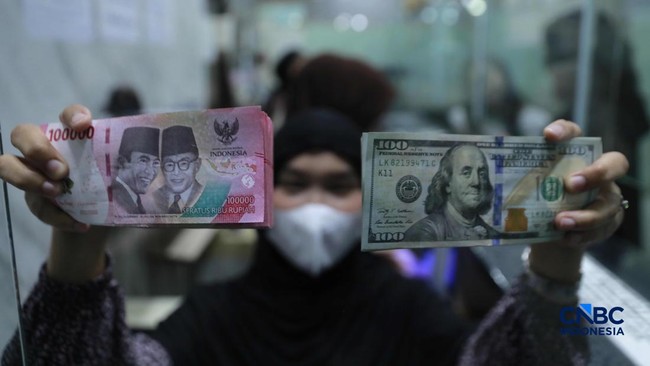
The phenomenon of overshooting can be observed in the movement of the Rupiah against the US Dollar from January 202<0xA0>26 to the present. When the national economy faced pressures such as rising global oil prices, increasing global inflation expectations, an upward trend in global interest rates, and declining global liquidity, it caused an extreme depreciation of the Rupiah against the US Dollar. This is evident in the exchange rate movement, which moved from approximately Rp16,690 per US Dollar in early January 2026 to Rp16,935 by 9 March 2026, and continued towards its lowest point to date, around Rp17,879 per US Dollar on 2 June 2026.
So, will the Rupiah continue to weaken against the US Dollar in the near future? And how long will it take for the Rupiah to reverse direction back to its long-term equilibrium? Based on the exchange rate overshooting model, the Rupiah initially undergoes extreme depreciation in the short term, where the rate of depreciation is much greater than its long-term depreciation rate. At a certain point, the Rupiah will experience a gradual strengthening towards its long-term equilibrium. The overshooting phenomenon occurs because, in the short term, prices are rigid and inelastic, and output remains constant. Consequently, the only variable in the Dornbusch Overshooting Model capable of absorbing this pressure is the Rupiah exchange rate. This means the weakening trend will, up to a certain limit, reverse direction and strengthen towards long-term equilibrium.
Regarding when this reversal will occur, we must examine several macroeconomic indicators, both nationally and specifically in the US. One indicator with a massive impact on the Rupiah is the trend of inflation and the benchmark policy rate in the US. As of April 2026, US inflation has tended to rise, from 3.3 per cent in March 2026 to 3.8 per cent in April 2026, the highest annual rate since May 2023. This upward trend increases the likelihood that the US Federal Reserve will raise the Federal Funds Rate (FFR) from its current 3.50–3.75 per cent range, as US inflation is well above the Fed’s 2.0 per cent target. While the probability of a rate hike at the 16–17 June 2026 FOMC meeting is very low, US economists predict the Fed will raise the FFR during the 16–17 September 2026 meeting. The CME FedWatch Tool predicts the FFR will reach 3.75–4.0 per cent by the September meeting and remain at that level through the 16–17 December 2026 meeting.
If the scenario of persistent Fed rate hikes to curb US inflation occurs, pressure on the Rupiah’s depreciation will continue until the end of 2026. However, if the Fed’s hike is limited to approximately 25–50 basis points (bps), the impact on the Rupiah will not be overly significant. Nevertheless, such an increase will mean the Rupiah requires a longer period to reverse direction and strengthen gradually towards long-term equilibrium, where prices are no longer rigid but flexible. Money is neutral; it does not influence real variables such as employment, GDP, or consumption, but directly affects nominal variables such as inflation, wages, and exchange rates. Finally, regarding steps for the Government and Bank Indonesia (BI) to reverse the depreciation: from a monetary policy perspective, BI is focused on maintaining inflation within its target of 2.5 per cent (plus or minus 1.0 per cent) and ensuring that the real interest rate differential—the difference between the BI rate minus inflation and the US FFR minus US inflation—remains positive. This will provide incentives for foreign investors to invest in domestic financial instruments, resulting in net capital inflows.