
Food Self-Sufficiency Accelerated: Zulhas Needed Only 3 Meetings, Here Are the Results
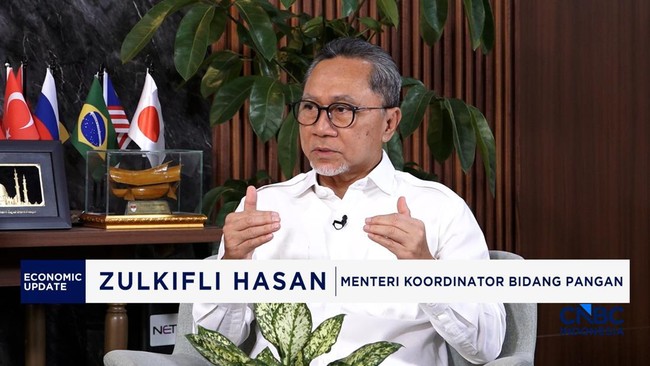
The Coordinating Minister for Food, Zulkiflagi Hasan (Zulhas), has revealed several key steps that have been instrumental in Indonesia achieving rice self-sufficiency, even faster than previously targeted. According to him, this success was achieved through a series of policies favouring farmers, ranging from the simplification of fertiliser regulations to an increase in grain prices.
Zulhas stated that the food self-sufficiency policy is a primary agenda of President Prabowo Subianto’s administration. He noted that the policy represents an effort to correct a decades-old approach that tended to rely on imports whenever domestic supply was low. “Therefore, the President’s core policy is that we must achieve food self-sufficiency, because self-sufficiency is sovereignty, and sovereignty is honour,” said Zulhas during the CNBC Indonesia Economic Update 2026 on Tuesday (23/6/2026).
He explained that the government’s first step was to overhaul the management of subsidised fertilisers. From evaluations, fertiliser absorption had been low due to convoluted bureaucratic processes. “We looked at fertiliser; the President Director of Pupuk Indonesia presented the data, and it turned out that fertiliser usage was only 6 million tonnes. I saw that the regulations were complicated, rambling, and circular, resulting in only 6 million tonnes being absorbed,” he said.
Zulhas noted that the government eventually slashed fertiliser distribution regulations from 145 rules to just three. Following the issuance of a Presidential Regulation, fertiliser can now be available before the planting season begins. “I held meetings here only three times, and we cut 145 rules down to just three,” he said.
As a result, fertiliser absorption in 2025 increased to 9.55 million tonnes, an increase of approximately 58% compared to previous levels. “The President immediately issued a Presidential Regulation that took effect in December. By January, fertiliser was available before planting. In 2025, 9.55 million tonnes were absorbed, which is an increase of about 58%,” Zulhas stated.
He mentioned that this increase in fertiliser usage contributed to a productivity boost of around 7% to 8%. “Because the fertiliser is good, and we have shown support for farmers, improved the supply chain, and fixed the regulations, the 9.5 million tonne absorption has increased productivity by about 7% to 8%,” he said.
In addition to fertiliser, the government has also overhauled the irrigation sector, which was previously identified as a major obstacle to increasing national food production. Based on government evaluations, while Indonesia’s rice field area reaches approximately 7.4 million hectares, the actual planting area was only around 10 million hectares. “We studied the problem, and it was irrigation,” said Zulhas.
Consequently, the government amended regulations so that irrigation improvements can be handled directly by the central government without being hindered by the division of authority between regional and central governments. “We proposed a Presidential Regulation to change this, so that regardless of the size, irrigation can be worked on by the central government. The President quickly issued the regulation, and the Public Works budget was reallocated to complete the irrigation,” he noted.
The next strategy involved improving farmer welfare through grain pricing policies. The government decided that the Reference Purchase Price (HAP) for grain would be set at Rp6,500 per kilogram (kg) without moisture content requirements, which previously often served as a loophole for price manipulation at the farmer level. “We decided that grain prices would rise to Rp6,500 for any quality. No more notes on 14-18% moisture content. Simply put, at harvest, we buy at Rp6,500 per kg, period,” said Zulhas.
He noted that this policy successfully increased farmers’ interest in planting rice, as the profits became more attractive. “Alhamdulillah, in 2025, up to this point, there is no more grain below Rp6,500 per kg. The average grain price is at Rp6,500 per kg and above,” he said.
Zulhas mentioned that the combination of fertiliser and grain price policies has provided a significant production boost. Coupled with favourable seasonal conditions and the use of water pumps to anticipate water shortages, Indonesia recorded a rice surplus of 4.2 million tonnes in 2025. Under these conditions, Indonesia will no longer import rice in 2025. “So, we will not import rice again in 2025; instead, we have an excess stock of 4.2 million tonnes,” he said.
Moving forward, the government is preparing several steps to ensure that rice self-sufficiency remains sustainable. One such measure is the new rice field expansion programme in several regions, such as Merauke, Central Kalimantan, and South Sumatra. “We are creating new rice fields; there is one in Merauke that has been much discussed. We are just starting to develop those fields. The Minister of Agriculture, Amran Sulaiman, is also developing them in Central Kalimantan and South Sumatra,” said Zulhas.
Furthermore, the government is preparing protections for sustainable agricultural land to prevent it from being converted into residential or industrial areas. “Therefore, land designated as sustainable agricultural land can no longer be changed into anything else, whether it be houses or factories. It is not allowed anymore,” he emphasised.
The government is also collaborating with the National Research and Innovation Agency (BRIN) to develop superior varieties and seeds to increase future rice productivity. “We are working with BRIN. We want the development of new varieties and new seeds so that our rice productivity increases significantly compared to before,” he concluded.