
Food Prices Rise, Market Traders Call for Government Intervention
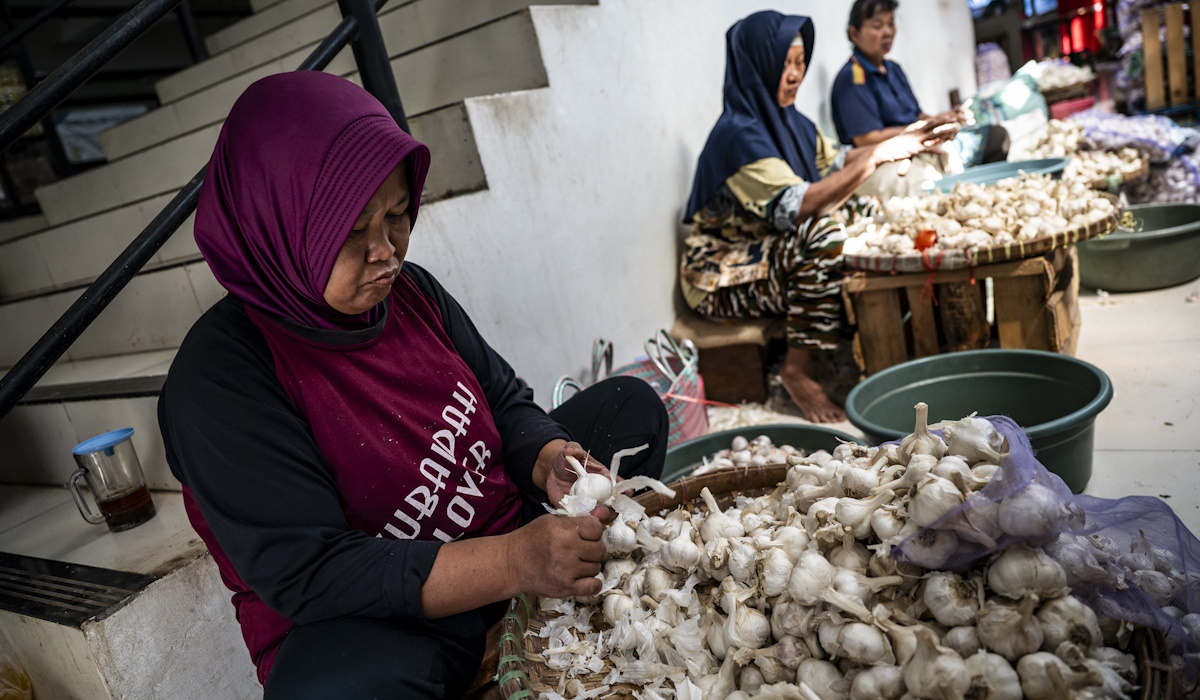
Market traders warn that most Indonesian food commodities are priced in USD, so rupiah weakness pushes up domestic prices. The secretary-general of the Indonesian Market Traders Cooperative (Inkoppas), Andrian Lame Muhar, said that a number of commodities are directly affected, including imported beef from Australia, garlic from China, and cooking oil. He noted that even plastic packaging prices rose due to a shortage of naphtha used as a raw material triggered by tensions in the Strait of Hormuz. The situation is more challenging ahead of Idul Adha 2026. In facing this, Andrian sees government subsidies as an effective step to curb price spikes, provided the state finances permit. He cited several subsidy and intervention programs that are underway, such as SPHP rice, buffalo meat as a substitute for imported beef, management of cooking oil via the Domestic Market Obligation (DMO), and tax relief for certain food commodities. Inkoppas also praised the Ministry of Agriculture for subsidies on poultry feed and chicks to farmers, a strategic move to reduce the cost of production (HPP). He said with lower production costs, chicken meat can be sold to markets at affordable prices. Andrian reminded that substituting commodities is not always easy because it requires an equivalent substitute. He also stressed that the key to food stability is stock availability; if stock in the market runs low, prices automatically surge again. The National Food Agency (Bapanas), together with Perum Bulog, had distributed 371,200 tonnes of SPHP rice by April 2026 to stabilise prices. Bulog continues to stabilise national rice supply and prices through the Stabilisation of Supply and Prices of Food (SPHP) programme, ensuring SPHP rice distribution proceeds without interruption. SPHP rice to Pasar Gedhe Klaten is distributed weekly to secure rice availability for market traders there. Inkoppas notes that plastic shortages are not a major issue hampering the public market currently, but transport costs are rising due to higher diesel prices. The Cheap Food Movement (GPM) programme provides SPHP rice at Rp57,500 for a 5 kg pack, cooking oil at Rp15,000 per litre, beef at Rp140,000 per kg, and chicken at Rp54,000 for 2 kg. Bank Tabungan Negara (BTN) is expanding its business by targeting the market cooperative ecosystem through a strategic partnership with Inkoppas. Inkoppas reiterates that plastic shortages are not a major issue interrupting public markets at present, but transport costs are rising because of higher diesel prices. The stagnation of public markets in Indonesia is not solely caused by the growth of online commerce but also by poor infrastructure and weak market management systems. The rise of online shopping is suspected to have driven buyers away from traditional markets. There is an overlap between SPHP rice distribution via traditional traders and on-market operations at the village and neighbourhood levels.