
Food Coordinating Minister Reveals Details on 'Red and White' Village Cooperatives
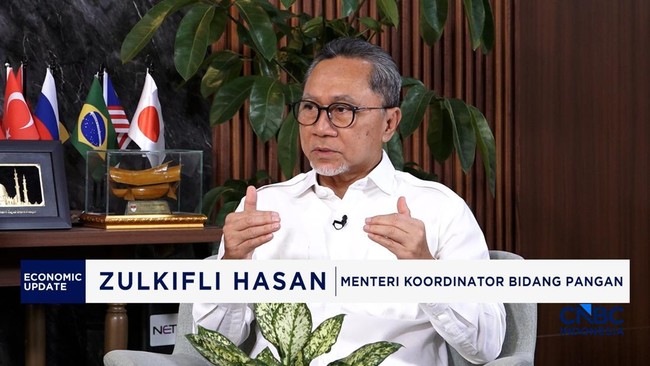
Coordinating Minister for Food, Zulkifli Hasan, has addressed the development of the Koperasi Desa Merah Putih (KDMP) programme, which has recently been a topic of public discussion. Questions have arisen regarding the government’s efforts to ensure the cooperatives can operate sustainably and are not only active during their inauguration. “The cooperatives are indeed not yet active, they haven’t started. A total of 80,000 cooperatives will be built, but 80,000 is a lot, not a small number. So this year we are focusing on 40,000 first,” he stated during CNBC Indonesia’s Economic Update 2026 on Tuesday (23/6/2026).
Zulhas acknowledged that building 80,000 KDMP requires a long time, as the process of establishing a cooperative body alone takes about six months. Therefore, the government will first focus on the physical construction of 40,000 KDMP. Currently, land is already available for the construction of the cooperatives, with an average area of 1,000 square metres. The land will later accommodate buildings of approximately 600 square metres.
Zulhas said the physical construction of KDMP has already reached 30,000 units. The construction of these cooperatives is targeted for completion by August to September 2026. Once the physical construction is finished, the government will optimise the function of the cooperatives, including preparing cooperative managers and operational systems to ensure smooth running.
On the other hand, Zulhas admitted that some public perception of KDMP is still inaccurate. The cooperative is not merely a grocery or convenience store, but is designed as infrastructure with broader functions than a typical cooperative. “The cooperative was established with the function, firstly, to cut long supply chains, and secondly, to act as an off-taker,” he explained.
As an illustration, KDMP can serve as a distributor of social assistance and other programmes targeting village communities. Through this mechanism, the distribution of social aid from the Ministry of Social Affairs and other government bodies is expected to be well-targeted and easier to monitor. “It must not be the case that the village head’s friends receive it, but the poor do not. So it serves as government infrastructure,” he clarified.
Furthermore, the distribution of subsidised products such as fertiliser, 3-kilogram LPG canisters, and electricity payment services can be conducted at KDMP. The integrated system provided by KDMP is believed to make it easier for the public to access various essential products and financial services. KDMP will also act as an off-taker or absorber of village community produce. For example, when the price of unhusked rice falls or fishermen’s catches are difficult for the market to absorb, KDMP will step in to purchase these products. Subsequently, KDMP will channel the farmers’ and fishermen’s products to various strategic government programmes. This scheme is expected to provide certainty for farmers and fishermen.
Zulhas emphasised that KDMP is part of the government’s effort to build new economic growth centres in various villages. Economic growth must not be concentrated solely in big cities but must be evenly distributed to villages across Indonesia.
Source: jawawa.id (https://jawawa.id/newsitem/food-coordinating-minister-reveals-details-on-red-and-white-village-cooperatives-1782197560)
Originally published by CNBC Indonesia (https://www.cnbcindonesia.com/news/20260623132032-4-745022/menko-pangan-buka-bukaan-soal-koperasi-desa-merah-putih-ada-apa), translated from Indonesian