
Food Coordinating Minister: Regulatory Simplification to Accelerate PSEL Projects
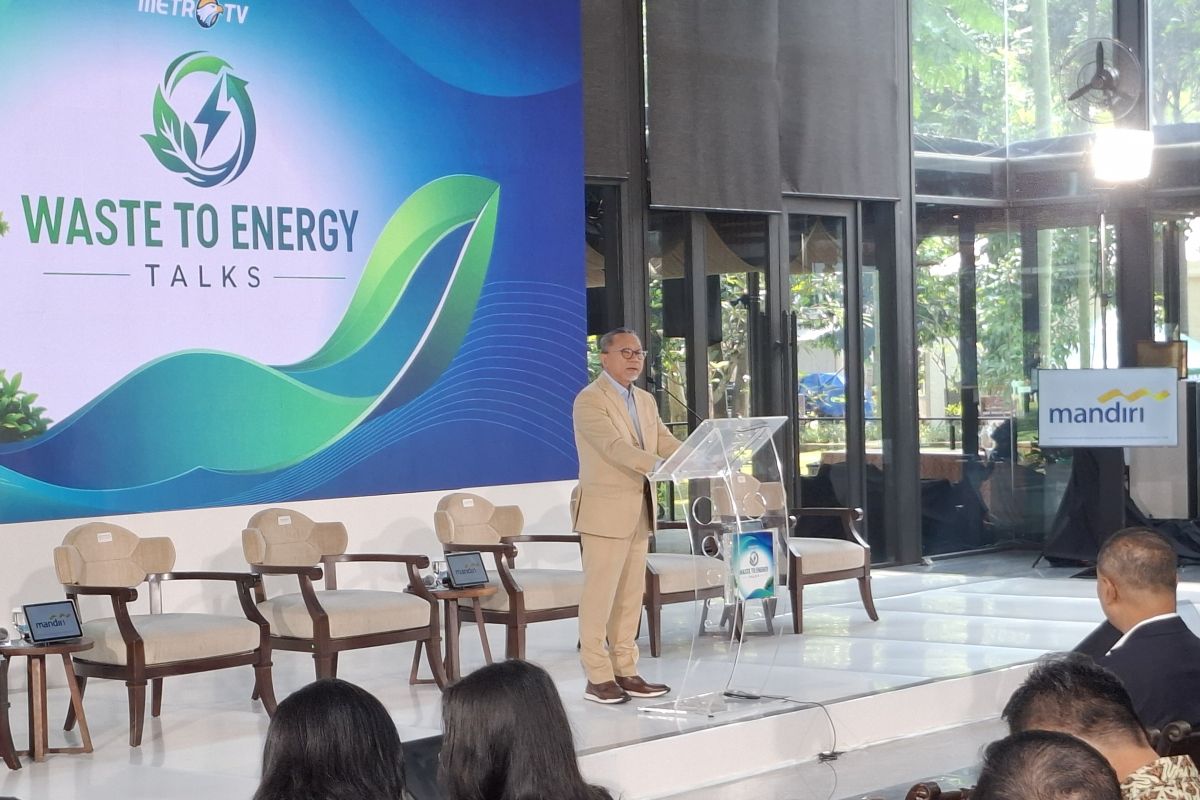
Jakarta (ANTARA) - Coordinating Minister for Food Affairs Zulkifli Hasan (Zulhas) said the government has simplified regulations for building Waste-to-Energy (PSEL) projects in order to accelerate the handling of urban waste problems.
“My task is just one: fix the regulations. From hundreds of rules, only three remain,” said Zulhas at the Waste to Energy Talks: Reducing Waste, Powering the Future event in Jakarta on Thursday.
According to him, the construction of waste-to-energy facilities had previously progressed slowly because developers had to go through various stages of approval, licensing, and inter-agency coordination.
He gave the example that developers had to coordinate with regional governments, regional legislative councils (DPRD), provincial governments, the Ministry of Finance, the Ministry of Energy and Mineral Resources, the Ministry of Environment, and PT PLN (Persero) before a project could be realised.
“Let me give an example: if I were a businessman wanting to convert waste into electricity, I would have to contact the district DPRD and the regent, and if two districts are involved, the governor and provincial DPRD as well,” he said.
After the regional stages, he continued, developers still had to settle funding matters, energy-sector permits, environmental impact analyses, and power purchase agreements with PLN.
Zulhas said President Prabowo Subianto subsequently formed a waste management task force and assigned him to shepherd the regulatory simplification and the resolution of obstacles across ministries and agencies.
“If there’s an obstacle, I just summon the parties. If I still cannot resolve it, I report it. The President leads,” he said.
The simplification was reinforced through Presidential Regulation Number 109 of 2025 on Urban Waste Management through Environmentally Friendly Technology-Based Waste-to-Renewable-Energy Processing.
The regulation replaces Presidential Regulation Number 35 of 2018, which previously governed the acceleration of waste-to-electricity processing plant construction.
The step was taken amid the scale of the national waste problem. According to government figures, Indonesia’s waste generation reaches around 141,926 tonnes per day.
Under the new scheme, the government directs the partner selection and investment development process through the Investment Management Agency (BPI) Daya Anagata Nusantara (Danantara), while PT PLN (Persero) acts as the buyer of electricity generated by PSEL facilities.
Zulhas said the government is prioritising the resolution of waste problems in urban areas facing emergency conditions in 2027-2028.
“The emergency ones must be completed by 2027, 2028. The rest by 2029,” he revealed.
He added that PSEL projects are directed at urban clusters with waste generation of at least 1,000 tonnes per day in order to meet economies of scale.
The government has identified 24 PSEL clusters, which may cover two to three regencies or cities within a single service area.
According to Zulhas, the accelerated construction of these projects must be accompanied by the readiness of regional governments in ensuring the collection, transport, and sustainable availability of waste.
The government targets that waste-to-energy facilities in priority areas can be completed in phases by early 2028.