
Food and Drink Prices in Indonesia at Risk of Rising: Here’s Why
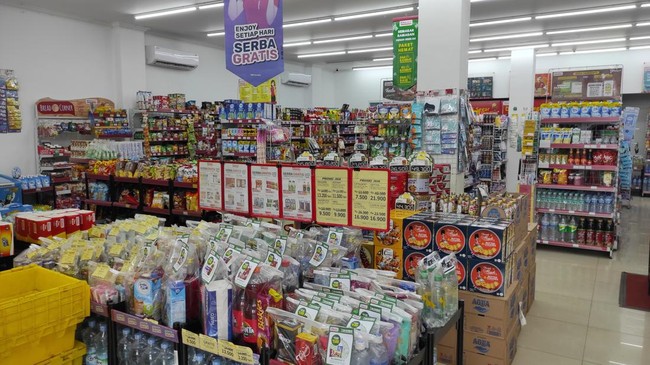
Jakarta, CNBC Indonesia — The food and beverage industry is beginning to face production cost pressures as the end of 2026 approaches. The rupiah’s weakness is one issue to watch, given the industry’s continued reliance on imported raw materials.
Adhi S. Lukman, chairman of the Indonesian Food and Beverage Producers Association (GAPMMI), said uncertainty over the rupiah’s movements was also a challenge for businesses. The situation has been compounded by higher international freight costs, making the industry’s supply chain more expensive.
“The rupiah is indeed worrying, because we do not know how far it will go. This is the most important issue, because certainty matters to industry. We very much hope the Government, together with Bank Indonesia, can maintain stability. Frankly, we have to acknowledge that many of our raw materials are still imported. We do not want to import, but it turns out that some materials cannot be sourced otherwise,” Adhi said at a media gathering hosted by the Industrial Journalists Forum (Forwin) in Sentul on Friday (6 November 2026).
The cost pressures are not limited to the exchange rate. International shipping routes have also become significantly more expensive, including trade lanes that were previously considered relatively cheap.
“Logistics and other costs are another issue. Shipping to several countries is still very expensive. We discussed this yesterday with some buyers from Australia: shipping to Australia, which usually costs just US$1,000, now costs US$3,000 per container. To China, it used to be just US$200–300, but now it can reach US$700–800. For destinations further away, such as the Middle East, it is even more costly,” he said.
The increase means companies need to adjust their procurement strategies. They are considering alternatives, from finding different shipping routes to switching raw-material purchases to countries where supplies remain available.
“We are, of course, looking for alternatives. For example, for the Middle East, we are considering alternative logistics routes. We are also looking for alternative sources of raw materials from countries where supplies have been disrupted, and so on. We are working on this. Ideally, domestic suppliers could meet demand, which would make things easier to manage, but that requires a long-term strategy,” Adhi explained.
For large companies, the pressure can still be absorbed for the time being. Some businesses have older purchase contracts and stocks of raw materials or finished goods that can help keep production going.
“Medium-sized and large companies have a reasonably strong ability to withstand pressure, so some still have old contracts, while others still have stocks of raw materials and finished products. Increases are likely at the beginning of next year. In my view, the food and beverage industry’s average increase will be around 5–6%. That is already quite high because consumers are very price-sensitive,” he said.
The situation is more difficult for small and medium-sized industries (IKM). Unlike larger companies, smaller businesses generally lack the storage capacity and working capital to secure raw-material stocks for an extended period.
Consumers may feel the impact directly through changes to prices or product sizes. Higher plastic costs are an additional burden, although supplies are currently still sufficient by volume.
“Our IKM businesses are the ones facing the greatest difficulty, because their resilience is very limited. Some home industries have only one or two days’ worth of stock, while others have enough for a week. Once their raw materials run out, they will inevitably struggle. If they do not raise prices, they will reduce product sizes. Tempeh producers, for example: what used to be a large block is now getting smaller. This is what we need to anticipate,” Adhi concluded.
Source: jawawa.id (https://jawawa.id/newsitem/food-and-drink-prices-in-indonesia-at-risk-of-rising-heres-why-1793958623)
Originally published by CNBC Indonesia (https://www.cnbcindonesia.com/news/20261106135439-4-782991/harga-makanan-minuman-di-ri-terancam-naik-ini-biang-keroknya), translated from Indonesian