
Food Affairs Coordinator: Emergency areas are the priority for waste management
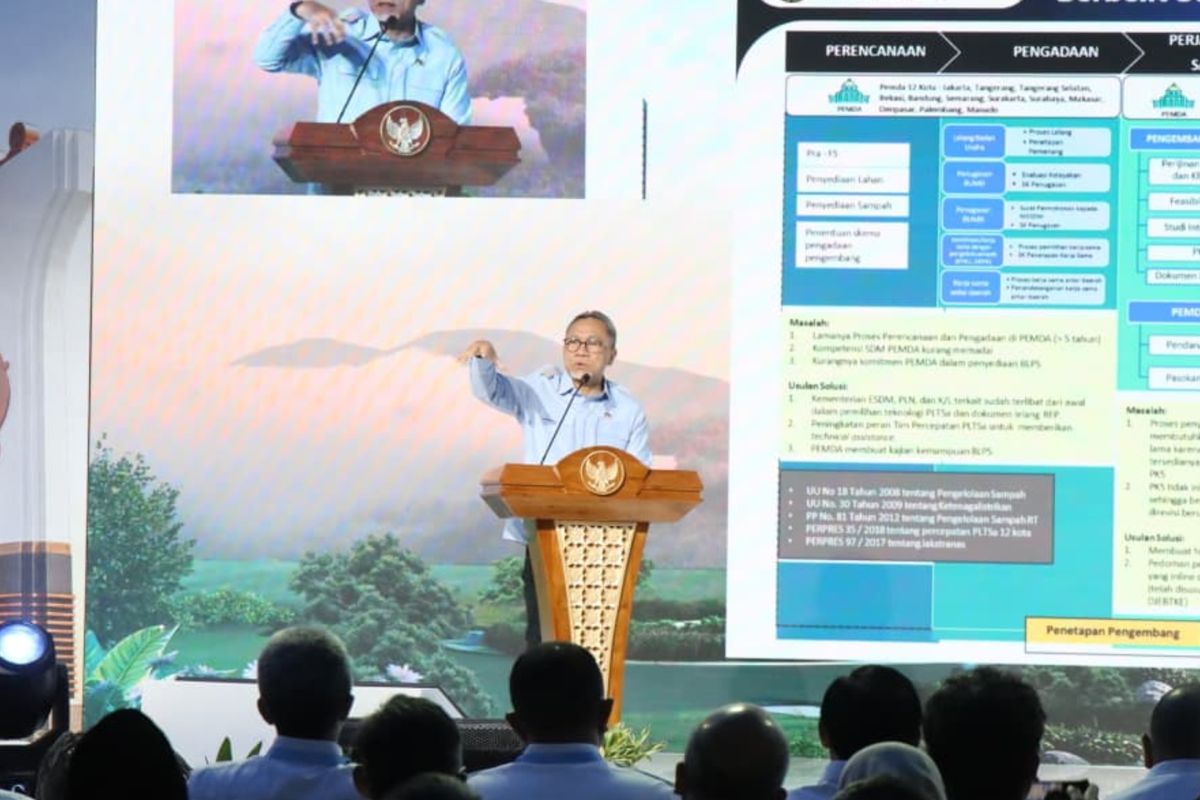
The Coordinating Minister for Food Affairs, Zulkarly Hasan (Zulhas), stated that the government is prioritising regions facing emergency waste conditions in its management and the construction of waste processing facilities.
One of the priority areas is the Greater Bogor region, through the development of Waste-to-Energy (PSEL) and pyrolysis facilities at the Galuga Landfill (TPAS) in Bogor Regency, West Java.
“The Galuga landfill is among those in an emergency condition. Therefore, we are prioritising areas that are in crisis and are having a negative impact on the community,” Zulhas said in an official statement received in Jakarta on Friday.
He made these remarks during the inauguration of the Greater Bogor Waste-to-Energy (PSEL) 1 construction at the Galuga Landfill, Bogor Regency, West Java, on Thursday (17/9).
According to him, large-scale waste issues require the involvement of the central government alongside local governments so that the burden of management is not placed on a single region alone.
“A problem this large cannot be solved by Bogor alone. The central government must step in, and we must work on this together,” he said.
Waste management in Galuga will be carried out through two schemes. PSEL is intended to process new incoming daily waste into electricity, while pyrolysis technology will be used to handle existing accumulated waste.
Zulhas noted that the integration of these two technologies within a single area aims to ensure that management does not merely stop the increase of new waste, but also gradually reduces the waste that has been accumulating for years.
“This is the first of its kind in Indonesia. The waste that arrives every day we will resolve through PSEL into electrical energy. But we will not stop there. The old waste that has been accumulating for years must also be resolved using pyrolysis technology,” the Coordinating Minister said.
The Greater Bogor PSEL project aims to process approximately 1,500 tonnes of new waste per day from Bogor Regency and Bogor City. This waste will be converted into electricity with a capacity of around 20–30 megawatts (MW), with PT PLN (Persero) serving as the electricity offtaker.
Meanwhile, pyrolysis technology is directed to process approximately 700–1,000 tonnes of old waste per day from the Galuga landfill, so that the accumulated waste burden can be reduced gradually.
Based on data provided by the Coordinating Ministry for Food Affairs, Bogor Regency produces approximately 3,000 tonnes of waste per day, while Bogor City produces approximately 700–1,000 tonnes per day.
In addition to building processing facilities, Zulhas stated that the government is conducting cross-ministerial and institutional consolidation and simplifying procedures to accelerate the construction of facilities in areas requiring immediate attention.
According to him, the long and complex processes lasting approximately 11 years have been a factor in why the development of waste processing facilities has not progressed according to need.
“Previously, waste management was complicated because each entity acted independently. Following the President’s orders, procedural and regulatory simplification has been implemented. We want the waste problem to be solved, not complicated by regulations,” said Zulhas.
The Greater Bogor PSEL development is one of the three first-wave PSEL projects designated as National Strategic Projects (PSN), alongside the Bekasi City PSEL and the Denpasar Raya PSEL.
Greater Bogor employs an approach that combines the processing of new waste streams through PSEL and the reduction of old waste piles through pyrolysis within a single area.
The government hopes this approach can serve as a model for integrated waste management, ensuring that new waste does not continue to pile up while old accumulations are gradually reduced.
“We want to prove that the waste problem can be resolved thoroughly. New waste becomes electricity, and old waste we will resolve into diesel fuel. If this model succeeds, Bogor can serve as an example of how Indonesia can comprehensively solve its waste issues,” the Food Affairs Coordinator concluded.