
Following Rice, Amran Announces Important News Regarding Soybeans
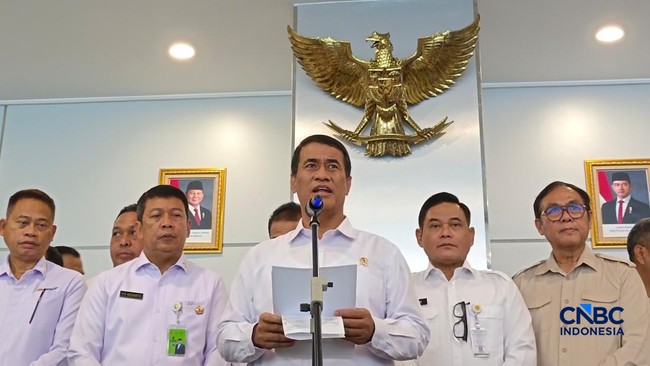
Following the focus on rice, the government is beginning to pave the way to strengthen state-controlled soybean reserves. The Minister of Agriculture and Head of the National Food Agency (Bapanas), Amran Sulloy, stated that the government needs to maintain soybean reserves to assist small-scale entrepreneurs, including tofu and tempeh artisans.
Amran made these remarks when questioned regarding domestic soybean prices, which are currently largely controlled by importers—a situation also lamented by tofu and tempeh producers. Amran noted that if any State-Owned Enterprise (SOE) is interested in managing soybean reserves, the government will provide the necessary space in accordance with applicable regulations.
“If an SOE is interested, I will allow it,” Amran said when met at his office in Jakarta on Tuesday (22/09/2026). When asked if this statement served as a green light for SOEs to move forward, he replied, “Oh, it is not a green light. What kind of light would it be if it just started immediately? It is not a light; it is already in motion.”
However, when asked whether Bulog could obtain permission to manage soybean reserves, Amran emphasised that this must still adhere to regulations. “It depends; it must follow the regulations. We will see the regulations,” he said, adding that the government should indeed possess soybean reserves to assist small businesses.
National Soybean Supply Remains Sufficient
Hermawan, the Deputy I for Food Availability and Stabilisation at Bapanas, stated that the national soybean supply is currently available and remains sufficient according to the balance sheet. Based on the Bapanas National Food Balance as of 3 September 2026, the total soybean availability for 2026 is projected at approximately 3.046 million tonnes, while national demand is around 2.755 million tonnes.
Consequently, there is a projected surplus of approximately 290,900 tonnes by the end of the year. Meanwhile, current national soybean demand reaches about 229,600 tonnes per month, or roughly 7,547 tonnes per day. “Therefore, the public and tofu-tempeh artisans do not need to worry about national availability,” Hermawan told CNBC Indonesia.
However, Bapanas acknowledged that Indonesia’s soybean supply structure remains heavily dependent on imports. Domestic production for 2026 is estimated at around 131,500 tonnes, while imports from January to August have reached approximately 1.920 million tonnes. Additionally, there are import plans for September–December of around 750,400 tonnes.
“This is what we must improve gradually through increasing domestic production and simultaneously strengthening government reserves,” he said. Hermawan noted that strengthening the Government Soybean Reserve (CKP) is a vital step in maintaining the stability of supply and prices. The government has set a minimum procurement target of 70,000 tonnes for 2026, and Perum Bulog has been prepared to undertake this task. With reserves controlled by the state, the country possesses an instrument to intervene in the event of supply disruptions or abnormal price surges.
Hermawan emphasised that the projected national end-of-year stock of 290,900 tonnes is not the same as the Government Soybean Reserve. National stock encompasses all availability within the community and businesses, whereas the CKP is the stock controlled by the government as a stabilisation instrument.
On the other hand, the government will also address complaints from artisans regarding soybean prices, which are perceived to be influenced by importers. Bapanas stated that the government does not wish to conclude there is price manipulation without a thorough examination of data and the distribution chain. The government will monitor prices from importers and distributors down to the artisans, including logistics costs and price disparities between regions. The government has set the maximum ceiling price (HAP) for imported soybeans at the artisan level at Rp12,000 per kilogram.
Data from the United Cooperative of Tempeh and Tofu Producers (Gakoptindo) as of 10 September shows that prices in several regions in Java are still within the range of Rp11,200–Rp11,850 per kilogram. However, there are disparities and higher prices in several regions outside Java.
“Therefore, our supervision will focus on areas experiencing high prices and at every stage of the distribution chain,” said Hermawan.
Bapanas reaffirmed that the government will maintain soybean supply while strengthening state-controlled reserves. “The government’s steps are clear: first, to ensure the soybean supply is not interrupted; second, to ensure prices at the artisan level remain fair; third, to strengthen the Government Soybean Reserve through Bulog; and fourth, to increase domestic production so that import dependence is gradually reduced.”
Bapanas also ensured that the national soybean supply remains sufficient so that the public and tofu-tempeh artisans do not need to worry about national availability. “Our soybeans are available and the balance is sufficient. The challenge is the high dependence on imports. Therefore, the government is strengthening soybean reserves through Bulog, monitoring importers and distribution, and ensuring tofu-tempeh artisans obtain raw materials at a fair price,” he concluded.
Source: jawawa.id (https://jawawa.id/newsitem/following-rice-amran-announces-important-news-regarding-soybeans-1790052957)
Originally published by CNBC Indonesia (https://www.cnbcindonesia.com/news/20260922101632-4-769780/usai-beras-amran-umumkan-kabar-penting-soal-kedelai), translated from Indonesian