
Following Gen Z, Gen Alpha Begins to Move and Shake the Government
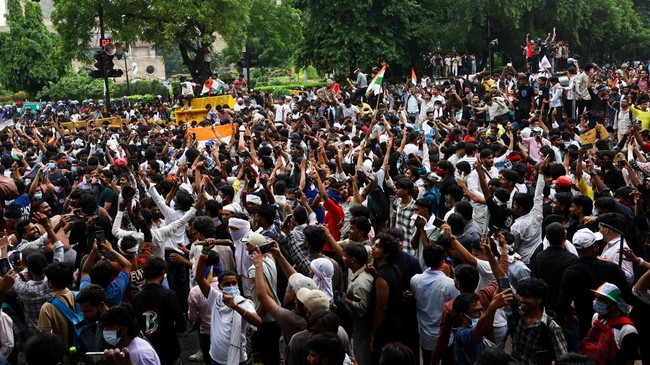
The wave of youth protests in India has entered a new phase. Following the Gen Z actions that shook Narendra Modi’s government, students from Generation Alpha are now taking to the streets to demand improvements in school facilities and educational quality.
On 22 August, 122 students from a public primary school in Samuhi Bhatpurwa village, Uttar Pradesh, refused to attend class. The children, some as young as six, requested that the government fulfil promises to build new school buildings.
The school is currently in a deplorable state. Parts of the building remain filled with rubble after a school wall collapsed in 2023, injuring a female student.
“We are afraid this school building will collapse one day. The condition is very bad,” said Priya (not her real name), an eight-year-old student, as quoted by Al Jazeera on Friday (4/9/2026).
“That fear makes it impossible for us to concentrate on our studies. That is why we are all protesting.”
The protest concluded after the Block Education Officer, Deepak Awasthi, met with the students and promised the construction of a new building. Upon receiving this assurance, the students finally agreed to return home towards evening.
However, Samuhi Bhatpurting is not an isolated case. Since late July, students in at least 10 states, including Maharashtra, Bihar, Rajasthan, Jharkhand, and Madhya Pradesh, have conducted similar protests against poor school facilities, teacher shortages, and the quality of food.
This phenomenon emerged following the wave of Gen Z protests that has been ongoing since early June. Thousands of young people previously gathered at Jantar Mantar, New Delhi, demanding government accountability for exam leaks and unemployment issues that are seen as increasingly burdening the younger generation. The movement was led by the satirical group, the Cockroach Janata Party (CJP).
After the Gen Z protests gained widespread attention, the CJP shifted its focus to school conditions through the “School Thik Karo” or “Fix the School” movement, launched on 15 August. CJP’s head of legal affairs, Ratna Singh, stated that the movement is a continuation of the grievances encountered during dialogues with children and parents from rural areas.
“They spoke about poor school conditions, teacher shortages, and the potholed, unpaved roads leading to schools,” said Singh. According to her, fixing schools is a follow-up step in the CJP’s movement to encourage a better future for children.
Education rights activist Nagasimha Rao also noted that fundamental issues persist in many public schools. Government data also records that over 100,000 schools have only one teacher for all grade levels, while thousands of other schools are recorded as having no students.
“Children are demanding their rights. They want teachers, desks, school buildings, drinking water, electricity, and toilets,” he said.
India possesses one of the largest education systems in the world, with approximately 247 million students across 1.5 million schools. Although a 2025-2026 government audit showed improved access to education, with the teacher-student ratio increasing to an average of one teacher for 24 students and dropout rates decreasing, the situation on the ground remains highly uneven.
Student demands have even extended to the issue of school meals. In Bihar, approximately 50 students walked 4 kilometres on 28 July to meet government officials and protest the quality of the food they receive. This situation demonstrates that Gen Alpha protests are not merely about facilities, but are also demands for the fulfilment of educational rights guaranteed under India’s Right to Education (RTE) Act.
Source: jawawa.id (https://jawawa.id/newsitem/following-gen-z-gen-alpha-begins-to-move-and-shake-the-government-1788537407)
Originally published by CNBC Indonesia (https://www.cnbcindonesia.com/news/20260904172541-4-765076/susul-gen-z-gen-alpha-mulai-bergerak-mengguncang-pemerintahan), translated from Indonesian