
Following Argo Bromo Collision with KRL, KNKT Issues Warnings to KAI, KCI, and Ministry of Transport
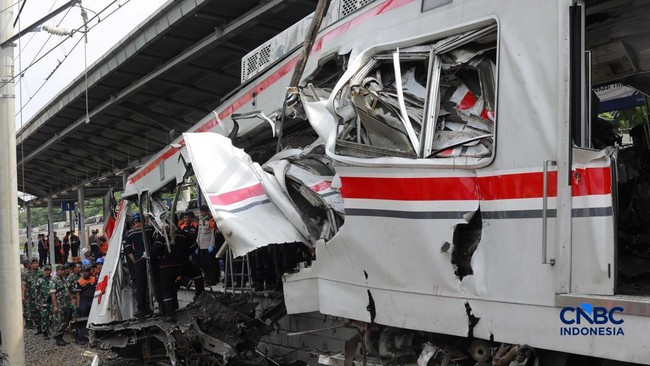
The National Transportation Safety Committee (KNKT) has issued several recommendations to PT Kereta Api Indonesia (Persero) and PT Kereta Commuter Indonesia (KCI) following the collision between the Argo Bromo Anggrek (KA 4B) and the KRL TM6000 (KA 556lar) at Bekasi Timur Station on 27 April 2026. These measures aim to prevent similar incidents and enhance passenger safety.
First, the committee advised re-evaluating the procedures for using communication equipment in driver cabins in accordance with specific device guidelines. Furthermore, KAI has been requested to enhance training for ASP and PPKP personnel regarding safety-critical communication during emergencies.
The condition of the windshield on the CC206 locomotive of the Argo Bromo Anggrek also drew the KNKT’s attention. “Ensuring that the condition of the windshield on locomotives always meets ergonomic and operational safety aspects through regular inspection, maintenance, and replacement,” the KNKT wrote in its report on Monday (5/10/2026).
KAI has also been asked to develop emergency braking procedures for high-speed conditions on curved tracks, which includes decision-making guidance and braking tactics, while considering risks to vehicle stability and passenger safety. Additionally, a study is required regarding the workload of PPKP at the Daop 1 Jakarta Train Control Centre, specifically concerning operated communication equipment and control area boundaries. The KNKT emphasised the need to “increase personnel capability and understanding in recognising potential hazards and safety risks.”
Beyond KAI, KCI has also received orders from the KNKT to standardise the master time reference used across all operational units to ensure every unit uses the same time reference. KCI is also required to develop standardised phraseology and communication structures for train movement control and regulation to improve the accuracy, effectiveness, and efficiency of communication, particularly during safety-critical emergencies. Finally, the committee called for the evaluation and refinement of training for ASP and PPKP regarding emergency communication to ensure information is conveyed accurately and swiftly.
The KNKT also provided recommendations for the Directorate General of Railways at the Ministry of Transport, including:
Re-evaluating the signalling relationship between Bekasi Station and Bekasi Timur Station, paying close attention to the behaviour of signals exiting Bekasi Station regarding the occupancy status of tracks 104AT and 104BT.
Re-examining the standards of railway signalling systems in Indonesia, specifically regarding signal aspect sequences, while considering vehicle speed, braking distance, varying characteristics of passing vehicles, and other safety factors.
Evaluating the visibility of the UB104 Auxiliary Signal located in densely populated areas, considering the impact of light pollution from the surrounding environment which may have similar intensity and colour to signal aspects at night.
Ensuring that Infrastructure and Rolling Stock Providers have standardised phraseology and communication structures for train movement control to improve communication accuracy and efficiency during emergencies.
Ensuring the availability of dedicated frequencies for railway telecommunications system operations in Indonesia.
Increasing supervision of the workload of PPKP at the Daop 1 Jakarta Train Control Centre, particularly regarding communication equipment and control boundaries.
Conducting a study on the implementation of the Minister of Transportation Regulation Number 52 of 2014 regarding Automatic Train Protection (ATP) systems, with adjustments for environmental conditions, regulations, culture, and prevailing standards in the Indonesian railway system.
Implementing independent verification and validation processes by an Independent Safety Assessor (ISA) at every stage of signalling system development, in accordance with RAMS procedures, to ensure system safety and reliability before operation.