
Flooding in Gaza kills three children
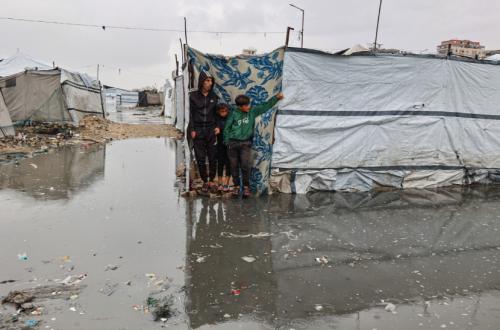
GAZA – Flooding across the Gaza Strip has claimed more lives amid the humanitarian crisis caused by Israel’s offensive in the territory. In central Gaza, five people were killed when a steep sand embankment collapsed onto tents at the Ard El-Rebat displacement camp in Deir al-Balah.
The victims included a woman and three children. Five other civilians were injured on Sunday night.
WAFA’s correspondent, citing rescue teams, reported that rescuers first found a woman’s body beneath the sand debris, followed by four other victims, including three children. Five injured people were also rescued alive from the site, while search operations for missing people continued.
Heavy rain has flooded thousands of tents across Gaza since Saturday, leaving displaced families exposed to cold weather, rising floodwater and the risk of further damage to already fragile buildings. Gaza’s Civil Defence said it had received around 1,500 emergency calls within 10 hours of the rain beginning on Saturday morning.
Al Jazeera reported that water levels in some displacement sites had reached 30 to 40 centimetres. Civil Defence spokesman Mahmoud Basal said: “What we feared has actually happened. Some displacement centres have been completely flooded, and everyone inside has now been forced to leave for an unknown destination.”
The incident comes as conditions continue to deteriorate for Palestinians displaced in the Gaza Strip. Heavy rain and a low-pressure weather system have flooded tents and damaged shelters.
The situation has prompted repeated calls for urgent intervention, safe shelter and the delivery of winter supplies. National and international organisations have warned that more than 2,000 damaged, cracked and structurally unsafe buildings are at risk of collapse, particularly amid persistent rain and strong winds, threatening Palestinians forced to live in or near them.
Meanwhile, the UN Office for the Coordination of Humanitarian Affairs (OCHA) warned on Saturday of the risks facing displaced families living in flood-prone areas and in buildings damaged by heavy rain. OCHA also highlighted shortages of aid supplies and called for winter items to be delivered urgently, as well as increased funding to support the humanitarian response.
Mansour al-Sakni, 33, could only watch as rainwater flooded the makeshift shelter on the roof of a building in Gaza City’s al-Tuffah neighbourhood, where he lives with his wife and four children. The family had replaced their old tarpaulin with a new one just two weeks earlier. Sakni had even sold two water tanks to buy sheets of tarpaulin to keep them dry and protected.
But when the first winter storm hit the Gaza Strip, the makeshift roof offered almost no protection. “We woke up and found ourselves surrounded by water. The children were crying. I didn’t know what to do, and I started crying too,” Sakni told Middle East Eye.
“We stood inside that tarpaulin tent waiting for the rain to stop, so we could try to get the water out of the room.”
Sakni lives in a 30-square-metre room with tarpaulin walls that have been damaged by the weather. “I sold two water tanks to buy new tarpaulin to protect my family from the rain and wind, but it was all in vain. Last night, we were flooded again by the rain,” he said.
Before the war, Sakni earned a living selling newspapers. He now has no regular income, and his family depends entirely on food distributed by community kitchens, locally known as takiya.
His 10-year-old daughter, Jana, has a visual impairment and needs glasses, but Sakni cannot afford them. A friend once gave him 200 shekels to buy glasses, but he used the money instead to buy wood to reinforce their shelter.
“We are poor people in Gaza. We want to live. We don’t want to die from bombing or from the cold. Enough is enough. Have mercy on us.”
Source: jawawa.id (https://jawawa.id/newsitem/flooding-in-gaza-kills-three-children-1794178229)
Originally published by Republika (https://news.republika.co.id/berita/to7fk0393/banjir-di-gaza-tiga-anakanak-meninggal), translated from Indonesian