
Flood of Good News in Early August: Dollar and Oil Tumble, Will the JCI Rebound?
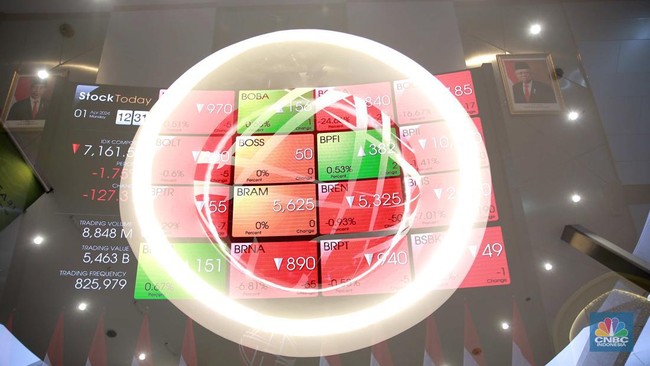
From the US stock market, Wall Street closed uniformly higher in Monday’s trading session (Tuesday Indonesian time).
The Dow Jones even notched a record all-time closing high. The rise was driven by a surge in major technology shares as well as receding geopolitical concerns after President Donald Trump cancelled plans to attack Iran.
The Dow Jones Industrial Average jumped 693.38 points, or 1.32%, to 53,178.41. Meanwhile, the S&P 500 rose 1.48% to 7,600.50, only around 0.3% below its record high set in early June. The Nasdaq Composite surged 2.13% to 25,913.90.
The technology and communication services sectors were the main engines of the market’s strength. Meta Platforms leapt 6%, while Amazon rose more than 4%, breaking through a US$3 trillion market capitalisation and setting a new closing record. Nvidia gained nearly 3%, while Alphabet and Microsoft each climbed almost 5%.
This performance contrasts sharply with July, which was a heavy month for technology stocks.
The State Street Technology Select Sector SPDR (XLK) technology ETF plunged almost 8% last month amid investor worries over the scale of corporate capital spending on artificial intelligence (AI) development.
However, investor sentiment improved again after several technology companies reported financial results stronger than expected.
Jed Ellerbroek, portfolio manager at Argent Capital Management, said the market had begun to judge that the tech giants’ capital spending was delivering attractive returns.
“Demand for accelerated computing still far exceeds supply, and that gap has not narrowed,” Ellerbroek told CNBC International.
He added that the cloud computing giants remain in a very strong position, while the semiconductor industry is still in a phase of rapid growth.
Positive market sentiment was also supported by falling oil prices. Brent futures fell 4.73% to US$83.77 per barrel, while West Texas Intermediate (WTI) dropped 5.11% to US$80.34 per barrel.
The decline in energy prices came after Trump announced the cancellation of strikes on Iran and said negotiations between the two countries would resume on Monday.
Previously, US media reported that Washington was preparing a new wave of attacks amid fading hopes of a diplomatic resolution to the conflict.
Michael Monaghan, partner and portfolio manager at Founder ETFs, viewed the easing of Middle East tensions as lifting investor interest in technology stocks, particularly the AI sector.
“The market sees the opportunity for a conflict resolution reopening, so worries about instability in the region are beginning to diminish,” he said.
In the bond market, the 10-year US Treasury yield fell almost 6 basis points to around 4.688%, reflecting easing inflation concerns.
Nevertheless, several analysts cautioned investors to remain careful. Adam Crisafulli, founder of Vital Knowledge, assessed that the market still realises the geopolitical conflict may not end soon and could reignite volatility.
Monday’s trading also marked the start of August, after the US stock market endured a fairly turbulent July.
Early August has brought plenty of good news for Indonesia, from manufacturing returning to expansion to easing inflation. However, the trade balance data pointed the other way.
From abroad, several pieces of good news are also arriving, including softer oil prices and a weaker US dollar.
- War Developments
US President Donald Trump claimed talks with Iran are under way, calling it a “last chance” for Tehran to agree a peace deal after a war that has lasted five months. Iran, however, denied any negotiations or scheduled meetings with Washington.
Trump said the talks were taking place at the request of Iran as well as several Gulf nations such as Saudi Arabia, the UAE and Qatar. The statement came after he cancelled plans for a major strike on Iran last weekend.
On the other side, Iran’s Foreign Ministry insisted there are no negotiations with the US and no talks scheduled. Tehran said the only discussion currently under way is with Oman concerning the management of the Strait of Hormuz.
The mismatch in statements from both sides suggests the prospects for a diplomatic resolution remain slim. The dispute over the Strait of Hormuz remains the focal point of the conflict, while Iran is believed to be stepping up pressure on the US through regional trade and energy channels.
- Oil Prices Ease, US Dollar Falls and US Treasury Yields Soften
Although tensions have not fully subsided, markets responded positively. Brent fell 4.73% to US$83.77 per barrel, while West Texas Intermediate (WTI) dropped 5.11% to US$80.34 per barrel.
The softening of oil prices has also translated into a weaker dollar index and lower 10-year US Treasury yields.
The dollar index weakened to 99.89 in yesterday’s trading, from 99.91 the previous day.
Meanwhile, the 10-year US Treasury yield fell to 4.68% from 4.75% the previous day.
The weakening of the US dollar index makes developing market currencies, including the rupiah, tend to strengthen as pressure on the dollar eases.
Meanwhile, the fall in US Treasury yields makes US assets less attractive, so capital flows could potentially enter developing markets and support a stronger rupiah.
- July 2026 Inflation Eases
The Central Statistics Agency (BPS) recorded the Consumer Price Index falling, or deflation of 0.14% month-on-month (mtm), in July 2026.
Annual inflation stood at 2.88% (year on year/yoy) and calendar-year inflation at 1.65% (year to date/ytd) in July 2026.
Meanwhile, the core component in July 2026 recorded inflation of 2.76% (yoy) and 0.14% (mtm).
“The expenditure groups driving deflation are primarily food, beverages and tobacco, with deflation of 0.89%, and this group contributed 0.26% to the deflation,” said Ateng Hartono, Deputy for Distribution and Services Statistics, on Monday (3 August 2026).
Ateng explained that the dominant commodities driving deflation were shallots with a 0.11% deflation contribution, red and bird’s eye chillies contributing 0.06%, laying hen eggs and tomatoes 0.03%, and oranges 0.02%.
In addition, the personal care group contributed 0.06% deflation. Deflation in personal care and other services was driven by gold and jewellery, which fell 3.58% with a deflation contribution of 0.08%.
On the other hand, the transport and education groups recorded significant inflation in July 2026. Transport inflation was 0.52%, contributing 0.06%.
“The dominant commodities in the transport group were petrol with a 0.08% contribution, and motorcycles and engine oil at 0.01%,” he explained.
- Trade Balance Back in Deficit
Indonesia’s trade balance has now recorded a deficit for two consecutive months. After posting a US$1.61 billion deficit in May, the trade balance was again in the red by US$450 million in June 2026.
BPS recorded exports of US$25.46 billion, up 8.84% year on year (yoy).
From January to June 2026, exports reached US$140.81 billion, growing 4.13% compared with the same period last year.
On the other hand, imports grew far faster. In June 2026, imports rose 34.27% yoy to US$25.91 billion.
From January to June 2026, the value of imports reached US$137.24 billion, surging 18.69% yoy.
Indonesia still posted an overall trade surplus of US$3.58 billion in the first half of 2026. The surplus was supported by the non-oil and gas sector, which recorded a US$19.35 billion surplus, although this was eroded by an oil and gas sector deficit of US$15.77 billion.
- Indonesian Manufacturing Returns to Expansion
Indonesia’s manufacturing sector finally returned to expansionary territory at the start of the third quarter of 2026.
S&P Global data showed Indonesia’s manufacturing Purchasing Managers’ Index (PMI) rising to 50.2 in July 2026, a significant improvement from 46.9 in June, which was still in contraction.
The PMI’s return above the 50 level signals that industrial activity is beginning to recover after several months under pressure.
The recovery was supported by rising production volumes for the first time since February 2026, alongside improving customer confidence and stabilising new orders.
Industry players also reported increased sales driven by the launch of several new projects. However, the recovery remains gradual, as businesses face pressure from rising raw material costs and increasingly fierce competition.
Meanwhile, the manufacturing sector is still shadowed by weak global demand. New export orders shrank again and have now contracted for five consecutive months, showing that overseas markets have not fully recovered even as domestic activity begins to show signs of revival.
- Bank Credit Rises
The Financial Services Authority (OJK) reported that national banking performance remained solid through June 2026. Credit grew 12.67% year on year (yoy) to Rp9,080 trillion, up from growth of 11.51% in May 2026.
OJK Board of Commissioners Chair Friderica Widyasari Dewi said credit growth was mainly supported by investment loans, which surged 24.9% yoy. Working capital loans grew 8.94% and consumer credit rose 5.75%.
On asset quality, the gross non-performing loan (NPL) ratio improved to 2.09% from 2.17% in May, with the net NPL at 0.82% and loan at risk (LAR) at 8.47%.
Third-party funds (DPK) also grew 10.21% yoy to Rp10,281 trillion. Liquidity remained strong with AL/NCD at 101.9% and AL/DPK at 23.08%, while the capital adequacy ratio (CAR) stood at 23.7%.
- Financial System Stability Committee Warns of Global Turmoil
The Financial System Stability Committee (KSSK) warned that global financial market turbulence remains high through the second quarter of 2026. The flight-to-safety phenomenon has intensified, prompting global investors to chase safe assets, strengthening the US dollar, pushing up bond yields and pressuring capital flows to developing countries.
The pressure stems from rising geopolitical tensions in the Middle East disrupting energy supplies and global supply chains. As a result, energy prices have been pushed higher, inflation is difficult to bring down, and global interest rates could stay elevated for longer.
Amid this global turmoil, Indonesia in fact recorded foreign capital inflows of US$8.5 billion in the second quarter of 2026. Global investor funds flowed mainly into Government Securities (SBN) and Bank Indonesia Rupiah Securities (SRBI), in line with the increasing attractiveness of domestic instruments’ yields.
- LPS Records Rising Public Deposits
The Deposit Insurance Corporation (LPS) reported that public deposit growth remains positive through June 2026.
Growth occurred across all customer segments, from small household savings to jumbo corporate deposits, indicating that the savings capacity of the public and business world is intact amid global economic uncertainty.
LPS Board of Commissioners Chair Anggito Abimanyu revealed that deposits with balances above Rp5 billion recorded the highest growth of 15.44% year on year (yoy), dominated by corporate funds. Meanwhile, deposits below Rp100 million, mostly held by individual customers, still grew 5.16% yoy.
Separately, LPS maintained the deposit insurance rate (TBP) at 3.75% for rupiah deposits at commercial banks, 2% for foreign currency deposits, and 6.25% for rural banks (BPR). LPS also recorded that more than 60% of banking accounts remain within full insurance coverage up to Rp2 billion.
- US Manufacturing Expands
US manufacturing activity expanded further in July 2026. The ISM Manufacturing PMI rose to 55.6 from 53.3 in June, exceeding market expectations of 54.0 and reaching its highest level since May 2022.
The strengthening was driven by a jump in production to its highest level since November 2021 and continued solid growth in new orders. Meanwhile, the employment index returned to expansion territory for the first time since January 2025.
ISM noted that the manufacturing sector continues to be supported by accelerated ordering to anticipate potential supply disruptions and cost increases arising from the US-Israel conflict with Iran. Strong AI-related investment has also helped cushion the impact of import tariffs, while low business inventories open room for further expansion.
- US JOLTS Data
Today, the US will release JOLTS (Job Openings and Labor Turnover Survey) data for June. This is a monthly report published by the US Bureau of Labor Statistics to gauge the state of the US labour market.
Job openings are expected to fall to 7.25 million in June from 7.59 million the previous month, which was the highest level since May 2024.
For the record, US job openings rose slightly by 9,000 to 7.594 million positions in May 2026.
That figure was the highest since May 2024 and far exceeded market expectations of 7.3 million, indicating the US labour market remains resilient amid rising energy costs caused by the Iran conflict.
Although job openings are projected to decline, US labour demand so far remains strong. In May, hiring held steady at around 5.2 million, while resignations were stable at 3.1 million.
The JOLTS data is in focus because it is an early indicator of labour market conditions ahead of the nonfarm payrolls release at the end of the week. If job openings fall moderately, the prospect of Federal Reserve policy easing could open further. However, if the decline is too steep, markets may instead worry the US economy is losing momentum.
The results could be the main driver of the US dollar, US government bond yields and global market sentiment in the coming days.
Today’s economic agenda:
The Ministry of National Development Planning/Bappenas will hold a National Dialogue: “Strengthening Cross-Sectoral Responses to the Impacts of a Strong El Niño” as a forum to present projections for the 2026 dry season, identify potential risks, and disseminate responses to the impacts of the strong El Niño of 2026.
The Indonesian Chamber of Commerce and Industry (Kadin), in cooperation with the Thai Chamber of Commerce, will hold the Indonesia-Thailand Business Forum themed “Advancing the Indonesia-Thailand Strategic Partnership: Building Integrated Value Chains in Industry, Services, and the Halal Economy”.
Press conference on the results of the Financial Services Authority’s (OJK) monthly Board of Commissioners meeting for July 2026.
The US will release June 2026 JOLTS data.
Today’s corporate agenda:
Extraordinary General Meeting of Shareholders of Bintang Mitra Semestaraya Tbk
Record date for the interim cash dividend of PT AKR Corporindo Tbk
Source: jawawa.id (https://jawawa.id/newsitem/flood-of-good-news-in-early-august-dollar-and-oil-tumble-will-the-jci-rebound-1785801048)
Originally published by CNBC Indonesia (https://www.cnbcindonesia.com/research/20260803181602-128-756212/banjir-kabar-baik-awal-agustus-dolar-minyak-tumbang-ihsg-bangkit), translated from Indonesian