
Flexible Study System Expands Access to Higher Education for People with Disabilities
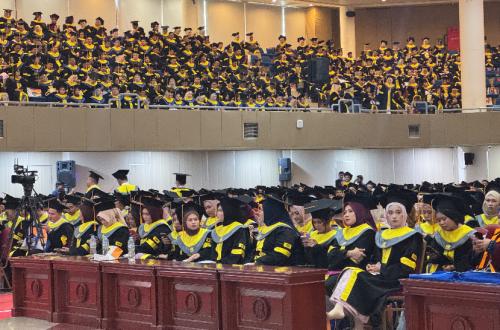
SOUTH TANGERANG – Inclusive higher education offers broader opportunities for students from diverse backgrounds, including those with special needs, to complete their studies. Flexible learning is one factor enabling people with disabilities to pursue education through to degree level.
This was evident at Universitas Terbuka’s graduation ceremony for the first semester of the 2026/2027 academic year in Region 1, attended by 2,183 graduates at the Universitas Terbuka Convention Centre (UTCC) on Tuesday (27 October 2026). Three graduates with disabilities were recognised as dedicated graduates by the central board of the Universitas Terbuka Alumni Association (IKA UT).
They were Alfahreza Revialdi and Mochammad Al Hafizh, from the undergraduate Management programme, and Ida Romauli, from the undergraduate Accounting programme at UT Jakarta. Their graduation shows that access to higher education can remain open to students with a range of needs.
Universitas Terbuka Rector Ali Muktiyanto said the university’s students came from diverse cultural backgrounds and personal circumstances. Physical conditions, he said, should not be an obstacle to obtaining higher education.
“Our graduates come from communities with different cultural backgrounds and personal circumstances. Among them today were blind and speech-impaired graduates. There is no such thing as ‘impossible’ when it comes to earning a degree,” Ali said on the sidelines of the ceremony.
UT operates an open and distance-learning system that allows students to adapt their studies to their individual circumstances. The system also serves students from a wide range of professions and age groups, including those with special needs.
“Through its open and distance-learning system, UT provides flexibility for students across professions, age groups and needs, including special needs,” Ali said.
The diversity of the graduating class was also reflected in its members’ social and professional backgrounds. Alongside graduates with disabilities, attendees included recipients of KIP-Kuliah scholarships, military officials, regional legislators and public figures.
Flexible access is an important element in expanding opportunities to pursue higher education. For students with special needs, as well as those facing time or mobility constraints, an adaptable learning model can make it easier to complete their education.