
Five Years of Planting Mangroves, Now Planting for the Next Generation: Pertamina Foundation Welcomes 12 Scholarship Recipients
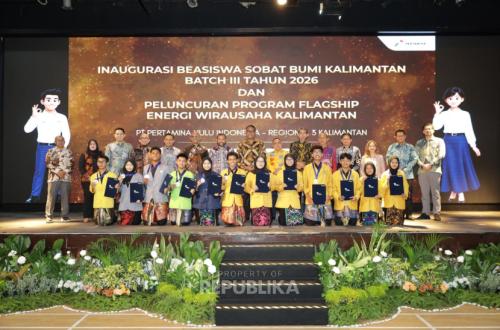
BALIKPAPAN — Pertamina Foundation (PF), together with PT Pertamina Hulu Indonesia (PHI), marked five years of the Mahakam Sustainable Forest Programme and inducted 12 recipients of the 2026 Batch III Sobat Bumi Kalimantan Scholarship (BSBK) at the Club House of PT Pertamina Hulu Mahakam (PHM) in Balikpapan on Thursday (12 November). The programme included the planting of mangroves for Phase 5 in the Mahakam Delta and the presentation of certificates and medals to the scholarship recipients, accompanied by their parents or guardians.
Both events share one goal: to restore Kalimantan’s environment today while preparing the younger generation to protect it in the future.
Kalimantan faces significant environmental challenges, from land conversion to the shrinking of coastal and mangrove areas. In the Mahakam Delta, much of the mangrove forest has been converted into fishponds. PF therefore views environmental restoration and the education of young people as two parts of the same effort. “Five years ago, we began with one simple belief: Kalimantan must not only provide us with benefits; we must also restore it,” said Pertamina Foundation Chair Agus Mashud S. Asngari.
That belief has been put into practice through the Mahakam Sustainable Forest Programme, which PF has run since 2022 on land covered by PHM’s Forest Area Use Approval (PPKH) in Muara Kembang and Muara Jawa, Kutai Kartanegara Regency. By 2025, the programme had planted 2.52 million mangrove seedlings across 157.1 hectares, or 2.5 times the target in the initial memorandum of understanding. In 2026, the programme entered Phase 5, with a target of planting 576,176 seedlings across 32.41 hectares, bringing the projected total to around 3.1 million seedlings.
The programme does not stop at planting. Each seedling is monitored through PF’s PC Prove PF-Lestari platform, developed by the foundation. The platform helped the programme win a Platinum award in the Continuous Improvement category at the 2026 APQ Awards. Monitoring results from Phases 1 to 4 recorded around 1.74 million surviving mangrove plants, which are beginning to form stands that trap sediment and provide habitat for coastal wildlife.
The growing mangroves are also restoring habitat for animals. A biodiversity study recorded 479 proboscis monkeys, an endangered primate endemic to Borneo, living in 76 groups in the Mahakam Delta. The Sonneratia and mangrove trees planted there provide both food and places for them to roost.
Local residents are also benefiting. The people of Sepatin village have been involved from the outset, from raising seedlings through the Karya Sepatin village-owned enterprise (BUMDes) to planting them in the field. Forty fish farmers have learnt the smart silvofishery model, which combines fish farming with mangrove conservation. Local groups manage soft-shell crab cultivation on 15 rafts using the same approach, while residents of three villages have received training in processing nipah palm sap. A Phase 1 social impact study found that every Rp1 invested by the programme generated Rp1.92 in social benefits. “This is what we mean by sustainability: nature is restored, wildlife returns and communities also prosper,” Agus said.
On the next-generation development front, BSBK provides access to higher education for outstanding young people from disadvantaged families in Kalimantan. The Batch III selection process attracted 364 applicants. Eighty passed the administrative screening, 60 took the academic aptitude test, and 26 finalists were interviewed on 23–24 September 2026. The interview panel assessed perseverance, family economic circumstances, honesty and applicants’ understanding of their chosen fields of study. The results were discussed with the PHI and PF Selection Team, which ultimately chose 12 recipients — just one for every 30 applicants.
The 12 recipients include nine from East Kalimantan, two from North Kalimantan and one from South Kalimantan. They are now in their first semester at Mulawarman University (seven students), Borneo Tarakan University (two), and the Kalimantan Institute of Technology, Samarinda State Polytechnic and Lambung Mangkurat University (one each). Two recipients are from Muara Jawa, one of the areas where mangroves have been planted under the Mahakam Sustainable Forest Programme.
“The places you have earned today are no accident. They are the result of your own efforts in successfully completing this rigorous selection process,” Agus told the recipients. He urged them to honour the responsibility of the scholarship in three ways: study diligently, uphold good character and integrity, and remember to return home to help develop Kalimantan.
PHI President Director Muharram Jaya Panguriseng said human development was part of the company’s contribution to Kalimantan. “For PHI, Kalimantan’s energy comes not only from its natural resources, but also from people with the knowledge, skills and courage to move forward. Through these full scholarships, we want to help high-achieving young people from low-income families continue their undergraduate studies. We hope economic hardship will not prevent them from developing their potential and pursuing their ambitions,” he said.
Through BSBK, recipients receive tuition fees (SPP/UKT), living and other support costs, and environmentally focused capacity-building. They also take part in Aksi Sobat Bumi, which encourages recipients to turn their knowledge into practical action in their communities, as well as the Sobat Bumi Independent Energy Village programme. The aspirations of the Batch III recipients reflect this spirit. Laura Purwanti, an environmental engineering student at Mulawarman University, hopes to develop a device to clean the Mahakam River. Rahmansi, who studies mining engineering at Lambung Mangkurat University, wants to become a post-mining reclamation engineer. Nur Mariyam, from the fisheries socio-economics programme, aims to improve the welfare of coastal fishers, while Syahsiyah Anindita Ismawan, a mathematics education student, has conceived “Mangrove Math” lessons.
Together with the 30 recipients from Batches I and II, the BSBK community now has 42 scholars, supported by 16 partner universities. The programme is fully funded by PHI subsidiaries PT Pertamina Hulu Mahakam, PT Pertamina Hulu Sanga Sanga and PT Pertamina Hulu Kalimantan Timur, with PF as its implementing partner. BSBK aligns with the fourth Asta Cita priority on strengthening human resources, as well as Sustainable Development Goals 4 on quality education and 10 on reduced inequalities.
Looking ahead, PF is committed to continuing both programmes on a sustained basis. Mangroves in the Mahakam Delta will continue to be monitored until they develop into a self-sustaining ecosystem, while the Sobat Bumi scholars will receive support through to graduation. “These five years have proved one thing: if the young people we educate through the Sobat Bumi Scholarship and the trees we plant through PF Lestari progress together, Kalimantan will have a sustainable future,” Agus concluded.
Source: jawawa.id (https://jawawa.id/newsitem/five-years-of-planting-mangroves-now-planting-for-the-next-generation-pertamina-foundation-welcomes-12-1794635490)
Originally published by Republika (https://esgnow.republika.co.id/berita/toguff522/lima-tahun-menanam-mangrove-kini-menanam-generasi-pertamina-foundation-sambut-12-penerima-beasiswa), translated from Indonesian