
Five-Year Target Set by Jakarta Provincial Government to Gradually Organise Overhead Cables
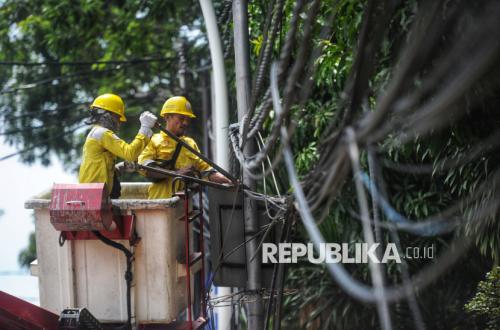
The Jakarta Provincial Government has set a target to relocate all overhead cables in the capital within five years. This arrangement will be carried out gradually through the construction of Integrated Utility Network Facilities (SJUT), independent network relocation by operators, and the removal of non-functional cables.
Jakarta Governor Pramono Anung stated that the policy is supported by a legal foundation through Regional Regulation Number 8 of 2025 concerning the Placement of Utility Networks.
“In accordance with Regional Regulation Number 8 of 2025, we now have a strong legal umbrella to organise utility cables from above the surface to underground. I target that within the next five years, all overhead cables in Jakarta can be fully moved underground to significantly transform the face of the capital,” said Pramono while inspecting the SJUT construction on Jalan Prof Dr Soepomo, Tebet, South Jakarta, on Thursday (10/9/2026).
The arrangement covers overhead cable networks spread across approximately 6,500 kilometres of Jakarta’s roads. As of September 2026, the constructed SJUT infrastructure has reached 41.7 kilometres.
The Jakarta Highways Agency (Dinas Bina Marga) is currently constructing an additional 12.5 kilometres of SJUT this year. With this addition, the total SJUT network is targeted to reach 54.2 kilometres by the end of 2026.
In addition to SJUT construction, the Provincial Government is implementing the ‘5M Program’ to accelerate the process. This programme includes using SJUT, performing independent relocation, binding overhead cables, cutting non-functional cables, and raising sagging cables.
Pramono noted that the government is also opening opportunities for business entities and the private sector to participate in the construction and utilisation of underground utility networks.
“Because the business scheme is promising and the legal framework is complete, we are opening as much space as possible for the private sector so that this acceleration becomes a collective movement for the comfort of all citizens,” he said.
Urban planning observer from Trisakti University, Yayat Supriatna, assessed the gradual approach as realistic. He noted that the arrangement cannot be done simultaneously because every area has different utility network conditions and space readiness.
“In my opinion, it is good for the arrangement to start by region. The areas that are easiest to execute should be the priority. Second, areas that are already ready for development,” Yayat told Republika on Tuesday (15/9/2026).
According to Yayat, new areas are relatively easier to organise because utility networks can be designed from the outset. The government can prepare special corridors so that electricity, telecommunications, or other networks do not need to be placed overhead.
“For newly developed areas, it can actually be prepared from the start. For example, with Multi-Tunnel Utility (MTU), so that utilities are already prepared underground from the beginning,” he added.
Greater challenges exist in older areas already crowded with various utility networks. Space beneath the road is not always sufficient, and excavation work has the potential to disrupt traffic and resident activities.
Therefore, Yayat suggested that the government must first map underground conditions before determining which road segments to organise. Utility construction also needs to be synchronised with other infrastructure projects to prevent repeated road excavations.
He warned that moving cables underground must not involve using drainage channels.
“Learning from the case in Depok at Margonda, all overhead cables were moved underground, but they ended up being placed in drainage channels. Consequently, the drains became clogged, leading to floods and puddles during rain,” said Yatt.
He noted that utility networks require their own corridors so as not to interfere with the function of drainage or other infrastructure.
Coordination with network owners is also considered vital. Operators must know which segments are priority areas so they can prepare network relocation without disrupting services.
“It must be gradual, with priority areas identified, and involving the cable owners so they can anticipate that one day, the road corridor will have an underground channel created,” he said.
Soepomo is One of the Priority Segments
The Jakarta Provincial Government is currently continuing SJUT construction on the western side of Jalan Prof. Dr. Soepomo, South Jakarta. The work is divided into five segments.
In Segment 1, 13 manholes must be constructed. As of 9 September 2026, 10 manholes have been completed, and work is proceeding to the next stage.
The Highways Agency aims to complete the SJUT construction on this segment by December 2026.
The Provincial Government has also requested utility network owners to help accelerate the arrangement. In areas without SJUT, operators are encouraged to perform independent network relocation.
The arrangement does not only target telecommunications networks; electricity networks are also being prepared for underground relocation.
Senior Manager of Construction at PT PLN Unit Induk Distribusi Jakarta, M Eryan Saputra, said PLN is preparing designs and testing low-voltage distribution boxes before Low Voltage Underground Cable Systems (SKTR) are implemented more widely.
“We provide full support for this urban arrangement programme. Currently, PLN is preparing designs and testing low-voltage distribution boxes before SKTR is deployed extensively,” said Eryan.
The Provincial Government has also implemented arrangements on other segments. On Jalan Sri Sultan Hamengku Buwono IX, Cakung, East Jakarta, for instance, 792 metres of overhead cables belonging to 17 fibre optic operators were cleared after the underground network was completed.
The arrangement in that area was carried out through stages of underground network construction, service migration (cut over), and finally, the removal of cables and poles that are no longer in use.
Source: jawawa.id (https://jawawa.id/newsitem/five-year-target-set-by-jakarta-provincial-government-to-gradually-organise-overhead-cables-1789527519)
Originally published by Republika (https://news.republika.co.id/berita/tlfpz3487/target-lima-tahun-pemprov-dki-tata-kabel-udara-secara-bertahap), translated from Indonesian