
Five Lessons from the Vice-President Crisis: Reflections on Power, Politics and Law
By OK Saidin
Professor at the Faculty of Law, University of North Sumatra
Crises always bring lessons, provided we are willing to read them. This week, the Republic is facing a crisis not seen since the Reform era: a directly elected Vice-President has expressed an intention to resign, not because of illness or inability to perform his duties, but because the basis of his nomination has collapsed in two courts.
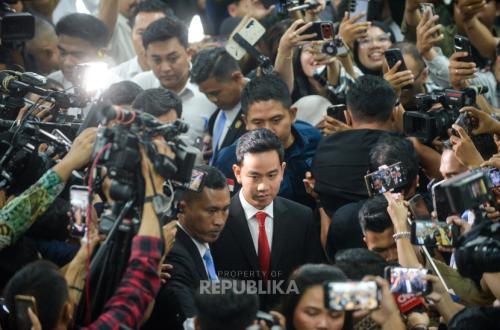
On Tuesday, 10 November 2026, Gibran Rakabuming Raka met President Prabowo Subianto for around two and a half hours and verbally conveyed his intention, as confirmed by State Secretary Prasetyo Hadi. At the time of writing, neither the Palace nor the MPR had officially declared the office vacant. Whatever the eventual outcome, at least five lessons can be drawn.
First lesson: Rules that are bent will come back to demand payment
The way was opened for Gibran’s candidacy by Constitutional Court Decision No. 90/PUU-XXI/2023, issued when the Court was led by Anwar Usman, Gibran’s uncle. The Constitutional Court’s Honourary Council subsequently found Anwar Usman guilty of a serious ethical breach and removed him as Chief Justice in November 2023. Three years later, the bill came due. On 6 October 2026, in case No. 01/PHPU.PRES-XXIV/2026, the Constitutional Court said it had found no convincing evidence that Gibran held a foreign qualification equivalent to an Indonesian senior secondary school certificate, although it did not disqualify him because the petitioners lacked legal standing (NU Online, 7 October 2026).
On 30 October 2026, the Supreme Court granted an appeal in a case against the Ministry of Primary and Secondary Education, ruling that Gibran’s senior secondary-school equivalency certificate was invalid and void, and ordering its withdrawal (CNBC Indonesia, 11 November 2026). The certificate had been a document submitted for registration in the 2024 presidential election (CNN Indonesia, 10 November 2026).
Hans Kelsen taught that the legal order is arranged hierarchically (Stufenbau), with each norm deriving its validity from the norm above it (Kelsen, 1967: 221–224). When a document establishing eligibility is annulled, the chain above it loses its foundation. Lon Fuller argued that law has an internal morality: it must be clear, promulgated, non-retroactive and consistently enforced (Fuller, 1969: 39). A candidacy resting on a decision issued amid a conflict of interest and on a document later annulled undermines that morality.
Gustav Radbruch warned that when positive law conflicts intolerably with justice, legal certainty must give way (Radbruch, 1946/2006: 7). We have not reached that point, but certainty built on procedural defects is merely apparent certainty.
Second lesson: Power is not the same as authority
Max Weber distinguished power (Macht)—the chance to impose one’s will despite opposition—from authority (Herrschaft), which is power accepted because it is believed to be legitimate (Weber, 1978: 53, 212–215). The modern state rests on legal-rational authority. When rules governing the filling of an office are found to have been breached, the office remains occupied and official protocol continues, but belief in its legitimacy, Legitimitätsglaube, is eroded. Power remains in hand; authority begins to slip away.
Seymour Martin Lipset cautioned that a government which is effective but has lost legitimacy is in the most vulnerable position (Lipset, 1959: 86).
David Easton distinguished specific support, arising from performance, from diffuse support, rooted in belief in the legitimacy of the system and its office-holders (Easton, 1965: 273). What is being eroded here is diffuse support, which cannot be restored through work programmes.
Steven Lukes showed that power operates in three dimensions: decision-making, agenda-setting and shaping what is regarded as normal (Lukes, 2005: 25–29). Decision No. 90/2023 was an exercise of the second dimension of power, changing the agenda without legislative debate. The third dimension is now shifting, and what was once accepted as the “will of the people” is being reread as manipulation. That memory is reinforced by challenges concerning the history of Gibran’s candidacy for mayor of Solo and the still-ongoing case alleging that his father, seventh President Joko Widodo, used a fake diploma.
Michel Foucault added that power circulates through networks of discourse (Foucault, 1980: 98): on social media, in mainstream media, courtrooms and experts’ podcasts, the “truth” about the diploma is contested, and formal office no longer guarantees control over the narrative.
Source: jawawa.id (https://jawawa.id/newsitem/five-lessons-from-the-vice-president-crisis-reflections-on-power-politics-and-law-1794466358)
Originally published by Republika (https://opini.republika.co.id/berita/todjtz415/lima-pelajaran-dari-krisis-wakil-presiden-catatan-teori-kekuasaan-politik-dan-hukum), translated from Indonesian