
FISIP UMJ PKM Team Secures 2026 Kemendiktisaintek Funding for Digital Ethics Research
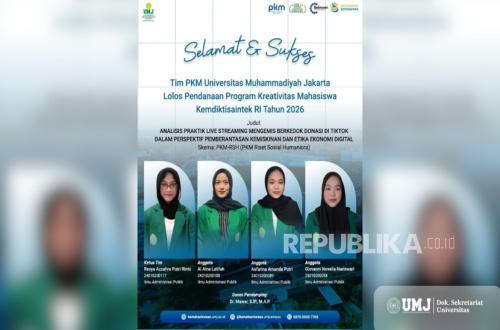
A student team from the Faculty of Social and Political Sciences at Universitas Muhammadiyah Jakarta (FISIP UMJ) has secured funding from Kemendiktisaintek in 2026 under the PKM-RSH scheme (Student Creativity Program for Social Humanities Research). The achievement, announced on Saturday, 23 May 2026, was secured through research titled ‘Analysis of Live Streaming Begging Under the Guise of Donations on TikTok from the Perspective of Poverty Eradication and Digital Economic Ethics’. Team leader Resya explained that the proposal was drafted from March 2026 onwards. The drafting process was intensive, covering background strengthening, research methodology, and budget preparation to comply with PKM guidelines. ‘We are extremely grateful and did not expect to secure funding. Our emotions are mixed—moved, proud, and happy—especially as our team is the only one from UMJ to succeed this year,’ Resya said. Resya stated that the research topic stemmed from the team’s concern over the prevalence of live streaming begging disguised as donations on TikTok. She noted the phenomenon requires study due to its potential to exploit vulnerable groups, such as the elderly, while fostering an instant-gratification mentality in society, particularly among the youth. ‘This phenomenon needs to be studied scientifically from an ethical and digital economics perspective, as it relates to the exploitation of vulnerable groups and societal behaviour in digital spaces,’ she added. She added that the main challenge was building a robust theoretical foundation, ensuring the research’s urgency, and aligning the writing structure with the detailed PKM guidelines. However, team cohesion and lecturer guidance were crucial factors in their success. Supervising lecturer and Public Administration Study Programme Head Dr Mawar, SIP, MAP, praised the PKM-RSH team’s achievement. She noted the success resulted from the team’s ideas, creativity, hard work, and solid collaboration. ‘This achievement is highly commendable. They competed against numerous proposals and demonstrated exceptional effort, even using holiday time productively to finalise the proposal,’ Mawar said. Mawar explained that the research topic emerged from students’ awareness of shifting digital platform functions. Digital spaces, intended for creativity, can be misused to gain instant income by exploiting public empathy. She added that the team’s success was supported by intensive guidance from the study programme, faculty, and university levels, including awareness sessions, internal selections, and proposal clinics with UMJ reviewers. She hopes the PKM-RSH team will conduct consistent research, produce high-quality outputs, and progress to the National Student Scientific Week (PIMNAS). ‘May the team optimally seize this opportunity, produce quality research outputs, and even exceed targets. This achievement is also hoped to motivate other students to continue actively creating,’ Mawar concluded. This achievement is a proud milestone for UMJ. The FISIP UMJ PKM team is the sole UMJ group to secure Kemendiktisaintek 2026 funding, having competed against 250 proposals from UMJ and tens of thousands from universities nationwide.