
Fiscal Policy Opens New Opportunities in Transmigration Areas, Says Finance Ministry
Jakarta (ANTARA) - The Ministry of Finance has said fiscal policy can create new growth centres in transmigration areas and broaden economic opportunities that improve public welfare.
Acting Director-General of Economic and Fiscal Strategy at the Ministry of Finance, Ferry Ardiyanto, said the benefits of development must be felt directly by local communities through the provision of infrastructure, improvements in human resource capacity, and stronger regional economic linkages.
“We do not only want to build new centres of growth in transmigration areas, but also new centres of opportunities,” Ferry said during a briefing for the 2026 Patriot Expedition Team in Jakarta on Wednesday.
According to Ferry, growth and equitable distribution need not be seen as two conflicting objectives.
Fiscal policy, he continued, must ensure that economic growth proceeds hand in hand with the expansion of opportunities and the reduction of disparities between regions.
He explained that the government is directing fiscal policy for transmigration areas towards three main aspects: connectivity, local capacity, and regional economic linkages.
“For transmigration areas, our fiscal policy target is not merely to create growth poles, but inclusive growth poles that deliver direct benefits to the community,” Ferry said.
Connectivity is being strengthened through the construction of basic infrastructure so that communities can connect with centres of economic activity.
The State Budget (APBN) is one of the government’s instruments for building bridges, infrastructure, and housing in transmigration areas.
Meanwhile, community capacity is strengthened through the provision of education, health and training services, support for micro, small and medium enterprises (MSMEs), and access to financing.
“Growth and equity do not have to be a trade-off. The challenge of fiscal policy is to ensure growth while expanding opportunities and reducing economic disparities,” he said.
Ferry said fiscal policy is also directed at building local economic linkages by ensuring investment creates jobs and involves local workers, MSMEs, farmers, and regional supply chains.
According to him, fiscal incentives will be granted based on outcomes achieved, not solely on the value of investment attracted.
The success of development, he continued, is measured not only through increases in gross regional domestic product (GRDP), but also through reductions in poverty, improvements in income and employment opportunities, and narrowing disparities between regions.
Ferry said the APBN serves as a shock absorber for economic turbulence, a driver of development, and an instrument for protecting the poor amid global uncertainty.
In carrying out these functions, the government maintains energy and food supplies and price stability, provides subsidies so that price spikes do not directly burden the public, and channels social protection programmes to preserve purchasing power.
The government is also preparing a number of economic stimuli, including vocational and apprenticeship programmes planned for launch in the second half of 2026.
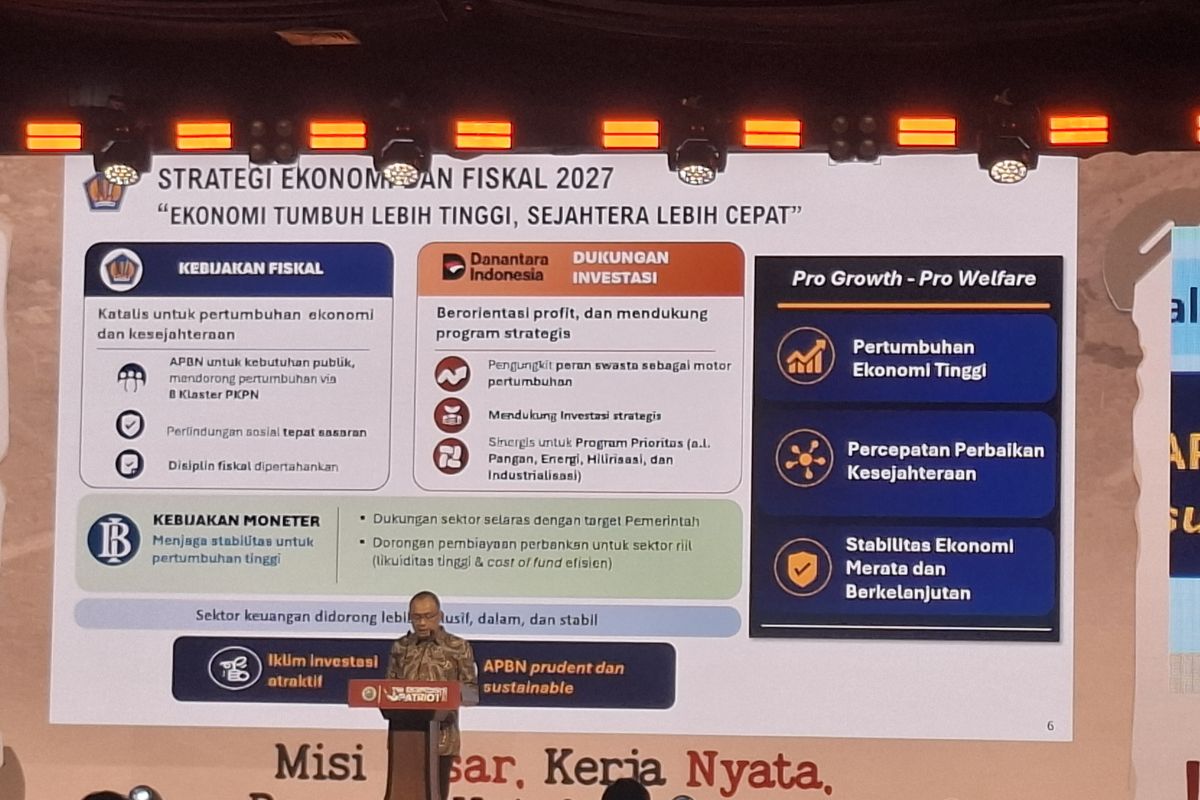
Ferry added that the 2027 economic and fiscal strategy carries the theme “Higher Economic Growth, Faster Welfare”.
The strategy is underpinned by disciplined, prudent and sustainable fiscal policy, monetary policy that maintains stability and liquidity for the real sector, and investment support for priority programmes such as food, energy, downstreaming, and industrialisation.
He said Indonesia’s economic fundamentals remain sound amid global turmoil. The Indonesian economy grew 5.61 per cent year-on-year in the first quarter of 2026, while inflation in June 2026 was recorded at 3.34 per cent.
Foreign exchange reserves in June 2026 reached US$145.6 billion, or around Rp2,360 trillion, equivalent to 5.5 months of import financing.
Economic liquidity also continues to support economic activity. Primary money (M0) grew 16.2 per cent year-on-year in the second week of July 2026, while bank credit grew 12.7 per cent in June 2026.
As of 27 July 2026, cumulative capital inflows had reached Rp115 trillion, supported by investment in State Securities (SBN) and Bank Indonesia Rupiah Securities (SRBI).
Source: jawawa.id (https://jawawa.id/newsitem/fiscal-policy-opens-new-opportunities-in-transmigration-areas-says-finance-ministry-1785304490)
Originally published by Antara (Indonesian) (https://www.antaranews.com/berita/5670621/kemenkeu-kebijakan-fiskal-buka-peluang-baru-di-kawasan-transmigrasi), translated from Indonesian