
Fiscal-Monetary Synergy Key to Facing Global Uncertainty
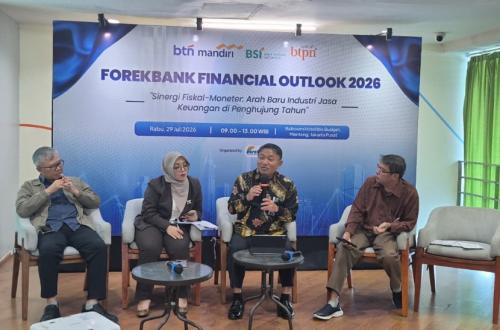
Global uncertainty is driving the strengthening of fiscal and monetary policy synergy to maintain national economic stability. Inter-agency coordination is considered crucial to mitigate pressure on the rupiah exchange rate, the financial sector, and economic growth.
Head of the Licensing and Crisis Management Department at the Financial Services Authority (OJK), Aslan Lubis, stated that the financial services industry faces significant challenges this year. Besides domestic conditions, pressure also stems from geopolitical conflicts and rising protectionism in several countries.
“All these uncertainty factors disrupt the global supply chain, particularly energy, and as we know, we are now a net importer, especially of oil,” Aslan said during the Forekbank Financial Outlook 2026 discussion in Jakarta, Wednesday (29/7/2026).
According to Aslan, these challenges cannot be resolved by a single institution. Therefore, synergy between the government, Bank Indonesia (BI), the OJK, and industry players is a key factor in maintaining national economic stability.
He cited the example of BI raising its benchmark interest rate by 125 basis points since May 2026. On the other hand, the government is implementing budget efficiency measures to strengthen the fiscal space and maintain rupiah stability.
“We should be proud that the stability of the financial sector, as you can all see, has been maintained very well so far,” he said.
University of Indonesia economist Telisa Falianty assessed that the harmonisation of fiscal and monetary policies must proceed in a balanced manner. According to her, the dominance of one policy could potentially disrupt economic stability.
“Lapangan Banteng and Kebon Sirih must be in harmony between monetary and fiscal policies. Fiscal policy should not be too dominant over monetary policy, or vice versa. If fiscal policy is too dominant, it will create the potential for a crisis and reduce prudentiality,” Telisa said.
She added that synchronisation between central and regional governments is also necessary so that adjustments to the Regional Transfer Fund (TKD) do not disrupt public services. On the other hand, credit transmission to the real sector is still considered uneven because financing growth remains concentrated in large corporations, while MSME credit and working capital loans have yet to show significant increases.
“Starting from the phenomenon of widespread withdrawal of savings (eating into savings) to the use of loan facilities to meet daily needs (eating into loans),” Telisa said.
Meanwhile, Senior Economist at the Prasasti Center for Policy Studies, Piter Abdullah, assessed that corporations and financial institutions need to strengthen risk mitigation through hedging instruments amid exchange rate volatility.
“The mitigation effort for the development and weakening of the rupiah exchange rate is hedging. This is an effort by corporations and financial institutions to protect the value of their assets and investments from the risk of exchange rate depreciation,” Piter said.
According to him, the financial industry already possesses various hedging instruments, such as forex forwards, domestic non-deliverable forwards (DNDF), FX swaps, FX options, cross currency swaps, and interest rate swaps. The synergy of fiscal policy, credible and independent monetary policy, and strong financial sector supervision is expected to maintain national economic resilience amidst global turmoil.
From the industry side, Vice President Director of PT Bank Syariah Indonesia Tbk. (BSI), Bob Tyasika Ananta, said the company is balancing its financing expansion strategy with strengthening asset quality, liquidity, and risk management to ensure sustainable growth.
According to Bob, financing growth opportunities remain open through productive sectors, investment financing, the housing sector, and government priority programmes. In addition to distributing People’s Business Credit (KUR) for housing, BSI is also preparing financing for Work Order Contracts (SPK) worth IDR 444 billion to support the operations of 296 Free Nutritious Meal (MBG) kitchens in various regions.