
First Space Weather Forecast: James Webb Telescope Discovers Planet with Morning Sand Rain!
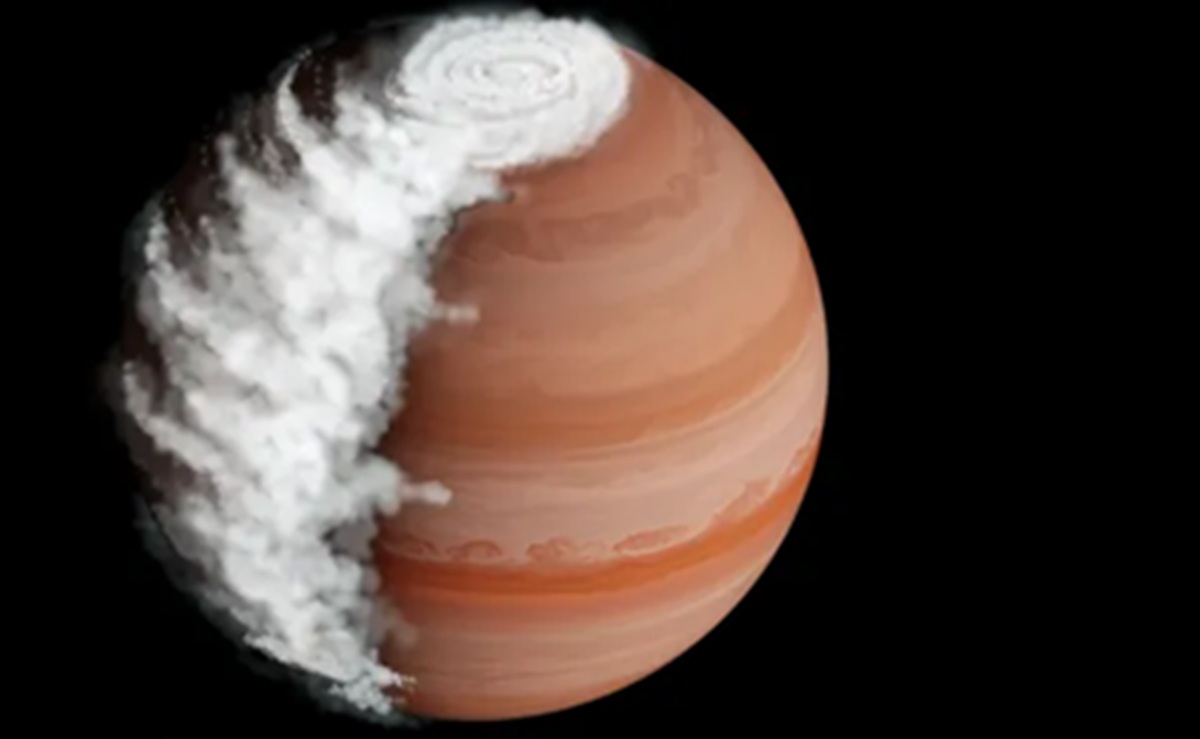
For the first time, astronomers have observed a daily weather cycle on a gas giant exoplanet of the ‘Hot Jupiter’ class named WASP-94Ab. Using the James Webb Space Telescope (JWST), scientists detected a striking phenomenon: the planet is enveloped in thick clouds of sand in the morning that gradually dissipate, leaving a clear sky by sunset.
WASP-94Ab lies around 690 light-years from Earth. This gas giant is about 1.7 times the size of Jupiter and completes an orbit around its star every four days. Its proximity to its host star drives extreme temperatures, exceeding 1,200 degrees Celsius.
Attempts to analyse the planet’s atmosphere were previously hindered by the planet’s thick cloud cover. Unlike Earth’s clouds, formed from water vapour, the WASP-94Ab clouds are composed of rock and metal vapours, specifically magnesium silicate, resembling a giant dusty storm sweeping across the planet.
“I have been observing exoplanets for 20 years, and the problem of thick clouds has always been a thorn in our side,” said David Sing of Johns Hopkins University in a statement. “We have long known that clouds are widespread on Hot Jupiter planets. It’s frustrating because it feels like trying to see the planet through a fogged window.”
However, through transit spectroscopy using JWST, the team was able to separate observations of the planet’s morning and evening sides. On the morning side, magnesium silicate clouds appear extremely dense. By contrast, on the evening side, the clouds disappear entirely, revealing an atmosphere dominated by hydrogen. The clear evening sky enables JWST to measure the atmospheric chemical composition accurately, and it found that its oxygen and carbon contents are only about five times that of Jupiter, correcting earlier telescope measurements that were skewed by the clouds.
The researchers offer two hypotheses why the sand clouds vanish in the afternoon. First, WASP-94Ab is tidally locked, with one side perpetually day and the other perpetual night. Strong winds are thought to loft magnesium silicate high into the atmosphere on the night side, forming clouds that are then carried to the day side, where they gradually settle into deeper layers and disappear. An alternative theory holds that the magnesium silicate clouds resemble Earth’s morning fog, slowly evaporating under the planet’s intense heat.
“We have not only clarified our view but have also been able to confirm the clouds’ composition and how they condense and evaporate as they move around the planet,” Sing said.
The study, published in the journal Science on 21 May, also reports similar cloud cycles on two other Hot Jupiter planets, WASP-17b and WASP-39b. The next step for astronomers is to broaden the search to a wider variety of planets.