
First Judicial Review at Constitutional Court Challenges Domestic Worker Protection Law Over Social Security
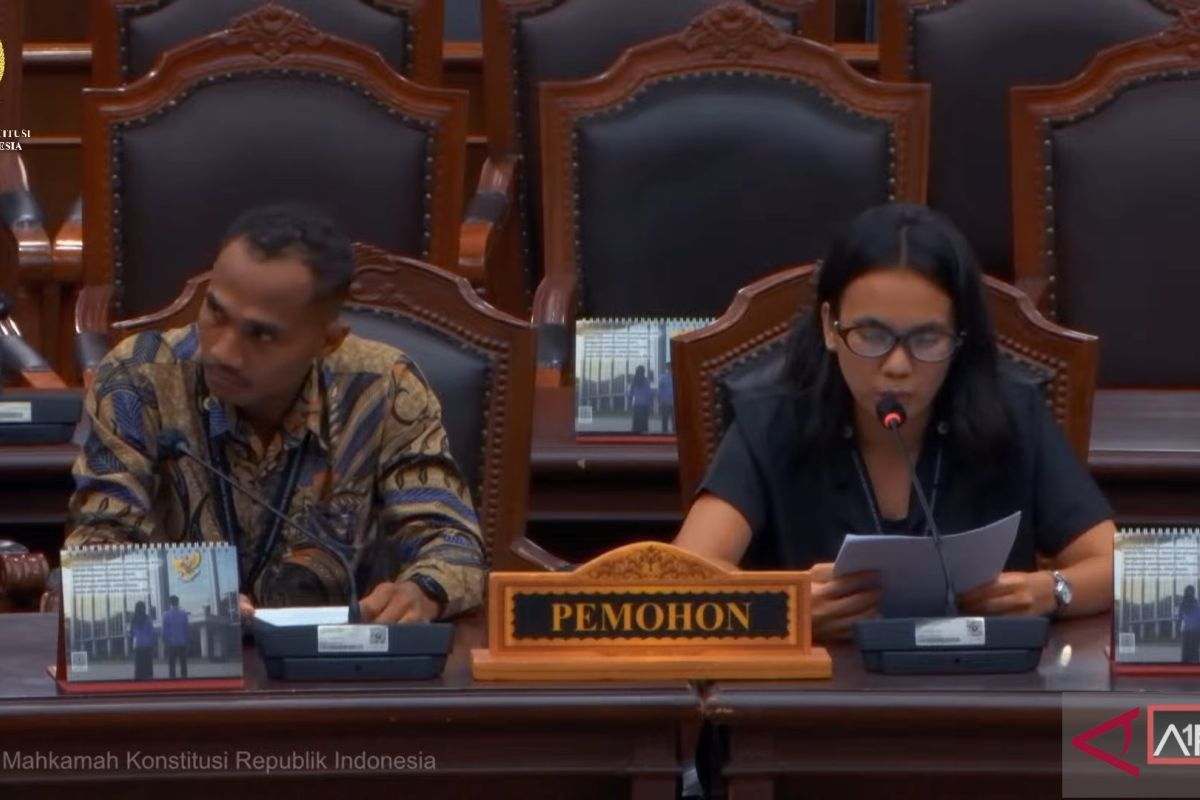
Jakarta (ANTARA) - Law Number 2 of 2026 concerning the Protection of Domestic Workers (UU PPRT) is undergoing its first material review at the Constitutional Court (MK), questioning, among other things, the provisions regarding social security contributions for domestic workers.
According to monitoring of the MK’s official website in Jakarta on Friday, the petition filed by Ferdinan Olla, a domestic worker from East Nusa Tenggara (NTT), is registered under Number 352/PUU-XXIV/2026.
The petition challenges the constitutionality of Article 16, paragraphs (2) and (3), as well as Article 32, paragraphs (4) and (5) of the UU PPRT, which regulate social security contributions and the resolution of disputes between domestic workers and employers.
The preliminary examination hearing was held at the MK on Thursday (1/10), presided over by Constitutional Judge Enny Nurbaningsih, with members Ridwan Mansyur and Arsul Sani.
During the trial, Ferdinan was accompanied by his legal counsel, Bernita Matondang. Before the main petition was read, Judge Enny verified Ferdinan’s employment status.
“Is this Ferdinan Olla indeed a domestic worker?” Enny asked.
“That is correct, Your Honour,” Bernita replied.
In the core of the petition, Ferdinan is described as a domestic worker from NTT who migrated and has been working in Bekasi since 2023 with a monthly wage of Rp1.5 million. Agreements regarding wages and work are practiced orally and are not documented in a written employment contract as intended by the UU PPRT.
According to the petitioner, this condition leaves his position as a domestic worker in an employment relationship highly dependent on agreements with the employer. He also lacks written documentation that could serve as a basis to ensure his rights in the event of disputes regarding wages, social security, or employer obligations.
One of the contested norms is Article 1::(2), which essentially regulates health social security contributions for domestic workers who are not recipients of assistance subsidies, to be covered by the employer based on agreement or employment contract.
The petitioner also challenges Article 16, paragraph (3), which regulates employment social security contributions to be covered by the employer in accordance with agreements or employment contracts.
According to the petitioner, these provisions create uncertainty as to whether the employer’s obligation to pay contributions applies automatically or depends on an agreement.
“For the petitioner, this formulation creates uncertainty as to whether the employer’s obligation remains automatic or is subject to agreement,” said Bernita.
She stated that the bargaining position of domestic workers is weaker when attempting to request that employers agree to and pay social security contributions.
Furthermore, the petitioner challenges Article 32, paragraphs (4) and (5), regarding the authority of mediators in resolving disputes and the final and binding nature of mediator decisions regarding wage disputes between employers and domestic workers.
According to the petitioner, the norm does not yet provide adequate details regarding examination and evidence standards, the opportunity for parties to be heard, the reasons for decisions, and correction mechanisms.
“The employer’s obligation to bear health social security contributions should have a clear basis of obligation. When that obligation is linked to an agreement, social protection potentially becomes a bargaining chip between the domestic worker and the employer, even though the bargaining position between the domestic worker socially and economically is unbalanced,” Bernita read from the petition.
In his advice, Constitutional Judge Arsul Sani requested the petitioner to clarify whether he falls under the exceptions regulated by the UU PPRT, namely individuals assisting within a household based on custom, kinship, or religious/educational purposes.
Constitutional Judge Ridwan Mansyur requested the petitioner to provide a more complete description of his legal standing, the reasons for the petition, and the link between the contested norms and the alleged constitutional loss.
Ridwan also requested Ferdinan to clarify his status as either a student or a domestic worker, as the constitutional loss resulting from the application of the contested norms had not been adequately explained.
Similarly, Judge Enny requested the petitioner to build an argument regarding the constitutional loss experienced and its connection to his rights and obligations as a domestic worker.
Ferdinan was previously recorded as one of the petitioners in Case Number 137/PUU-XXIV/2026 regarding the judicial review of Law Number 20 of 2025 concerning the Criminal Procedure Code.
The Constitutional Court has granted Ferdinan time to submit the amended petition no later than 14 October 2026 at 12:00 WIB.
According to the MK’s official website, Case Number 352/PUU-XXIV/2026 represents the first review against the UU PPRT since the law was enacted in April 2026.