
First Dog on the Moon: The Cartoonist Who Bites Capitalism with a Wombat's Smile
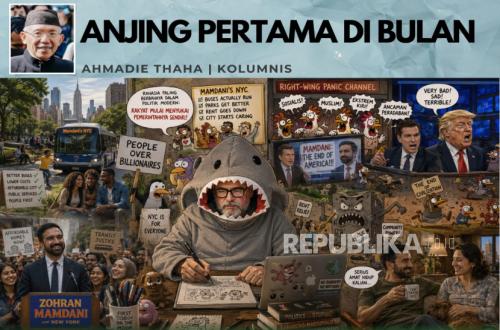
Do you know Andrew Marlton? In the world of Australian political cartoons, Marlton is not just a cartoonist. He is like a crossbreed between a parliamentary jester, a street-corner philosopher, an environmental activist, a graffiti artist, and a political science lecturer who lost patience and decided to draw stressed chickens in the newspaper. His stage name alone sounds like a late-night cartoon title: First Dog on the Moon. From the outset, the public is invited to suspect that this person has come deliberately to disrupt political sanity. His absurd logo features himself emerging from the mouth of a shark or giant dog costume, like a human born from a pocket of chaos. But therein lies his entire artistic manifesto. Marlton understands that modern politics has become too insane to be discussed with a straight face. If democracy has turned into a circus, then the most effective criticism is sometimes not an academic speech, but a drawing of a drunk wombat carrying a protest sign. Born in Bega, New South Wales, Marlton first gained recognition as a political cartoonist for Crikey in 2007 before moving to Guardian Australia in 2014. There, he transformed from a mere cartoonist into a kind of high priest of Australian progressive satire. People open his cartoons not just to laugh, but to check whether the world is truly as broken as they feel. His drawing style deliberately looks like the scribbles of a street-corner loiterer sketching on a café napkin while complaining about rising rent. But do not be fooled. Hidden within those messy lines are sharp critiques of capitalism, media oligarchy, colonialism, racism, climate change, and populist politics sold like instant noodles flavoured with nationalism. He draws politicians as absurd animals: a penguin civil servant, a gender-ambiguous chicken, an interpretive-dancing bandicoot, even a prime minister with a bucket for a head. Politics is stripped naked, because Marlton knows many modern rulers more closely resemble cartoon characters than statesmen. He calls his ideology anarcho-marsupialist, half-joking, half-serious. He believes patriarchy and capitalism need dismantling, but he delivers this not with the stern face of a doctoral seminar that makes participants want to flee to the canteen. He appears like an eccentric neighbour who suddenly explains the collapse of democracy while drawing a depressed kangaroo holding an electricity bill. That is why his cartoons easily go viral. People laugh first, then realise five minutes later they have been slapped with a sandal made of political theory. Marlton is no amateur cartoonist. He won a Walkley Award, one of Australia’s most prestigious journalism prizes, for a cartoon about refugees and the hypocrisy of immigration politics. He consistently sides with those who have no loudspeaker: refugees, climate activists, minority groups, the urban poor, and people who usually appear in political speeches only as statistics of suffering. This is why he became interested in Zohran Mamdani. In a full-page cartoon for The Guardian, Marlton depicted the paradox of modern America through this young politician. Mamdani is a progressive Muslim politician attacked relentlessly by the right-wing, labelled a socialist, anti-American, extreme leftist, a civilisational threat. If they run out of accusations, he might even be blamed for global warming. Yet, strangely, ordinary citizens like him. The Guardian cartoon is classic Marlton: full of tiny handwriting like the notes of a panicking person, reactive animals, pointless arrows, absurd comments in the corner panels, and visual chaos resembling a political WhatsApp group exploding on the eve of an election. Essentially, he compares two worlds. The first is the industry of fear. The second is the reality of everyday life. On television, Mamdani is portrayed as an ideological monster ready to devour America. But on the streets of New York, citizens simply notice that buses now arrive on time, city parks have improved, public services feel alive, and discussions about rent prices finally seem more important than the culture wars manufactured by cable news. One of the funniest sections shows the American right-wing as panicked chickens in a coop screaming, Danger! A Muslim socialist is coming! Meanwhile, in the next panel, New Yorkers sit relaxed enjoying a cleaner city park with discounted coffee. A small character runs hysterically carrying a sign reading THE END OF CIVILIZATION, but a resident flatly responds, He just made the buses run on time. This is how Marlton’s satire works, like poison wrapped in sweets. He shows that political propaganda often sounds like a Hollywood apocalypse trailer, while the people simply want a life that is not too expensive and not too miserable.