
Fire on Peatlands: Unravelling the 'Fire Economy' and the Myth of a Single Cause of Forest and Land Fires
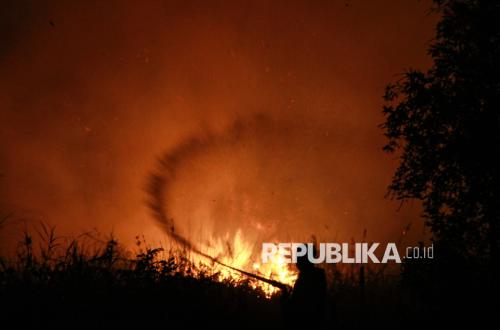
The August sky has once again turned yellow above the forest canopies of Kalimantan and Sumatra. Towards the end of August 2026, the National Disaster Management Agency (BNPB) recorded an alarming figure: 1,842 hotspots burning across five provinces in Kalimantan.
Central Kalimantan led the grim list with 976 hotspots, followed by South Kalimantan with 696. Across the sea, Sumatra suffered a similar fate. The Meteorology, Climatology, and Geophysics Agency (BMKG) detected 1,104 hotspots, half of which were concentrated in South Sumatra.
This ecological disaster is no longer a surprise and has become a deadly routine that has exacted costs in health, the economy, and regional diplomacy for at least the past three decades. This month, haze was again reported to have crossed national borders, choking the Sarawak region of Malaysia and pushing air quality indices to very unhealthy levels. Domestically, six provinces are on alert status amid projections of a peak dry season due to El Niño.
The question is why the trillions of rupiah spent on firefighting, recovery, and legal sanctions seem unable to extinguish the embers on our land. As an ESG practitioner who has reviewed academic literature from 1995 to 2026, I see that there is something wrong in the way we diagnose this disease.
For years, public debate has always been split by a misleading dichotomy: is this purely a natural disaster caused by extreme drought (El Niño), the palm oil industry, or purely the fault of smallholder farmers?
Science shows that this dichotomy is inaccurate. Forest and land fires (karhutla) are not a phenomenon with a single cause. They are a structural crisis born from the interaction of three interlocking layers: climate anomalies, the vulnerability of peatland ecosystems due to past land governance, and the rationality of the ‘fire economy’ at the ground level.
The myth of natural disaster and the curse of peat
The El Niño phase does indeed magnify the risk of catastrophic fires by up to 2.7 times. However, climate is merely an ‘enabling condition’. The massive biomass emission bursts in Indonesia only experienced drastic amplification after the 1960s due to massive human-driven land-use change.
The greatest risk multiplier in this tragedy is drained peatland. Naturally, tropical peat ecosystems are like giant sponges that are wet and fire-resistant. However, the construction of canals to drain water for planting oil palm and acacia has transformed this landscape into a giant pile of fuel. Dried peat is highly susceptible to burning below the surface, can persist for months without being visible to the naked eye, and is 4.5 times more likely to burn than natural land.
So why does deliberate burning still occur? The answer lies in economic analysis. Research shows that land cleared manually without fire has a sale value of around 665 US dollars per hectare. However, if the land is burned, its value rises to 856 US dollars, and jumps sharply to 3,800 US dollars per hectare once oil palm is planted on it. In fact, local land organisers can reap profit margins of up to 486 US dollars per hectare from this practice.
Fire is no longer merely an accident, but has transformed into a rational and profitable economic instrument. As long as this margin still exists, a ban on burning without providing alternative economic substitutes will always remain a paper tiger in the field.