
Finland Sets Its Sights on Indonesia
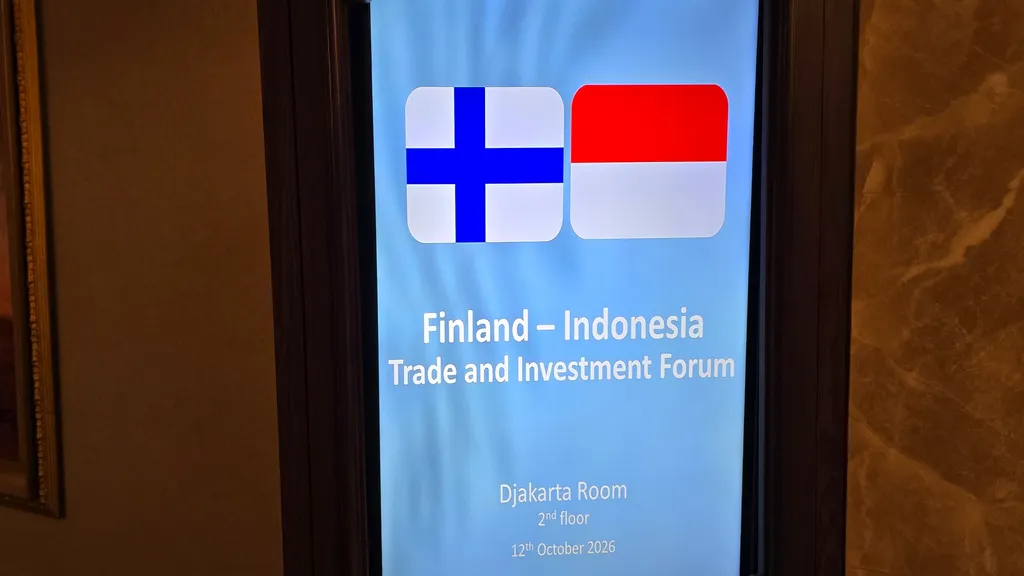
Finland once had a significant presence in Indonesia through Nokia. Now it wants to play a larger role in technology, digital services, energy and even the Free Nutritious Meals programme, known as MBG.
Following Vietnam, Finland is exploring Indonesia as a major trading partner in Southeast Asia. Energy, digital infrastructure and healthcare are among its priorities. Finland is also interested in contributing to MBG.
Finnish Minister for Foreign Trade and Development Ville Tavio’s visit to Jakarta on 12–14 October 2026 was intended to advance that agenda. He sees the industries of Indonesia and Finland as complementary.
“We are currently drawing up a new strategy. I think one outcome of my visit is that we will consider including Indonesia in our future strategy as one of our main partners in Southeast Asia. Indonesia is therefore one of the most important markets for us,” Tavio told Kompas in Jakarta on Monday, 12 October 2026.
Indonesia’s large population is one of its attractions. Tavio sees strong potential for trade with the country to grow.
He arrived with a delegation from 10 companies and financial institutions. Meetings were held with representatives of the Indonesian Chamber of Commerce and Industry (Kadin), the Ministry of Health and the Ministry of Energy and Mineral Resources, among others.
Tavio also met officials from the Coordinating Ministry for Economic Affairs and the Ministry of National Development Planning (Bappenas). The meetings aimed to identify new forms of cooperation and expand the partnership.
In Tavio’s view, the Indonesia-EU Comprehensive Economic Partnership Agreement (IEU-CEPA) sends a positive signal to Finnish companies. “We also hope this agreement will make the business climate in Indonesia simpler. It could also support Indonesia’s downstreaming goals through technology transfer,” he said.
Indonesia and the European Union concluded negotiations on the IEU-CEPA on 23 September 2025. The final agreement is expected to be signed by the end of 2026, before implementation in 2027.
At the end of September, Coordinating Minister for Economic Affairs Airlangga Hartarto said President Prabowo Subianto had asked for the agreement’s completion process to be expedited. “The IEU-CEPA is now being prepared in English to be submitted to the European Parliament, after which our version will be brought to Parliament for ratification,” he said, according to the Ministry of State Secretariat’s website.
Indonesia and Finland have had a bilateral investment protection agreement since 2006. The two countries also signed a memorandum of understanding on clean-energy cooperation in October 2025, partly aimed at expanding Finnish companies’ access to the Indonesian market.
“We very much want to deepen cooperation in critical minerals. We also hope the US-led critical minerals initiative can be concluded in a way that strengthens cooperation between the European Union and Indonesia,” Tavio said.
From Indonesia, Tavio will travel to Hanoi, Vietnam. Vietnam is currently Finland’s only priority country in Southeast Asia and its largest trading partner in the region. Finland-Vietnam trade is reported to be worth about €1 billion a year. Tavio estimates Finnish investment in Indonesia at several hundred million US dollars.
In its 2025–2027 strategy, Finland designated 21 priority countries. In addition to Vietnam, the five Asian countries on the list are India, China, Japan, South Korea and Saudi Arabia.
Tavio said the selection reflects Finland’s ability to expand its capacity in each country. However, countries outside the list are not being sidelined; Singapore and Australia, for example, are also not included.
Data centres and AI
The development of data centres continues to attract foreign investment to Indonesia. Like other countries, Finland sees opportunities in the growth of data centres and AI-using industries.
Finnish telecommunications giant Nokia is pursuing those opportunities. The company, once a dominant force in Indonesia’s mobile telecommunications industry, has partnered with Indosat, Nvidia and Ooredoo Group to develop ZanKore, an AI computing infrastructure project with a target capacity of 1 gigawatt.
“Nokia is a major player in Indonesia. Recently, it partnered with Nvidia and an Indonesian telecommunications operator to build an AI infrastructure platform with a capacity of one gigawatt,” Tavio said.
Another opportunity lies in supplying electricity to data centres. Wärtsilä, one of the companies in the delegation, has operated in Indonesia for decades.
The company has power-generation technology that uses biofuels. Tavio said using electricity generated without fossil fuels could address one of the environmental challenges facing data centres.
Finland also wants to deepen cooperation with Indonesia on critical minerals. “We very much want to deepen cooperation in critical minerals. We also hope the US-led critical minerals initiative can be concluded in a way that strengthens cooperation between the European Union and Indonesia,” Tavio said.
In April 2026, Finland joined Pax Silica, a US-led initiative to secure supply chains for critical minerals, semiconductors and AI infrastructure. Indonesia, meanwhile, has joined the China-initiated World AI Cooperation Organization (WAICO) and the US-initiated Tokyo Vision.
Pax Silica and WAICO are often portrayed as opposing sides in the US-China technology rivalry. However, they have different priorities: Pax Silica focuses on the security of technology supply chains, while WAICO emphasises cooperation on AI development and governance.
In healthcare, Finland is offering digital health technology, smart hospitals, and equipment and solutions for hospitals and clinics. Tavio said digitalisation could extend healthcare services to remote areas.
“Finland is also a knowledge partner in the new capital city project in Nusantara. We are discussing various smart-city and smart-building solutions,” he said.
Alongside technology and infrastructure, Finnish consumer products are also beginning to expand in Indonesia. Finnish fashion brand Marimekko entered the Indonesian market a few weeks ago.
Beyond trade and investment, Finland is willing to share its experience in running school meal programmes with Indonesia. Under President Prabowo Subianto, Indonesia is implementing MBG.
According to Tavio, Finland was the first country in the world to provide free school meals. It was also a founding member of the School Meals Coalition, which Indonesia joined in 2024.
However, each country needs to adapt its programme to its own circumstances. “Building a school meal programme is a long-term project. In Finland, it took several years to implement it well,” Tavio said.
He stressed the importance of ongoing evaluation and improvement. Finland, he added, is still refining its school meal programme today.