
Finding Common Ground Between Indonesia and China in a Changing World
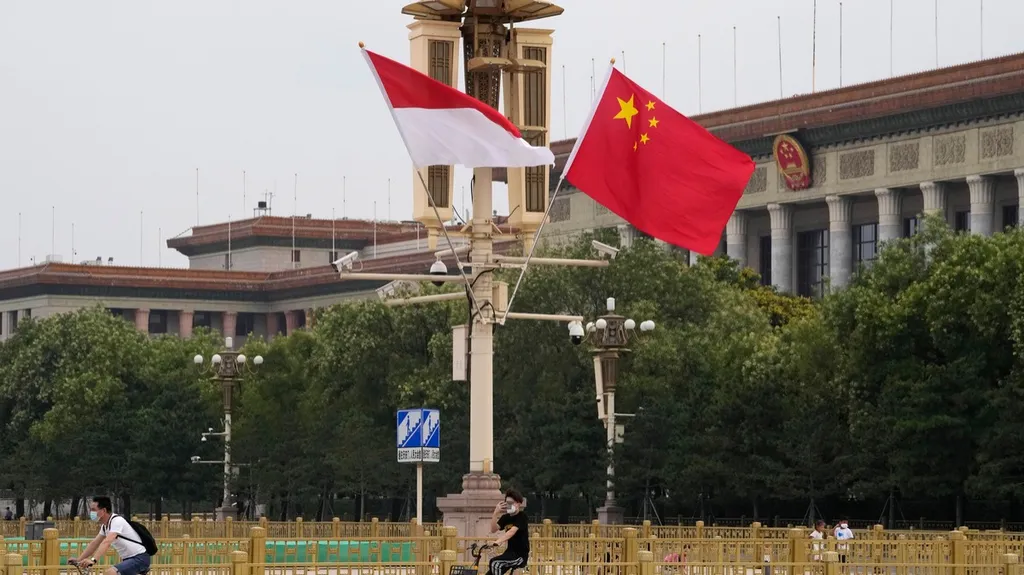
The Jakarta-Beijing relationship is not just about investment and trade. ASEAN, industry, technology, and the interests of the Global South also shape its direction.
25 Sep 2026 08:10 WIB · Internasional
AP/Ng Han Guan
The relationship between Indonesia and China can no longer be viewed solely as a bilateral relationship. Amidst changes in the international order, the relationship between the two countries also intersects with ASEAN’s position, great power competition, the interests of Global South countries, and changes in economic cooperation patterns.
The Executive Director of the Center for Strategic and International Studies (CSIS) Indonesia, Yose Rizal Damuri, on Tuesday (22/9/2026), stated that the relationship between Indonesia and China does not occur in a vacuum. Changes in the international order also determine how Indonesia and China position their bilateral relationship.
“The competition between the United States and China is one of the factors, but this development is also influenced by the increasing importance of developing countries and middle powers such as Indonesia, ASEAN, the business sector, and other stakeholders,” he said.
In this context, he continued, the relationship between Indonesia and China becomes important in shaping the evolving international order. Both countries can utilize regional platforms, such as ASEAN, to promote a more pluralistic order, rather than a fragmented one, while also supporting the prosperity and stability of the region.
However, efforts to strengthen cooperation still face differing interests between the two countries. Indonesia and China, according to Yose, have different perspectives on several issues, one of which is related to investment in Indonesia and Southeast Asian countries.
“This difference needs to be discussed openly to find common ground and build a more favorable condition for the relationship between the two countries,” he stated.
The need to understand differences is one of the reasons why CSIS and the China Institute of International Studies (CIIS) held a second-track dialogue titled “Roundtable on Indonesia-China Relations and the Changing International Order,” from September 20 to 23, 2026, in Yogyakarta. This forum discussed the challenges and interests of each party while also seeking conditions that would better support Indonesia-China relations.
This dialogue is not only directed at the government. The results of this dialogue will be translated into concrete policy proposals and practical cooperation, and communicated to the business world, academics, the media, and the public.
“At the initial stage, discussions are still at a strategic level, although several issues such as energy transition, climate change, digital economy, and governance of artificial intelligence have already been included in the agenda,” he said.
The perspective on international environmental changes and the importance of regional cooperation was conveyed by Zhou Pingjian, Vice President of the Chinese People’s Institute of Foreign Affairs (CPIFA). He assessed that the world is at a crucial point due to profound changes in the international landscape. The more complex the situation, the greater the need for stability and certainty.
In that situation, China maintains the continuity and predictability of both domestic and foreign policies. Development remains a priority with high quality and openness.
In this framework, China is ready to cooperate with Indonesia and ASEAN countries to maintain economic integration and regional stability while upholding the ASEAN Way and ASEAN Centrality. “Economic cooperation is one concrete form. China and ASEAN have been each other’s largest trading partners for six consecutive years, with a bilateral trade value of approximately 1 trillion US dollars,” he said.
Zhou assessed that this indicates a deepening economic interconnection between the two regions. In the future, cooperation can be expanded to include digital economy, environmentally friendly technology, electricity networks, and cross-border connectivity.
At the bilateral level, particularly between China and Indonesia, Zhou proposed that industrial cooperation and supply chains should also be developed, transitioning from the traditional model of “resources for the market” to a more integrated relationship between the market, industry, and resources.
“This pattern is expected not only to strengthen trade relations but also to enhance local job opportunities, technology transfer, industrial capacity building, and the participation of domestic economic actors,” said Zhou.
Cooperation can be expanded to energy transition, climate change, agriculture, and poverty alleviation. Zhou linked this cooperation to the increasing needs of Global South countries to support one another. Indonesia and China, as major developing countries, have an interest in strengthening political, economic, and inter-societal cooperation to support each other’s development aspirations.
He cited the manufacturing sector as an example. Zhou mentioned that Indonesia is pursuing aspirations to increase the share of manufacturing to 28-30 percent of the national economy by 2045. China is similarly positioned. This opens up opportunities for mutually supportive cooperation.
Strengthening relationships should not only be positioned at the government level. Zhou mentioned the “2+2” meetings and the Comprehensive Strategic Dialogue as forms of the seriousness of both governments. Beyond that, there are youth exchanges, research institutions, educational institutions, and local authorities that need to be expanded to strengthen inter-societal relations.
At this point, Indonesia’s interests become crucial in observing how this cooperation is translated. Professor of International Development in East Asia at the Department of International Relations, Faculty of Social and Political Sciences, Gadjah Mada University, Nur Rachmat Yuliantoro, explained that a healthy bilateral relationship