
Finance Ministry sets 2027 regional transfer budget at 2.5-2.7% of GDP
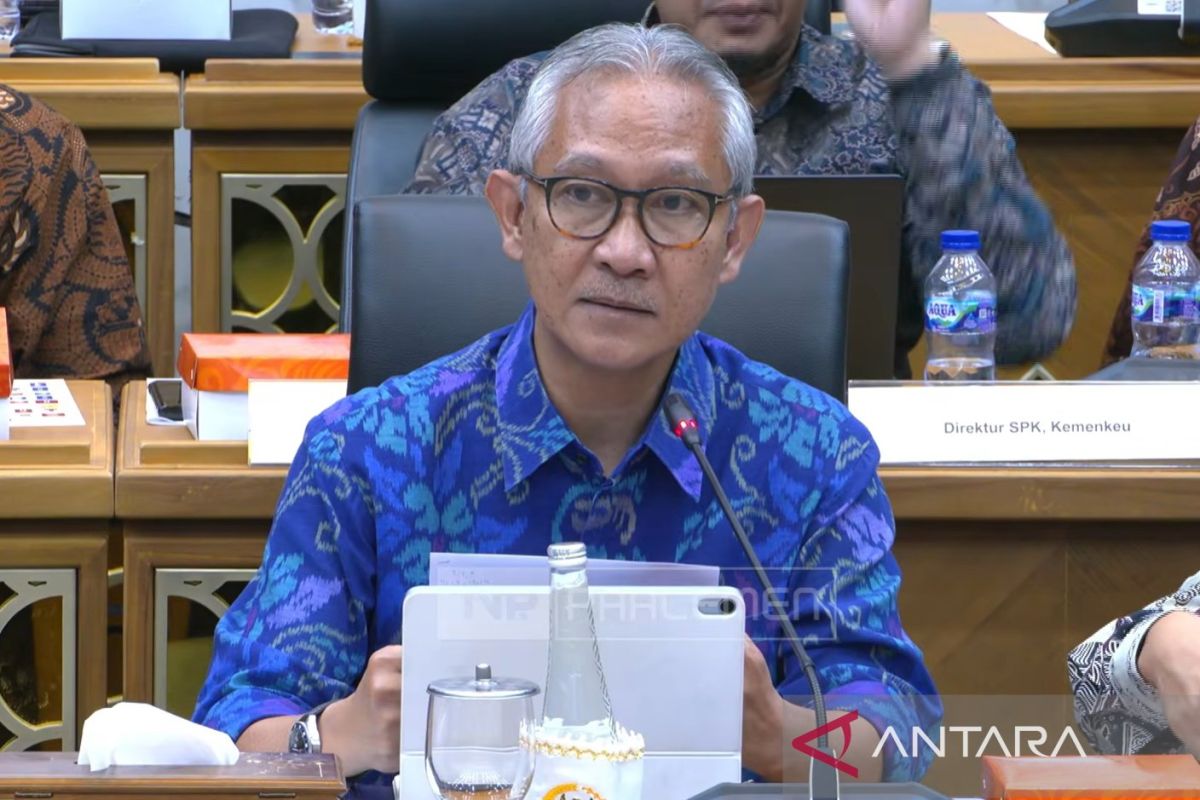
The Director General of Fiscal Balance at the Ministry of Finance, Askolani, stated that the ratio for the Regional Transfer Fund (TKD) within the 2027 Macroeconomic Framework and Fiscal Policy Main Points is set to range between 2.5% and 2.7% of Gross Domestic Product (GDP).
“We are prioritising this TKD allocation to support essential regional expenditures, namely for personnel costs, local government operations, and basic public services,” Askolani said during a meeting with the Indonesian House of Representatives (DPR RI) Budget Committee in Jakarta on Tuesday.
He noted that the budget will also focus on reducing fiscal inequality, fostering better fiscal synergy between the central and regional governments, and supporting regional competitiveness for higher-quality development.
The TKD budget is distributed in several forms, including Revenue Sharing Funds (DBH), General Allocation Funds (DAU), Special Allocation Funds (DAK), Special Autonomy Funds (Otsus), Special Funds, and Village Funds.
Askolani mentioned that the central government will align the allocation of Revenue Sharing Funds (DBH) with state expenditure policies to support local government operations. His department also plans to strengthen the quality of data and the DBH calculation formula using adequate information technology systems.
Meanwhile, the General Allocation Fund (DAU) is specifically directed towards meeting the needs of regional government administration, basic public services, and development in frontier, outermost, and least developed (3T) regions. This includes the salaries of Civil Servants (ASN) stationed in these areas, the rehabilitation of schools and other educational infrastructure, the provision of health facilities and equipment, and the payment of government-funded National Health Insurance (JKN) premiums.
“This is our commitment to ensure that the outermost regions truly receive attention from the government and various ministries to strengthen development in their respective areas,” said Askolani.
Regarding the Special Allocation Fund (DAK), he stated that the government prioritises this budget to realise various national priority programmes, improve public services, and provide regional affirmation.
Special Autonomy Funds (Otsus) are allocated in line with the master plan for accelerated development in Papua. In addition to Otsus funds, additional infrastructure funding is also being prepared for new autonomous regions (DOB) in Papua.
The government is also drafting governance regulations to support the sustainable distribution of Aceh’s special autonomy funds, which are set to expire in 2027.
“As for the special fund policy, particularly for the Special Region of Yogyakarta (DIY), we will sharpen the focus of its use towards reducing poverty levels, empowering community economies and MSMEs, and addressing inter-regional disparities,” Askolani added.
Finally, regarding the Village Fund, he explained that the budget will be utilised to support poverty alleviation, food security programmes, and rural infrastructure development. Additionally, the funds are directed towards strengthening the role of the Merah Putih Village Cooperative (KDMP) in accordance with central government priorities.
“Our hope is that the role of the KDMP will be more tangible, more implementable, and truly able to strengthen the economy right down to the village level,” Askolani concluded.