
Finance Minister Suahasil introduces school pupils to the Rp3,800 trillion state budget
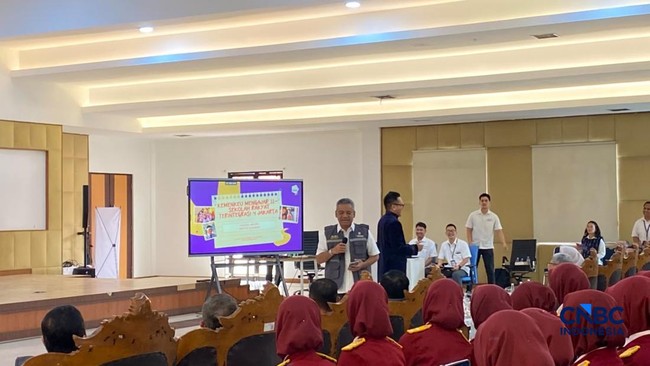
Finance Minister Suahasil Nazara held the Finance Ministry Teaching programme at Integrated People’s School 4 in Jakarta, South Jakarta, on Monday (9 November 2026). The state treasurer said 7,800 Finance Ministry employees were at schools that day to lead the activities.
Suahasil said this was equivalent to 10% of the ministry’s nearly 77,000 employees. The programme, now in its 11th year, aims to explain the Finance Ministry’s duties and functions.
“Some 7,800 of us from the Finance Ministry are going to schools across Indonesia. Not just in Jakarta, but also in Medan, Bandung, Manokwari, Manado and throughout the country. We want to explain what the Finance Ministry does,” Suahasil said at Integrated People’s School 4 in South Jakarta on Monday (9 November 2026).
Suahasil discussed the rupiah, management of the State Budget (APBN) and state assets. He first explained that the rupiah can be used because the government has declared it legal tender. Two institutions are responsible for safeguarding the currency: the Finance Ministry and Bank Indonesia.
The Finance Ministry safeguards public funds to maintain people’s confidence in the government that issues the rupiah, while Bank Indonesia is responsible for preserving the currency’s value. The rupiah’s exchange rate changes over time. For example, the purchasing power of Rp10,000 today may differ from what it was five or 10 years ago.
“Bank Indonesia safeguards the value, while the Finance Ministry, together with Bank Indonesia, safeguards confidence in the rupiah,” he said.
Suahasil then turned to management of the state budget. Under the 2026 APBN, the government has set state revenue at Rp3,153.6 trillion. This comprises Rp0.7 trillion in grants, Rp336 trillion in customs and excise revenue, Rp459.2 trillion in non-tax state revenue (PNBP), and Rp2,357.7 trillion in taxes.
The funds will be spent through state expenditure, which is set at Rp3,842.7 trillion in the 2026 APBN. The state treasurer said spending must help grow the economy and protect the public. To support growth, some spending is channelled to micro and small businesses, help expand people’s businesses, and fund infrastructure, among other things.
The APBN must also protect the public when shocks occur. For example, when the price of non-subsidised fuel such as Pertamax rises, the government can keep the price of Pertalite, a fuel supplied under a special assignment scheme, at Rp10,000 per litre.
“An APBN of this size, at more than Rp3,800 trillion, must be scrutinised by various parties. These include Bank Indonesia, the Finance Ministry, the House of Representatives, regional governments and the Audit Board, before it is implemented,” he said.
Suahasil compared the state budget cycle to the work of a school student council (OSIS). For instance, a budget working meeting discusses planned programmes and which proposals should be approved. They are then presented to the supervising teacher for consultation and approval, and every expenditure is recorded.
The state budget is managed in a similar way. The government, through ministries and agencies, draws up programmes and discusses them with the House of Representatives; the budget is then approved, reported on and audited.
Once state revenue has been collected, some of it is used to create assets, such as school buildings and dormitories. The state then records those assets.
Source: jawawa.id (https://jawawa.id/newsitem/finance-minister-suahasil-introduces-school-pupils-to-the-rp3-800-trillion-state-budget-1794203453)
Originally published by CNBC Indonesia (https://www.cnbcindonesia.com/news/20261109120432-4-783501/menkeu-suahasil-kenalkan-apbn-rp3800-t-ke-siswa-sekolah-rakyat), translated from Indonesian