
Finance Minister and BI Governor Announce Key Coordination Efforts
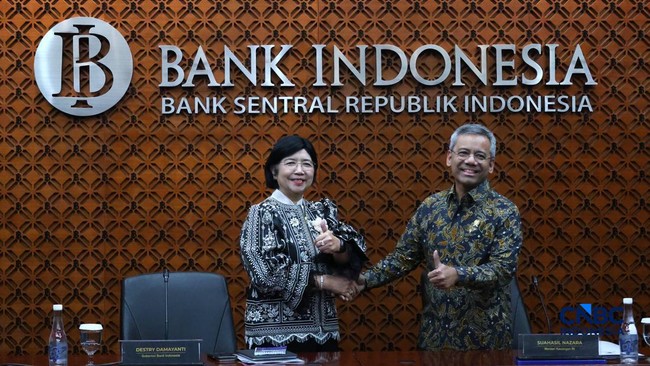
Bank Indonesia and the Ministry of Finance held a meeting aimed at coordinating and synergising monetary and fiscal policies. The meeting took place at the Bank Indonesia office in Jakarta on Thursday (24/09/2026).
Following the meeting, Bank Indonesia Governor Destry Damayanti noted that the discussions were intensive and lasted quite some time. Although the press conference was originally scheduled for 16:00 WIB, it only commenced around 17:26 WIB.
According to Destry, this meeting between the leaders of the fiscal and monetary authorities is a routine matter, particularly as both she and Finance Minister Suahasil Nazara have recently been inaugurated by the Head of State, making the context largely one of introductory diplomacy.
Nevertheless, Destry emphasised that the meeting also addressed several issues and the synergy required between both authorities to strengthen the Indonesian economy amidst significant global economic uncertainty.
“We discussed liquidity, strategies for issuing government securities, BI’s SRBI (Bank Indonesia Securities Rate), and several other issues,” stated Destumnayi.
Destry welcomed the arrival of Minister Suahasil, noting that beyond coordination between newly appointed leaders, the meeting strengthens cooperation between the government and the central bank, particularly regarding financial stability, as Suahasil serves as the Chairman of the Financial System Stability Committee (KSSK).
“As the Finance Minister acts as the coordinator and we are both members of the Financial Stability Committee, good cooperation and synergy will certainly be beneficial,” said Destry.
Bank Indonesia and the Ministry of Finance are maintaining synergy and coordination to sustain economic growth momentum through the optimisation of available fiscal and monetary policy instruments. In addition to strengthening cooperation to maintain domestic economic growth, Destry revealed that discussions also pertained to strengthening external resilience amidst global volatility, regarding both international trade and foreign capital flows.
“We discussed how international trade will inevitably have a larger connection involving the government as a whole, the real sector, and so on. To encourage foreign capital inflows, we are trying to synchronise our policies, including the incentives we provide for hedging costs, for foreign funds entering, and foreign investment entering our domestic market,” said Destry.
“We are also using underlyings for the purchase of SPN (Treasury Bills), including SRPI, as well as for stocks and foreign loans.”
The Finance Minister expressed his hope that coordination and synergy between the government and the central bank would continue, both in a bilateral context and within the KSSK.
Furthermore, liquidity in the money market, the banking sector, and the broader economy was discussed by Bank Indonesia and the government. This included discussions on interest rate structures, involving close coordination between the Ministry of Finance and Bank Indonesia.
Lastly, synergy was discussed to ensure inflation remains within the target range of 2.5% plus/minus 1% by monitoring inflation-driving factors.
“We also have regional offices, and with the government, we will monitor the situation to help reduce inflationary pressures in the regions,” explained Destry.
Finally, the focus remains on ensuring smooth policy transmission and expanding sources of economic growth.
Finance Minister Suahasil also expressed his appreciation for the meeting with Bank Indonesia and hoped that coordination and synergy would continue, both bilaterally between BI and the Ministry of Finance, and within the context of financial sector stability, which comprises Bank Indonesia, the Ministry of Finance, OJK (Financial Services Authority), and LPS (Deposit Insurance Corporation).
“We continue to seek synergy so that within our respective policy mandates, we can continue to grow the economy and protect our people,” said Suahasil.
He explained that such synergy is built through concrete policies, such as the management of the Budget Surplus (SAL) placed in state-owned banks (Himbara), which is conducted in a measured manner and through close coordination.
Additionally, the relationship between monetary policy, such as interest rates, serves as a fundamental consideration in formulating fiscal policies that impact the public economy.
Suahasil also noted the close relationship between the government and Bank Indonesia includes coordination to lower high deposit interest rates in the banking sector. This includes urging State-Owned Enterprises (BLU) not to pursue high interest rates when depositing funds in banks.
“Several of our State-Owned Enterprises have been directed not to merely chase high interest rates,” he asserted.
Finally, Suahasil touched upon coordination with Bank Indonesia regarding the strategy for issuing sovereign securities and treasury bills, which were discussed with BI as part of the budget financing design.
Source: jawawa.id (https://jawawa.id/newsitem/finance-minister-and-bi-governor-announce-key-coordination-efforts-1790257981)
Originally published by CNBC Indonesia (https://www.cnbcindonesia.com/news/20260924193829-4-770705/menkeu-dan-gubernur-bi-kompak-umumkan-kabar-penting-simak), translated from Indonesian