
Finance Leaders Exchange Views at Jogja Financial Festival
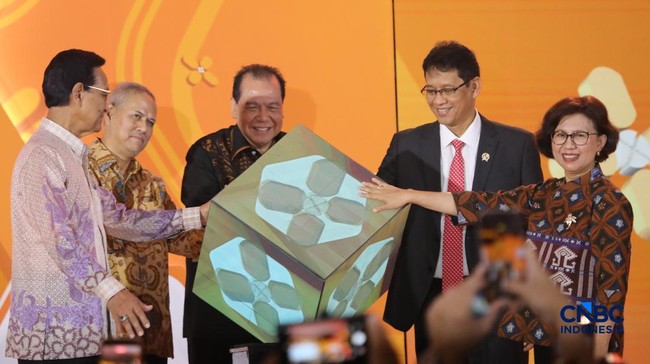
Finance Leaders Exchange Views at Jogja Financial Festival
Yogyakarta, CNBC Indonesia – The first day of Jogja Financial Festival (JFF) 2026 officially opened on Friday, 22 May 2026. A number of key players in the financial industry shared their views before participants of JFF 2026, consisting of pupils, students, and the general public.
Anggito Abimanyu, Chair of the Board of Commissioners of the Deposit Insurance Corporation (LPS), warned that the trend of increasing investment interest among young people must be balanced with strengthened financial literacy to prevent it from turning into mere speculation.
He noted that today a range of investment instruments are increasingly popular among young people, from stocks, retail bonds, fintech, crypto, to other digital assets.
“Today, portfolio investments such as stocks, retail bonds, fintech, crypto, and other digital assets are increasingly popular among the younger generation. Retail investment growth is rising every year, with a large share of youth, students and schoolchildren,” he said as he opened Jogja Financial Festival 2026, Friday, 22 May 2026.
According to him, this phenomenon is a positive signal for the development of the national financial industry. At the same time, he reminded that optimism without adequate understanding can trigger speculative behaviour.
Alongside this, the Rector of Gadjah Mada University (UGM), Professor Ova Emilia, appreciated the Jogja Financial Festival 2026. The event is deemed very important for UGM because participants will understand that financial literacy is not only about saving or investing. The risk factors of both activities must also be understood by everyone.
“Developments in digital technology, as mentioned by the chair of the LPS board, impact ease of access. But this ease must be balanced with risks, so understanding these risks is extremely necessary to avoid becoming vulnerable,” Ova said.
In the same vein, the Governor of the Special Region of Yogyakarta, Sri Sultan Hamengkubuwono X, also appreciated the Jogja Financial Festival 2026. In a fast-changing era, according to Sri Sultan, the bigger question is no longer just how to expand financial access.
“The more fundamental question is whether access makes people more empowered? Or does it make them more easily steered by consumer appetites, algorithms, and debt that comes with ease,” he said.
Therefore, Sri Sultan reminded everyone to stay mindful of the meaning of prosperity itself. For him, money and the financial system are important, but money must not rise to become the ultimate goal of all endeavour.
Indonesia’s Economic Condition
In the same event, Finance Minister Purbaya Yudhi Sadewa provided evidence that Indonesia’s economy is healthy, supported by strong purchasing power. The strength is reflected in key indicators, such as the consumer confidence index, kept in an expansive level of 123 in April 2026.
Moreover, car and motorcycle sales rose as activity returned to normal after Eid al-Fitr. Car sales grew 55% and motorcycles by 28.1%.
“That means a healthy economy, strong purchasing power,” Purbaya said.
In addition, Bank Indonesia Deputy Governor Aida S Budiman explained that the rupiah’s pressure to date is caused by the imbalance between demand and supply of the US dollar.
This issue, according to Aida, can be seen in Indonesia’s current account deficit as reflected in the current account balance, which again turned negative at the start of 2026. The deficit reached US$4 billion or 1.1% of GDP in Q1-2026, higher than Q4-2025 at 0.7% of GDP or US$2.5 billion.
“Our current transactions show a deficit; our net position is paying more than receiving, and that is the problem,” Aida emphasised.
To address this, Aida said the government and BI have several tools to increase domestic dollar supply to match demand, one of which is the presence of BUMN Export PT Danantara Sumberdaya Indonesia (PT DSI).
Meanwhile, Chair of the Board of Commissioners of the Financial Services Authority (OJK), Friderica Widyasari Dewi, disclosed that the majority of investors in Indonesia’s stock market today come from Generation Z (Gen Z).
“Did you know that among 27 million investors in the stock market, 54% are Gen Z? This is incredible. They are the young people under 30. This is contextual for you all,” she said.
According to Kiki, Gen Z is now colouring Indonesia’s financial sector. They are also the first generation to grow up in a digital world.
“This is extraordinary,” she said.
Furthermore, she urged Gen Z to be skilled at filtering information, because not all information circulating on social media is true.
“So your ability to sift and choose information will determine your future. Especially since some content is not good, not healthy, not educational; it should not be viewed or listened to,” she explained.
Additionally, the Executive Head of the Supervisory Innovation of the Financial Sector, Digital Financial Assets and Crypto Assets (ADK IAKD) at OJK, Adi Budiarso, stated that crypto assets continue to grow. In 2026, the number of crypto assets traded in Indonesia reached 1,464.
He also shared tips for selecting safe digital asset or crypto investment instruments in Indonesia. First, the public must check the licensing of the crypto asset on the Financial Services Authority (OJK) website.
“Which ones are licensed? The crypto asset providers are traders, the transactions occur on exchanges. The traders with licences currently number 25. Please choose those, and pick one of the 1,464. Check the history first.”