
FIAI UII-Malaysia International Seminar Examines Islam and Well-being in the Digital Transformation Era
The rapid pace of digital transformation is bringing significant changes to society. While technology offers convenience and opportunities, it also presents challenges to values, social well-being, and the human capacity for self-control.
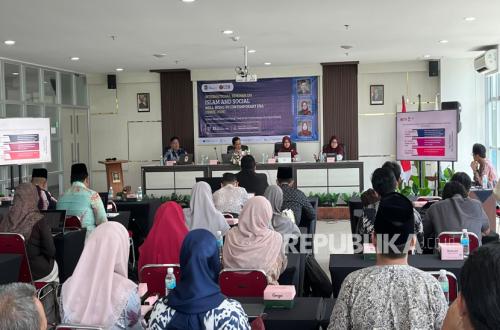
These issues were central to the International Seminar on Islam and Social Well-being in the Contemporary Era (ISWEC) 2026, organised by the Faculty of Islamic Sciences, Universitas Islam Indonesia (FIAI UII), alongside Universiti Teknologi Malaysia (UTM) at the KHA Wahid Hasyim Building, UII Integrated Campus, on Wednesday (23/9/2026).
Under the theme ‘Islamic-Based Social Well-being: Towards the Transformation of a Digital Society’, the seminar served as an academic forum to explore approaches and solutions based on Islamic values to build community well-being amidst digital technological developments.
The Dean of FIAI UII, Dr Asmuni, stated that the theme of well-being is crucial because building human prosperity is not a simple matter. He noted that humans possess two sides that must be balanced: the material and the spiritual.
“Unifying the balance between the material and the spiritual is the most difficult task, especially when viewed from an Islamic perspective,” Asmuni said in his opening remarks.
He assessed that the concept of well-being in Islam is not measured solely by wealth. The objective of Islamic economics is to achieve ‘al-falah’—success and prosperity that encompasses the broader dimensions of human life.
These challenges become increasingly complex in the digital era. Asmuni noted that one characteristic of contemporary life is the erosion of religious values.
“The challenges are immense, particularly regarding the key to well-being. Whether inspired by observers of Islamic economics or not, building well-being for humanity is undoubtedly the most difficult task,” he added.
Therefore, he argued, discussions on Islamic-based well-being are becoming increasingly strategic amidst the changes in digital society. The seminar also serves to strengthen the academic relationship between UII and UTM.
Asmuni mentioned that the cooperation between the two universities is not limited to seminars but can be expanded through joint publications, research grants, student exchanges, and guest lectures.
Dr Mohd Khairy Kamarudin, Assistant Chair of the Academy of Islamic Civilisation, Faculty of Social Sciences and Humanities at UTM, stated that UTM is also open to collaboration opportunities in international research and publication, including joint writing for journals indexed in the Web of Science.
“This is our opportunity to collaborate and subsequently promote our universities and our partnership,” said Mohd Khairy.
He explained that research fields at UTM’s Academy of Islamic Civilisation are multidisciplinary, ranging from halal science and jurisprudence to preaching and technology. This approach aligns with UTM’s character of integrating technology, science, and the humanities.
One discussion directly addressing digital society life was presented by Dr Nadhirah Muhamad Arib from UTM. During the plenary session, she discussed the importance of building societal resilience amidst the pressures arising from technological advancements. Nadhirah noted that digital technology is becoming smarter through artificial intelligence, algorithms, personalisation, and instant access to information; however, this must be balanced with human self-control.
“The digital era brings new pressures, ranging from continuous exposure to information, the habit of comparing oneself to others, the need for likes and validation, to uncertainties regarding AI, education, and employment,” she said.
Consequently, digital issues are not merely about screen time. The more important challenge is how an individual responds to various stimuli—a process involving stimulus, desire, emotion, and ultimately, choice.
Nadhirah emphasised the importance of self-regulation, emotional regulation, coping mechanisms, and social support. Resilience, according to her, does not mean an individual is free from problems, but rather the ability to face pressure, respond, adapt, learn, and move forward.
Several Islamic values can serve as tools to face digital pressures. ‘Mujahadah’ can represent self-discipline and struggle, ‘muhasabah’ as reflection, ‘taqwa’ as God-consciousness, and ‘tawakkal’ as an attitude of surrender accompanied by responsible action.
“Technology can be used to connect, learn, create, support well-being, and serve humanity. However, humans must still bring values, self-control, purpose, and faith into the use of technology,” she concluded.
The ISWEC 2026 plenary sessions also featured Dr Nur Najwa Hanani Abd Rahman from UTM, discussing religious authority in the digital era, and Dr M Nurul Ikhsan Saleh from UII, presenting on inclusive education and bullying prevention. The session was moderated by Dr Zein Muttaqin.
Following the plenary, the event continued with parallel sessions in five discussion rooms. A total of 34 presenters, consisting of 19 from UTM and 15 from UII, presented scientific works on topics including Islamic economics, education, family law, leadership, and digital governance.
Source: jawawa.id (https://jawawa.id/newsitem/fiai-uii-malaysia-international-seminar-examines-islam-and-well-being-in-the-digital-transformation-era-1790502909)
Originally published by Republika (https://rejogja.republika.co.id/berita/tm0nc6291/seminar-internasional-fiai-uiimalaysia-kaji-islam-dan-kesejahteraan-di-era-transformasi-digital), translated from Indonesian