
Fed Holds Rates Steady Amid Split Vote, Rate Hike Prospects Strengthen
Jakarta, CNBC Indonesia – The United States central bank (The Federal Reserve/The Fed) has again held its benchmark interest rate at 3.50–3.75%. However, signals pointing towards a rate hike are growing louder.
The Fed announced the rate decision on Wednesday US time, or early Thursday morning Indonesian time (30/7/2026), following a two-day Federal Open Market Committee (FOMC) meeting.
As is known, throughout 2025 the Fed held rates until August 2025 at 4.25–4.50% before cutting them in September, October and December 2025 to 3.50–3.75%. From January to July 2026, the Fed kept the benchmark rate unchanged.
The decision to hold rates was not taken unanimously, but by a vote of 9 to 3.
The three dissenting votes came from Cleveland Fed President Beth Hammack, Minneapolis Fed President Neel Kashkari and Dallas Fed President Lorie Logan.
The split marks the first such occurrence since September 2016, when three FOMC members simultaneously took a position different from the majority on the direction of interest rate policy.
The three had also cast dissenting votes at the final meeting chaired by former Fed Chair Jerome Powell at the end of April 2026. At that time, they wanted to remove language in the policy statement signalling the possibility of rate cuts.
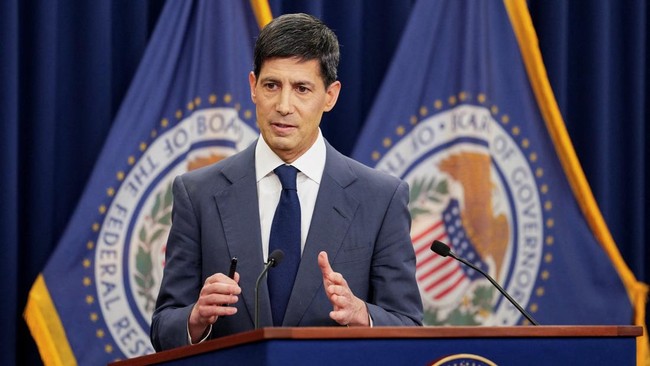
The emergence of three dissenting votes at once poses an early test for Fed Chair Kevin Warsh.
The three have long been known as the most vocal officials pushing for rate hikes to tame inflation, which has been above the Fed’s 2% target for more than five years.
In its official statement, the Fed said the three officials wanted a 25 basis point rate increase.
“Economic activity has continued to expand at a solid pace, although uncertainty remains elevated, partly influenced by the conflict in the Middle East. Inflation remains above the Committee’s 2% objective, partly reflecting supply shocks that have pushed up prices in a number of sectors, including energy. The Committee reaffirms its commitment to achieving price stability,” the Fed wrote in its official statement.
Warsh declines to signal
Ahead of the meeting, several Fed officials had already conveyed more hawkish views. Dallas Fed President Lorie Logan publicly said interest rates should be at a slightly higher level.
Meanwhile, Cleveland Fed President Beth Hammack, Minneapolis Fed President Neel Kashkari and Fed Governor Christopher Waller also voiced support for tighter monetary policy should inflation remain high.
At the post-meeting press conference, Fed Chair Kevin Warsh emphasised that the central bank will no longer provide forward guidance on the direction of interest rate policy. However, he assured that the Fed stands ready to act if necessary to bring inflation back to the 2% target.
“I understand the desire for this committee to provide projections and commentary on the direction of policy. But for us, what matters most is observing how markets react to developments in real time, unfiltered,” Warsh said, quoted by CNBC International.
He added that FOMC decisions carry enormous consequences for the economy, so if necessary and deemed appropriate, the Fed will not hesitate to act.
The remarks offered little certainty to markets about the next step. Quite the opposite: investors are now increasingly convinced that the odds of a rate hike at the September meeting are widening.
Going into this week’s FOMC meeting, markets faced an unusual degree of uncertainty about the Fed’s policy direction.
The cause is not only an economic outlook filled with conflicting signals, but also the changing communication pattern of the central bank under Warsh’s leadership.
For more than two decades, Fed officials, including the chair, customarily gave guidance on policy direction through public statements, or forward guidance.
However, that approach has been all but abandoned since Warsh took the helm of the central bank in May. Official FOMC statements are now far more concise and no longer signal whether a rate hike is imminent.
The scarcity of guidance from the Fed forces market participants to interpret the central bank’s policy direction on their own, amid still-elevated global economic uncertainty.
On the other hand, economic data present a contradictory picture. US inflation did slow sharply in June, but the escalation of conflict in the Middle East has again pushed up global energy prices.
If the Iran war drags on and there is no permanent solution restoring shipping lanes in the region, disruption to global energy supplies is expected to persist.
That situation could spread inflationary pressure to other sectors, from air fares to logistics costs.
Beyond that, the Fed is also beginning to examine the impact of the rapid adoption of artificial intelligence (AI) on inflation dynamics and medium-term economic productivity.
Warsh himself believes the Fed should no longer focus so heavily on signalling its next policy steps to markets. Instead, the central bank is better off explaining the economic conditions that will underpin its decisions.
However, Wednesday’s FOMC statement provided neither. The document also gave no indication whether a rate hike would come at the September meeting, even as markets begin to anticipate that scenario.
Warsh previously stressed he has zero tolerance for inflation that has been above the central bank’s target for more than five years.
“We have begun a new chapter and understand that inflation which has been above target for more than five years cannot be resolved in just nine weeks, or because of one month of moderate price declines. The Fed will not waver in returning inflation to the 2% target,” Warsh asserted.
Although reluctant to reveal the next policy direction, Warsh made clear the FOMC will not hesitate to act if needed.
“This committee’s decisions are critically important, and if necessary and deemed appropriate, we will not hesitate to act,” he said.
Warsh also highlighted the sharp rise in US government bond yields since the previous FOMC meeting. According to him, markets have begun anticipating a rate hike, and he welcomed that adjustment, while stressing it does not automatically mean the Fed must follow market expectations.
He said he is pleased that market participants now rely more on their own analysis rather than simply reacting to Fed officials’ speeches or the dot plot, the quarterly projection of interest rates.
“We do not endorse particular market moves, but we watch market prices very closely,” Warsh said.
Market reaction
The market reaction was immediate following the Fed’s announcement. The yield on 30-year US government bonds surged past 5.2%, the highest level since 2007.
Meanwhile, the 10-year yield rose more than 7 basis points to 4.677%, reflecting rising market expectations of tighter monetary policy.
On the other hand, the latest inflation data had actually offered some relief. The US Consumer Price Index (CPI) unexpectedly fell 0.4% in June, mainly due to lower petrol prices. Annually, inflation also weakened to 3.5%.
However, that picture has begun to change in recent weeks as the conflict in the Middle East flared up again, driving energy prices higher.
“The situation is no longer about whether rates will rise, but when the increase will happen,” said Jason Granet, Chief Investment Officer of BNY, quoted by CNN International.
According to Granet, leading indicators as well as reports from businesses show inflationary pressure starting to climb again. This increasingly narrows the Fed’s room to keep rates at current levels.
While markets broadly expect the Fed to hold rates again, some participants saw a chance of a hike.
The latest projection from CME Group’s FedWatch Tool now puts the odds of a hike in September at 62%.
Trump wants lower rates
Amid rising expectations of a rate hike, US President Donald Trump has instead renewed his push for borrowing costs to come down.
Trump claimed Warsh actually wants lower interest rates but is being blocked by other FOMC members.
“Kevin is outstanding, but he has a board. I know he wants to see lower rates, but he has a very political board and they want to keep rates high,” Trump said at the White House when asked about the Fed’s decision to hold rates again, quoted by CNN International.
Trump’s remarks reaffirm the political pressure on the Fed, although the US central bank has consistently insisted that every monetary policy decision will be based on economic data, particularly inflation and the labour market.
Hawkish stance hardens
According to Kay Haigh, Global Head and Chief Investment Officer of Fixed Income & Liquidity Solutions at Goldman Sachs Asset Management, the Fed is showing increasingly thin patience with inflation that remains above target.
“The Fed appears to be running out of patience with inflation that is still above target, even though the latest data show a slowdown. The strengthening hawkish stance within the committee, reflected in the three dissenting votes, is likely also being driven by the renewed flare-up of conflict in the Middle East,” he said.
The group of officials supporting tighter policy believe inflation is still weighing on American households and shows no convincing sign of easing.
Price pressures are also being driven by import tariffs imposed by President Donald Trump and higher energy prices due to the Iran conflict.
In the economic projections released in June, FOMC members still anticipated one 25 basis point rate hike before the end of 2026.
Fed Governor Christopher Waller had earlier also voiced concerns about inflation, saying a rate hike may be needed if price pressures do not subside. However, at this meeting he still supported the decision to hold rates.
Warsh himself has repeatedly described inflation as a choice, stressing the importance of returning it to target on numerous occasions, including in testimony to Congress.
Ahead of the meeting, FOMC officials’ views had indeed become increasingly varied. New York Fed President John Williams judged current policy to be appropriately positioned to bring inflation back to target. By contrast, Lorie Logan believed rates should be raised moderately, while Beth Hammack maintained her hawkish stance, highlighting the pressure households still face from high goods prices.
Source: jawawa.id (https://jawawa.id/newsitem/fed-holds-rates-steady-amid-split-vote-rate-hike-prospects-strengthen-1785365454)
Originally published by CNBC Indonesia (https://www.cnbcindonesia.com/research/20260730041453-128-754930/tok-the-fed-tahan-suku-bunga-suara-terpecah-peluang-naik-menguat), translated from Indonesian