
Fed Holds Interest Rates as Government Bond Yields Surge: Are the JCI and Rupiah Safe?
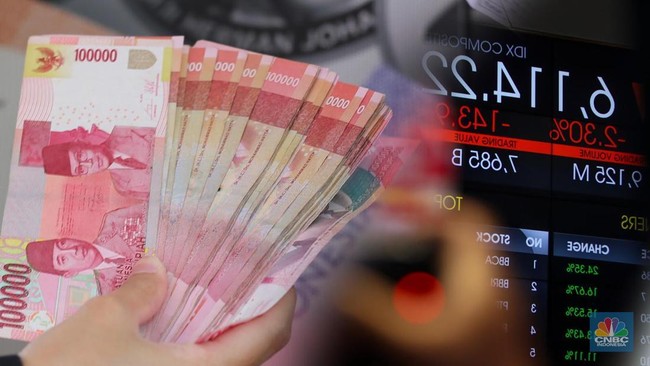
Indonesia’s financial markets ended mixed on Wednesday (28 October 2026). The stock market rebounded from its slump, while the rupiah and government bond prices fell.
Indonesia’s financial markets are expected to rise in unison today. Further details of the outlook and market sentiment are on page three of this article.
The Jakarta Composite Index (JCI) reversed course and closed higher on Wednesday (28 October 2026), after coming under heavy pressure in the morning session.
The JCI gained 16.18 points, or 0.31%, to 5,282.31. It opened at 5,249.07 and briefly fell to around 5,170 before recovering in the afternoon session.
A total of 272 stocks rose, 406 fell and 112 were unchanged.
Trading value reached Rp15.9 trillion, with 32.2 billion shares changing hands. Foreign investors ended the session as net buyers, with net purchases of Rp664.24 billion.
The index’s gains were supported by shares in PT Bank Central Asia Tbk (BBCA), PT Astra International Tbk (ASII), PT Amman Mineral Internasional Tbk (AMMN), PT Merdeka Copper Gold Tbk (MDKA) and PT Bank Rakyat Indonesia (Persero) Tbk (BBRI).
Meanwhile, PT Telkom Indonesia (Persero) Tbk (TLKM), PT Barito Pacific Tbk (BRPT), PT Barito Renewables Energy Tbk (BREN), PT Dian Swastatika Sentosa Tbk (DSSA) and PT Mora Telematika Indonesia Tbk (MORA) weighed on the index.
Market participants focused on three main factors: the US Federal Reserve’s interest-rate decision, weak demand at a government bond auction and growth in Chinese industrial profits.
The rupiah closed lower again on Wednesday (28 October 2026), as the market awaited the US Federal Reserve’s interest-rate decision.
According to Refinitiv data, the rupiah closed 0.17% weaker at Rp18,175 per US dollar, a record closing low that surpassed the previous record of Rp18,170 per US dollar set on 8 June 2026.
The pressure was evident from the start of trading, when the currency opened 0.04% lower at Rp18,152 per US dollar. Its losses then widened, leaving it 23 points below its opening level.
At 3pm Western Indonesian Time, the US Dollar Index (DXY), which measures the greenback against six major currencies, was up 0.14% at 102.461.
Bank Indonesia’s Head of Monetary and Securities Asset Management Erwin Gunawan Hutapea said the rupiah was under pressure amid worsening sentiment in global financial markets.
“The rupiah and regional currencies are still being affected today by uncertainty over the resolution of the Middle East conflict,” Erwin said on Wednesday (28 October 2026).
High oil prices have increased fiscal risks and strengthened expectations of US interest-rate rises. At the same time, risk aversion has prompted investors to shift into safer assets, bolstering the US dollar and triggering capital outflows from emerging markets.
Domestically, concerns about a possible downgrade of the Indonesian stock market’s classification by MSCI, as well as increased foreign-currency demand towards the end of the month, have also weighed on the rupiah.
To ease the pressure, Bank Indonesia intervened in the NDF, DNDF and spot markets, and bought government securities in the secondary market. It also stepped up coordination with companies and market participants to help stabilise the exchange rate.
Government bond yields surge
In the bond market, the yield on 10-year Indonesian government securities surged to 7.706% on Wednesday, its highest level since 19 May 2020, more than six years ago.
The sharp rise in yields indicates that bond prices have fallen as investors sell them.
The yield surge coincided with lower foreign investor demand at the auction.
Data from the 27 October 2026 auction showed total bids of just Rp31.09 trillion.
That was a fall of about 52.1% from the previous auction on 13 October 2026, when bids totalled Rp64.85 trillion.
US stocks closed higher on Wednesday (28 October 2026), or early Thursday in Indonesia.
Investors responded to the Federal Reserve’s interest-rate decision and awaited earnings reports from large-cap technology companies.
The S&P 500 rose 0.28% to 7,743.98, while the Nasdaq Composite gained 0.27% to 26,549.85. The Dow Jones Industrial Average advanced 97.53 points, or 0.19%, to 52,475.10. All three indices have now risen for three consecutive days.
The Fed kept its benchmark rate at 3.75%–4.00%, in line with market expectations. The US central bank had raised rates by 25 basis points in September, its first increase since 2023.
Fed Chair Kevin Warsh said the central bank remained focused on price stability and that labour-market conditions continued to show positive developments.
Jeff Schulze, head of investment strategy at the Franklin Templeton Institute, said the decision did not rule out a 25-basis-point increase before the end of the year. Markets are now watching how soon the Fed might continue tightening monetary policy.
Technology shares provide support
Technology stocks were in focus after Oracle shares jumped nearly 11%. The software company forecast fiscal 2030 revenue of US$225 billion, implying annual growth of 35%.
Semiconductor shares also rose after SK Hynix reported its highest quarterly profit on record.
SK Hynix shares in the US surged 13%, while Micron Technology gained nearly 6%. Arm Holdings rose 4%, and Marvell Technology and Advanced Micro Devices each climbed 3%.
Investors are now awaiting earnings reports from Alphabet and Microsoft, due after the market closes.
However, artificial-intelligence-related technology shares have faced pressure in recent weeks amid concerns about how AI investment is being funded and whether the substantial spending will generate lasting returns.
Bill Northey of U.S. Bank Asset Management Group said the technology business cycle remained strong in the short term. But the key question for investors is whether that growth can last for years, and which companies will be able to profit from heavy investment in AI.
Pressure on Indonesia’s financial markets is expected to ease today after the Fed held interest rates.
However, the release of US PCE inflation data and developments in the war could affect stocks and the rupiah. The surge in government bond yields will also remain in focus.
Here are some of the key factors for today:
1. Fed holds interest rates
The Federal Reserve kept its benchmark rate at 3.75%–4.00%, but the decision on Thursday (29 October 2026) was not unanimous. Two officials, Lisa Cook and Beth Hammack, supported a 25-basis-point increase.
The Fed said inflation remained high and left the door open to further rate adjustments. Chair Kevin Warsh declined to signal the direction of future policy, saying the central bank was still working to bring inflation back to its 2% target.
Warsh also said the US economy was strengthening, with first-half 2026 growth revised up to 2.4%. However, high interest rates continue to raise borrowing costs and affect investment, including the construction of artificial-intelligence infrastructure.
Markets put the probability of a rate rise in December at about 80%. The yield on 10-year US Treasuries rose to 5.042% after the decision was announced.
At a press conference, Warsh gave no indication of the direction of monetary policy. He acknowledged, however, that the central bank had yet to achieve price stability.
“We are working on it,” Warsh was quoted as saying by Reuters.
Warsh, who took over as Fed chair in May, added that he did not want to prejudge the outcome of the next meeting.
“A lot can happen. So I can’t share my thinking about what’s going to happen when this group gets back together six weeks from now,” he said.
2. Indonesia Stock Exchange cuts 2026 IPO target to 15 companies
The Indonesia Stock Exchange (IDX) has cut its target for initial public offerings (IPOs) to 15 companies in 2026, down from 50.
IDX President Director Jeffrey Hendrik said market challenges remained, but opportunities for IPOs were still available. For 2027, the exchange is targeting 25 listings.
Potential candidates include companies involved in manufacturing investment and industrial estate development, as well as corporate restructuring within Danantara. The IDX hopes these initiatives will add more listed companies despite challenging market conditions.
3. Danantara in due diligence to become an IDX shareholder
The IDX said Danantara Indonesia had submitted an offer to become a new shareholder as part of the exchange’s demutualisation process. The proposal is now undergoing due diligence.
Jeffrey Hendrik said Danantara was the only party to have submitted an offer so far. The Finance Ministry and Bank Indonesia have not made similar proposals.
Jeffrey did not disclose the value of Danantara’s offer, as discussions are ongoing.
The IDX will next hold a follow-up extraordinary general meeting of shareholders to discuss issuing new shares through a rights issue as part of the demutualisation process.
4. Danantara plans to cut the number of state-owned firms to fewer than 200
The Daya Anagata Nusantara Investment Management Agency (BPI Danantara) aims to reduce the number of state-owned enterprise (SOE) entities from 1,074 to fewer than 200, in a major streamlining drive intended to improve efficiency, financial performance and governance.
Danantara Chief Operating Officer Dony Oskaria said the restructuring would involve consolidation, mergers, divestments and the liquidation of companies deemed no longer necessary.
By October 2026, about 364 entities had been streamlined. The move is beginning to show in financial performance: consolidated SOE net profit reached Rp214.9 trillion in January–August 2026, up 18.4% from the same period last year.
Danantara plans to continue the transformation through 2030, including strengthening human resources, digitalisation, expanding access to funding through IPOs and bonds, and creating companies that meet global standards.
5. Tax administrative penalties reduced
The Directorate General of Taxes at the Finance Ministry is offering reductions of up to 100% on administrative tax penalties for taxpayers who meet the requirements. The reduction depends on the type of penalty and the reporting or payment period.
Meidijati, head of the directorate’s Tax Procedures and Taxpayer Voluntary Disclosure Programme regulations sub-directorate, said a 100% reduction in penalties for late tax returns and payments would apply to underpaid annual tax returns and/or monthly returns for September 2026 if settled between 8 October and 31 December 2026.
If payment or filing takes place between 1 January and 31 March 2027, the penalty reduction will be 50%. For the period from 1 April to 30 June 2027, the reduction will be 25%.
For penalties related to the Voluntary Disclosure Programme, reductions of up to 100% may be granted if the principal tax is paid no later than one month after the tax authority issues an underpayment assessment, in line with applicable rules.
“To get a 100% reduction, the principal tax must be paid no later than one month after the underpayment tax assessment is issued,” Meidijati said at a briefing on Wednesday (28 October 2026).
The tax authority also provides for reduced penalties when payment is made more than one month, but no later than two months, after the assessment is issued. Taxpayers should therefore pay attention to the deadlines to receive the applicable reduction.
6. US PCE inflation for September 2026
The US will release September Personal Consumption Expenditures (PCE) inflation data today, Thursday (29 October), at 7.30pm Western Indonesian Time.
In August 2026, PCE inflation was 3.4% year on year, while core inflation was 3.0%.
Core PCE inflation, which excludes food and energy, is expected to rise by 0.3% month on month in September, up from 0.2% in August. On an annual basis, core inflation is projected to increase to 3.1% from 3.0%.
The data matter because PCE is one of the key inflation indicators the Fed uses to set monetary policy.
The release comes after the Fed’s decision, so it is more likely to shape expectations for the next meeting than affect the decision already announced. A reading above consensus could sustain concerns about persistent inflation and limit hopes of monetary easing.
Conversely, a lower figure could give markets room to conclude that price pressures are easing, although that would need to be confirmed over several months.
7. US unemployment claims
The US will also release unemployment claims data for the week ending 24 October 2026.
Initial jobless claims fell by 6,000 to 194,000 in the week ending 17 October 2026, their lowest level since mid-July and below the market forecast of 200,000, according to the US Department of Labour.
The decline suggests the labour market remains solid despite economic uncertainty. Strong corporate profits and resilient domestic demand are helping to limit a wave of layoffs.
However, expensive energy amid the US-Israel war with Iran, uncertainty over Federal Reserve policy and trade measures are weighing on companies’ hiring decisions.
8. ECB interest-rate decision for October 2026
The European Central Bank (ECB) will announce its decision today at 8.15pm Western Indonesian Time, followed by a press conference at 8.45pm. The consensus forecast is for the main refinancing rate to remain at 2.65% and the deposit facility rate at 2.50%.
Attention is focused on the ECB’s response to inflation risks and slowing growth. Any decision to hold rates needs to be considered alongside the bank’s communications, particularly its assessment of possible further tightening and energy-cost pressures.
For global markets, a change in the ECB’s tone could affect the euro, European bonds and the dollar’s relative movements. As the announcement is close to the release of major US data, investors will need to assess the combination of developments rather than either one in isolation.
Today’s economic events include:
A closed-door discussion with the Minister of Agriculture at the minister’s residence in South Jakarta.
The national leadership meeting of the Indonesian Chamber of Commerce and Industry at the Flores Ballroom, Hotel Borobudur, Central Jakarta, with the President among those expected to attend.
Minerba ConvEx 2026 at the Soemantri Brodjonegoro Building in Kuningan, South Jakarta.
HSBC Redefining Treasury Asia Pacific: Voices of Treasury 2026 at HSBC Indonesia’s office in South Jakarta.
The PPDP Sustainability Forum 2026 at CGV Mall Grand Indonesia, Central Jakarta, attended by the OJK’s Chief Executive for Insurance, Pension Funds and Guarantee Institutions.
The ECB announces its interest-rate policy.
The US releases September 2026 PCE data.
The US releases unemployment claims data for the week ending 24 October 2026.
Today’s corporate events include annual general meetings of PT Indofarma Tbk, PT Victoria Care Indonesia Tbk, PT Borneo Olah Sarana Sukses Tbk and PT Bank Neo Commerce Tbk.
Source: jawawa.id (https://jawawa.id/newsitem/fed-holds-interest-rates-as-government-bond-yields-surge-are-the-jci-and-rupiah-safe-1793231472)
Originally published by CNBC Indonesia (https://www.cnbcindonesia.com/research/20261029051052-128-780393/the-fed-tahan-suku-bunga-yield-sbn-terus-melonjak-ihsg-rupiah-aman), translated from Indonesian