
Fed Chief Surprises Market, US Interest Rates Could Rise
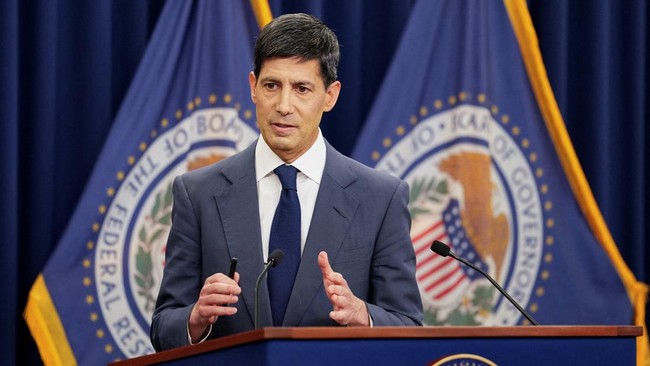
Federal Reserve Chairman Kevin Warsh surprised markets with a signal that the US central bank still views inflation risks as a serious problem. The statement immediately pushed up US Treasury yields, particularly on short-term tenors, while weighing on the stock market.
Citing The Wall Street Journal, Warsh said the Fed may still need to “try harder” to control inflation. The statement prompted markets to reassess the possibility of a rate hike at the Fed’s upcoming September meeting.
According to CME Group data, interest rate futures now reflect a roughly 58% chance that the Fed will raise rates at its next meeting. That figure jumped from around 35% on Thursday (27/8/2026).
The signal also eased concerns that Warsh would be reluctant to raise rates due to pressure from President Donald Trump. Those concerns had previously contributed to a rise in long-term Treasury yields, which serve as a benchmark for borrowing costs across the US economy.
However, some investors believe Warsh’s remarks have put the Fed in a difficult position. Markets could now pressure the central bank to raise rates in September, even if economic conditions do not necessarily warrant such a move.
“You have essentially signalled to the market that the Fed is more or less going to raise rates. I am just not convinced that when the data comes in, that will happen,” said George Catrambone, Head of Americas Fixed Income at DWS, as quoted by the WSJ on Saturday (29/8/2026).
According to Catrambone, a rate hike could weigh on the economy at a time when consumers are beginning to show signs of weakness. Conversely, if the Fed does not raise rates, the long-term bond market risks another sell-off as investors question Warsh’s credibility in controlling inflation.
Stock Market Relatively Calm
Despite the surprise, the stock market’s response to Warsh’s remarks was relatively limited. The Dow Jones Industrial Average fell less than 0.1%, the S&P 500 slipped 0.2%, while the Nasdaq Composite declined 0.5%.
The moves were far more moderate than the market reaction after Warsh’s two previous appearances as Fed chairman, namely at press conferences following the June and July meetings.
In June, Warsh surprised investors by revealing his concerns about inflation. A month later, markets were unsettled after several of his statements raised questions about his willingness to translate those concerns into monetary policy.
While the stock market has still recorded gains in recent months, turbulence has been more pronounced in the bond market. After the Fed’s July meeting, the 30-year Treasury yield briefly breached 5.3%, its highest level since 2007.
That prompted the US Treasury Department last week to announce plans to at least double its purchases of long-term government bonds through a buyback programme.
Treasury Secretary Scott Bessent said the programme is aimed at suppressing long-term bond yields, which he argued do not reflect US economic fundamentals.
The move appears to be having an impact. The 30-year Treasury yield closed at 5.207% on Friday (28/8/2026), down from 5.266% on Wednesday before the buyback announcement.
However, the 10-year Treasury yield rose to 4.721%, compared with 4.671% on Thursday and 4.682% before the buyback announcement.
Bond yields move inversely to bond prices and reflect market expectations for the Fed’s interest rate path. Rate hikes typically push short-term yields higher more quickly, while over the longer term, higher rates can also curb inflation and reduce the need for more aggressive rate increases in the future.
Market Still Guessing the Fed’s Direction
Pressure was also visible in economically sensitive stocks. The Russell 2000 index fell 1.4%, while the S&P 500 industrials sector weakened 1%.
Alphastar Capital Management Chief Investment Officer Tony Parish said Warsh is still leaving the direction of monetary policy open.
“Warsh left a lot in uncertainty. If there is a change in certainty, it leans towards the possibility of a rate hike that the market does not like,” Parish said.
Meanwhile, equity investors have so far largely ignored the bond market turmoil and focused more on a strong earnings season. Stocks also received a boost after Nvidia’s performance eased concerns about demand for artificial intelligence chips.
The S&P 500 is now only about 1% below its all-time high.
However, September has historically been one of the more volatile months for the stock market. With the next Fed meeting scheduled for 16 September 2026, investors are still awaiting further economic data to gauge the direction of interest rate policy.
LPL Financial Chief Macro Strategist Kristian Kerr said Warsh’s remarks have not provided certainty about the Fed’s decision.
“There is still an element of trying to understand (Warsh). That will continue for a while,” Kerr said.