
Fear and Greed are Destructive Engines
There are some songs that end when the music stops. But there are also songs that begin to speak after the final note has faded. Queen’s ‘Las Palabras de Amor’ is one of them. Written by Brian May and recorded for the 1982 album Hot Space, it sounds like a love song on the surface.
There is longing, distance, cold nights, and words of love that wish to be heard. Yet, amidst that tenderness, there is a much larger observation about the world: humans live amidst fear and greed.
Those two simple words—fear and greed—can be read as two old engines that continuously drive human history. Fear makes humans see others as threats. Greed makes humans see others, and even nature, as objects to be exploited. When both meet, humanity begins to lose its brakes.
Fear is essentially a survival mechanism. In certain amounts, it is useful. Fear makes humans alert to danger. The problem arises when fear becomes a permanent way of viewing the world. We begin to fear losing power. Fearing the loss of wealth. Fearing different groups, even criticism. Fear is then produced into politics.
A fearful society is easier to direct. They can be convinced that there is always an ‘enemy’ to be suspected, monitored, or removed. On the other hand, greed operates with a different logic but produces similar destruction.
If fear says, ‘I must protect what I have,’ greed says, ‘I must have more.’ More land, more minerals, more timber, more energy, more profit.
There is nothing wrong with economic progress or reasonable profit. The problem arises when profit is separated from moral, social, and ecological responsibility. At that point, the economy transforms into an extraction engine.
Look at what happens when greed enters the landscape. Forests are no longer viewed as ecosystems, but as timber reserves. Mountains are no longer seen as life-support systems, but as mineral deposits. Rivers are no longer viewed as ecological arteries, but as disposal channels or industrial water sources. The sea is no longer treated as a living space, but as a warehouse of resources that seemingly never runs out.
Mining is the easiest example to read. Mining itself is not a sin. Civilisation requires minerals. The energy transition also requires various mining materials. The issue is how humans extract them and who bears the cost.
When a mountain is excavated recklessly, the economic profit can be calculated in rupiah and dollars. But how do we calculate the loss of a spring? How do we calculate river sedimentation? How do we calculate the loss of habitat? How do we calculate the suffering of communities losing their living space? In financial reports, ecological damage often appears as an ‘externality’. For the communities living there, it is not an externality. It is their lives.
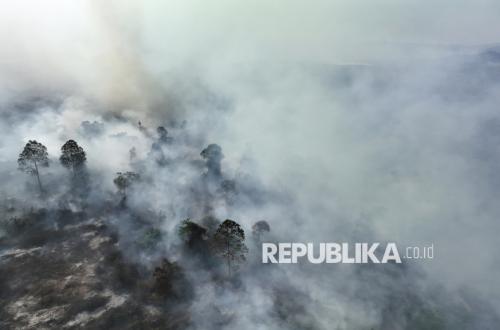
Forest fires show an even more horrific face. Fire in nature is part of certain ecological dynamics. But forest fires used intentionally to clear land is another matter. When forests are burned to accelerate land conversion, it is not just trees that burn. It is habitat. It is biodiversity that is lost. It is the water cycle that is disrupted. What emerges is smoke that crosses administrative and even national borders. Children inhale air they did not choose. Communities lose productivity. Schools are disrupted. Health declines. The local economy also bears the losses.
This is where greed shows its most dangerous nature: it takes profits privately but shares the losses with the public. Profit is privatised. Damage is socialised. This is one of the most tangible forms of ecological injustice. However, there is something deeper. Environmental damage is ultimately damage to humans, because humans are not creatures living outside the ecosystem. We drink from rivers. We eat from the soil. We breathe through the atmosphere.
We depend on forests to regulate water and climate. We need the sea for food and life. In other words, when humans destroy ecosystems, they are actually destroying the very infrastructure of life that sustains them. Ecological greed is ultimately a form of slow-motion civilizational suicide.
This is where ‘Las Palabras de Amor’ gains much broader relevance. If fear and greed are destructive engines, then love should be the balancing force. But love must not stop at mere words. We need what can be called ‘works of love’.
Loving the forest means not burning it. Loving the river means not making it a dumping ground. Loving the community means not sacrificing their health for short-term profit. Loving future generations means not bequeathing a broken earth. In other words, love for humanity cannot be separated from love for the human living space.
At this point, we also need to be careful not to oversimplify the issue as ‘evil corporations versus good society’. The problem is more complex. We need industry. We need energy. We need minerals. We need jobs and economic growth. But the question is: Growth for what? And growth at whose cost?
Source: jawawa.id (https://jawawa.id/newsitem/fear-and-greed-are-destructive-engines-1789719994)
Originally published by Republika (https://analisis.republika.co.id/berita/tljmdc393/ketakutan-dan-ketamakan-itu-mesin-penghancur), translated from Indonesian