
Farmers Suddenly Demand Government Audit of Business Actors
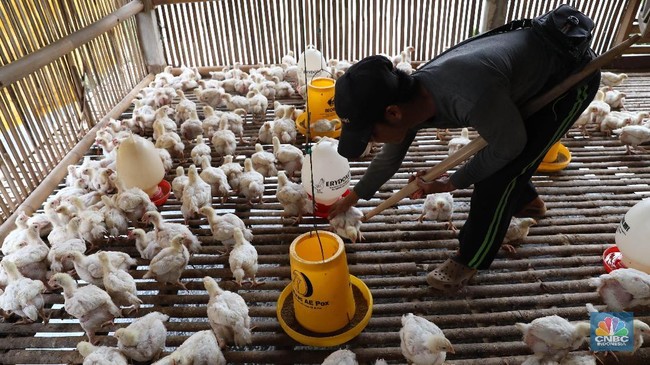
Jakarta, CNBC Indonesia - The Indonesian Independent Smallholder Poultry Farmers Association (Permindo) has requested that the government refrain from rushing to suppress chicken prices at the farmer level, following the high prices of broiler meat paid by consumers.
The General Chairman of Permindo, Kusnan, believes that the issue of chicken prices in the market needs to be viewed comprehensively. This is because the price of Live Bird (LB), or live chickens, at the farmer level is currently around Rp2’5,000 per kg, while the carcass price paid by consumers in several markets reaches Rp38,000–Rp40,000 per kg or even higher.
Consequently, there is a significant price difference after the chickens leave the farm. Kusnan has asked the government to trace the price formation throughout the supply chain, from farmers to consumers.
“We must not let the public see chicken prices of Rp40,000 in the market and then blame the farmers. A price of Rp25,000 per kg at the farm does not automatically become Rp40,000 per kg in the hands of the consumer. The chain following the farmers must be opened transparently,” Kusnan stated in a release, quoted on Friday (4/9/2026).
Kusnan also questioned the cost components that cause chicken prices to increase significantly from the farmer level to the consumer. The government is deemed to need detailed information regarding slaughtering costs, transportation, cold chain logistics, as well as the margins of traders, distributors, and brokers. The primary question is at which point the largest price formation occurs.
“What are the slaughtering costs? What are the transportation and cold chain costs? What are the trader costs? What is the distributor margin? What is the broker margin? And most importantly, at which point does the largest price formation occur?” he said.
According to him, this cannot be answered based on mere assumptions. The government needs to conduct a data-driven supply chain audit, from the farms to the markets.
This is because if price increases occur after the chickens leave the farm, policies aimed at suppressing prices at the farmer level will not resolve the issue.
“What needs to be fixed is the link in the chain that causes the price widening,” he said.
On the other asides, Kusnan emphasised that the live bird price of approximately Rp25,000 per kg is not excessive for farmers. With current production costs, the profit margin for farmers is actually relatively limited.
He detailed that the price of Day Old Chicks (DOC) is around Rp8,000–Rp8,500 per chick, while feed prices have reached Rp9,500–Rp10,000 per kg. Meanwhile, the farmers’ Cost of Goods Sold (COGS) is around Rp23,500–Rp24,000 per kg.
This means that at a live bird price of Rp25,000 per kg, the difference from the COGS is only about Rp1,000–Rp1,500 per kg. If the live bird price falls below the COGS, farmers will immediately enter a loss position.
According to Permindo, this condition risks causing farmers to reduce their populations or even stop farming if it recurs. In the long term, the chicken supply could decrease, which would subsequently pressure consumer prices upwards again.
Therefore, Kuslam requested that the government should not make farmers the party that must bear the pressure when chicken prices in the market rise.
He also requested that the Regional Inflation Control Team (TPID) and the Food Task Force do more than just monitor market prices, but rather track prices from upstream to downstream. This chain includes farmers, collectors or traders, Poultry Slaughterhouses (RPHU), distributors, traders, and consumers.
Every link in the chain, he said, needs to have its purchase price, expenses, selling price, and margin identified. This would allow the government to objectively determine the point of the most significant price formation.
“If high distribution costs are found, fix them. If the chain is too long, shorten it. If there are unfair trading practices, take action according to the rules. If there are unreasonable margins, investigate,” he asserted.
Furthermore, Kusnan stated that his organisation would support the government in investigating suspected unfair trading practices within the poultry industry. However, the investigation must be conducted thoroughly, rather than looking at prices in only one part of the chain.
The poultry industry chain that needs to be opened includes maize, feed raw materials, feed mills, feed, DOC, farmers, live birds, traders, slaughterhouses, distributors, markets, and consumers.
In his view, each link in the chain involves price formation. Therefore, the government should not merely look for someone to blame, but rather find the point that makes the price structure inefficient.
Five Demands of Poultry Farmers
Kusnan mentioned that they have five demands for the government. First, to maintain live bird prices above the farmers’ COGS. With a COGS of approximately Rp23,500–Rp24,000 per kg, a live bird price of around Rp25,000 per kg is considered reasonable.
Second, requesting that the TPID and Food Task Force conduct a supply chain audit, not just price surveys. Third, to open price formation data ranging from DOC, feed, live birds, slaughterhouse costs, and distribution to consumer prices.
Fourth, to shorten the distribution chain by providing greater space for cooperatives and farmer organisations to enter the supply chain, including input procurement, production consolidation, slaughtering, and marketing.
Fifth, to build a farmer protection system through an early warning system that connects COGS, population, production, feed prices, DOC, supply-demand, and live bird prices.
Kusnan believes the government must be able to detect earlier when there is a potential for oversupply that could depress chicken prices and harm farmers.
He emphasised that the chicken price issue will not be resolved if the government only looks at a single figure at a single point.
“A price of Rp25,000 per kg at the farm and Rp40,000 per kg or more for the consumer are two different problems,” said Kusnan.
“If the problem lies in distribution, do not pressure the farmers. If the problem lies in the…”
Source: jawawa.id (https://jawawa.id/newsitem/farmers-suddenly-demand-government-audit-of-business-actors-1788501455)
Originally published by CNBC Indonesia (https://www.cnbcindonesia.com/news/20260904111350-4-764930/tiba-tiba-peternak-teriak-minta-pemerintah-audit-pengusaha-ini), translated from Indonesian