
Farmers Rejoice as Bulog Warehouses Overflow
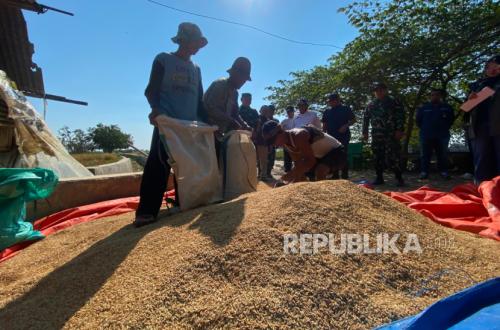
A mound of grain lies spread across a plastic tarpaulin, reflecting a golden sheen. The grain had just been harvested from a rice field cultivated by a farmer in Srengseng Village, Krangkeng District, Indramayu Regency, in mid-July. Under the scorching midday sun, Sodik (62), the farmer who owns the grain, could not hide his happy smile. Although sweat poured down the lines of his tired face, relief and gratitude were clearly visible on his expression. “Alhamdulillah, the yield is decent,” Sodik said briefly while gazing at the fruits of his labour.
The area of the rice field he cultivates is less than a hectare. As a result, the harvest he obtained only reached two tonnes. Even then, it still had to be divided equally with the landowner because he is only a sharecropper. “It is a fifty-fifty system. So one tonne goes to the landowner, and one tonne is for me,” Sodik explained.
Sodik acknowledged that this harvest had decreased slightly compared to last year. He said the previous year’s harvest reached 2.2 tonnes, a drop of around two quintals. Nevertheless, Sodik remained grateful for a harvest that could be used to meet his family’s needs, including financing his child’s university education. Moreover, selling the rice felt easy and profitable.
Bulog came directly to the rice field to buy his grain. He said Bulog’s move greatly eased the burden because it could cut transport costs. His grain was also purchased in cash at the government purchase price (HPP) for harvested dry grain (GKP), namely Rp 6,500 per kilogram.
Bulog’s presence to absorb the harvest was also welcomed by other farmers. A farmer in Tambi Village, Sliyeg District, Indramayu Regency, Kasunah, admitted he was happy to sell his rice harvest to Bulog. He did not need to bother looking for buyers or drying his freshly harvested grain. “We farmers do not want hassle. If we sell to Bulog, the grain is immediately transported. Farmers do not have to struggle. After harvesting, it is sold straight away, not taken home,” Kasunah told Republika on Friday (31/7/2026).
Kasunah said he planted rice on a field covering 400 bata. The harvest reached around four tonnes. The grain was immediately absorbed by Bulog at the government purchase price (HPP) for harvested dry grain (GKP), namely Rp 6,500 per kilogram. Farmers also received payment in cash immediately. “Cash payment. So we go home and get money straight away. No need to transport it; it is like just sitting back,” he said.
Kasunah added that the HPP for GKP of Rp 6,500 per kilogram had provided profits for farmers, including himself. He also thanked President Prabowo Subianto for setting the HPP for GKP at Rp 6,500 per kilogram.
One important goal of Bulog going into the field is to minimise the presence of middlemen. Not without reason: if the harvest is poor, middlemen are in a position to pressure farmers. As a result, farmers are hit twice. The harvest is minimal and the price is suppressed.
Wastam Priyatna, Deputy Chairman of the Indramayu Regency Farmers and Fishermen Contact (KTNA), said that during the April harvest, rain still often fell, so the quality of the grain deteriorated. In addition, simultaneous harvests in various regions made it difficult for farmers to sell their grain. This condition was ultimately exploited by middlemen to depress farmers’ grain prices. Fortunately, Bulog stepped in to absorb farmers’ grain at Rp 6,500 per kilogram. “At that time, farmers found it hard to sell their grain. But fortunately Bulog carried out absorption, so farmers were greatly helped,” Wastam told Republika on Thursday (30/8/2026).
Source: jawawa.id (https://jawawa.id/newsitem/farmers-rejoice-as-bulog-warehouses-overflow-1786938765)
Originally published by Republika (https://ekonomi.republika.co.id/berita/tjk9ym377/petani-semringah-gudang-bulog-berlimpah), translated from Indonesian