
Farmers Protest Egg Price Slump, Yogyakarta Government Points to Brokers
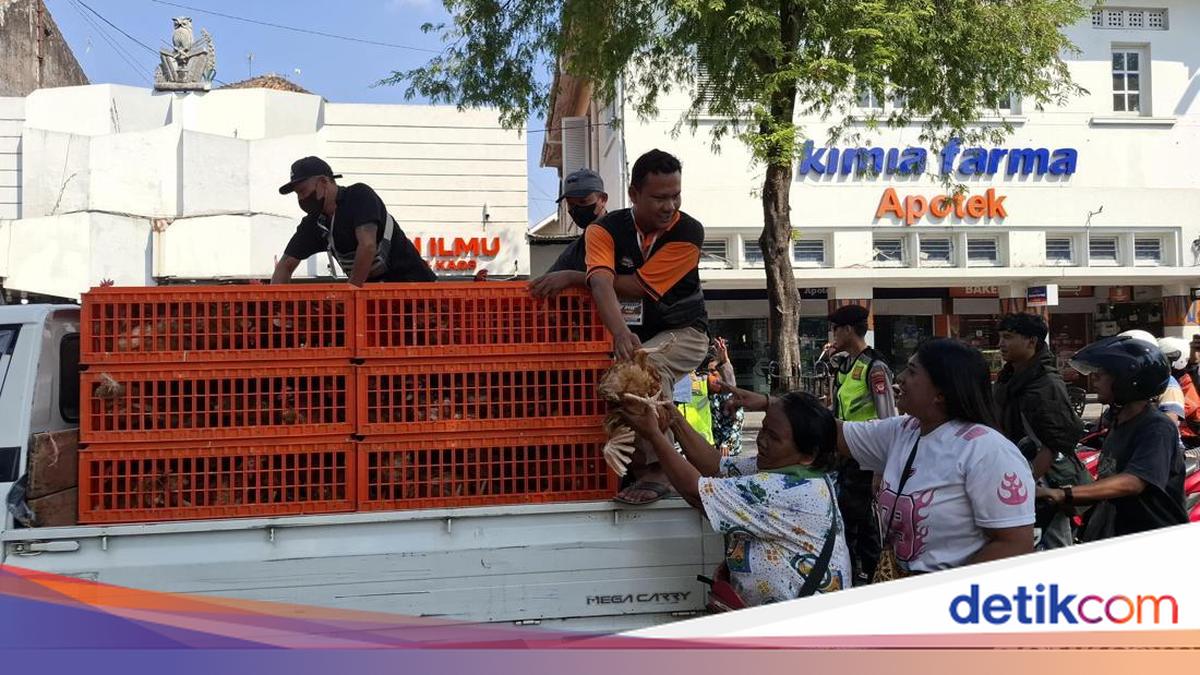
A mass of poultry farmers from across the Special Region of Yogyakarta (DIY) protested the slump in egg prices by distributing free spent laying hens in the Malioboro area of Jogja. Responding to the farmers’ complaints, the Food and Agriculture Service (DPKP) highlighted the role of brokers.
Head of the Livestock and Animal Health Division at DPKP DIY, Agung Ludiro, stated that egg production is currently abundant while public demand has decreased, resulting in farmers’ produce not being fully absorbed.
“Essentially, we have heard the complaints from our fellow farmers. The current situation is that there is overpopulation. The population is large, and egg production is also high, while public demand is declining,” Agung said when met at the DIY Regional House of Representatives (DPRD) office on Jalan Malioboro, Jogja, Monday (10/8/2026).
In addition to the oversupply issue, farmers are also facing high feed costs. One of the main raw materials for chicken feed is corn. In response, Agung said the government would seek ways to increase the availability of corn while keeping its price affordable for farmers.
“Indeed, it will be our task in the Agriculture sector to figure out how to make corn planting more effective so that availability is high and prices are expected to be low,” he explained.
Agung also highlighted the absorption of eggs through the Free Nutritious Meal (MBG) programme. He noted that the presence of brokers in the distribution chain has the potential to affect egg prices at the farm level.
“We previously received information from the Ministry of Agriculture that the Minister of Agriculture directly contacted the Head of the National Nutrition Agency (BGN) to maximise the procurement of eggs from SPPG directly to farmers. So, no longer through brokers,” he explained.
“Because some experiences indicate that the eggs actually come from farmers, but not directly; they go through brokers, and this damages the price,” he added.
Agung mentioned that some farmers have already established direct contact with the SPPG. However, based on the information received, the volume of eggs procured from farmers for the SPPG is still not very high.
“Indeed, the information we received is that the procurement from SPPG is not very high. That is something we will investigate further. The expectation is that livestock products, whether meat or eggs, go directly from the SPPG to the farmers. It is almost the same situation,” he stated.
Agung said his party would coordinate further with the BGN to ascertain the actual conditions on the ground.
“This is also a bit difficult for us. Because several times we have tried to collect data at the SPBG, we have also faced difficulties. So, we will try to coordinate with them later,” he explained.
DIY Farmers Distribute Free Chickens in Malioboro
It was previously reported that farmers across DIY held a protest by distributing free spent laying hens in the Malioboro area, Jogja. The action was a protest against the plummeting prices of eggs and spent hens, while feed prices remain high.
Based on detikJogja’s observations on Monday (10/8), a group of farmers from Bantul, Sleman, Gunungkidul, and Kulon Progo gathered in the courtyard of the DIY DPRD office at 08:37 WIB. They brought several pickup trucks loaded with thousands of spent laying hens to be distributed to the public in the Malioboro area.
At 09:15 WIB, the group of farmers began distributing the free chickens to the public. From the back of the pickup trucks, the chickens were handed directly to residents who had been waiting below. Several passing motorcyclists and TransJogja bus passengers also received the free chickens.
The coordinator of the DIY Laying Hen Farmers, Andry Patra, said this action was a form of charity to the community. The farmers deliberately released the chickens to reduce the population, which is currently considered too high. The 1,600 chickens distributed had also reached their culling age.
“This is our way of giving charity to the community. Because the price of chickens is not selling. At Rp 13,000, it is like we are throwing the chickens away, so the population drops faster,” Andry told the media at the DIY DPRD office courtyard on Jalan Malioboro, Suryatmajan, Gedong Tengen, Yogyakarta City, Monday (10/8/2026).
“These chickens are distributed to the surrounding community. Anyone can take them. This is just a symbolic gesture; 1,600 is actually nothing. We are distributing them so that other people know that farmers today are complaining, are sad, and are experiencing considerable losses,” he explained.
Andry said the unstable egg prices have been ongoing for about three months. Currently, the price of eggs is around Rp 22,000 per kilogram. According to him, this price is still below the ideal price for farmers, which is in the range of Rp 24,000 to Rp 25,000 per kilogram.
“Because the price of eggs today is Rp 22,000, the normal price is Rp 24,000 to Rp 25,000. Every day, farmers are guaranteed to lose Rp 4,000 to Rp 5,000 per kilo of eggs. It could be millions, hundreds of thousands, or billions. It depends on the population of each farmer,” he said.
Not only egg prices, but the price of spent hens has also fallen. Farmers are also asking the government to help absorb the spent hens.
“The cull price has dropped to around Rp 13,000 to Rp 14,000 (per kilogram). We hope for government assistance so that this cull price can be higher, or the government can help absorb these cull chickens by accommodating them in cold storage,” Andry said.
On the other hand, according to Andry, feed prices also remain high. He stated that the price of layer chicken feed has increased by about 30 to 40 percent.
“The price of concentrate feed is around Rp 480,000, or when it becomes ready-made feed, it is around Rp 8,000 per kilo. We hope feed prices will drop, so our production costs can also decrease. If possible, the manufacturers should not increase the price of feed,” he said.
Meanwhile, a resident of the Malioboro area, Ngatmi (67), expressed her happiness at receiving the free chickens.