
Farmers' Distress Sounds Alarm: Indonesian Rubber Could Face Extinction in 10 Years
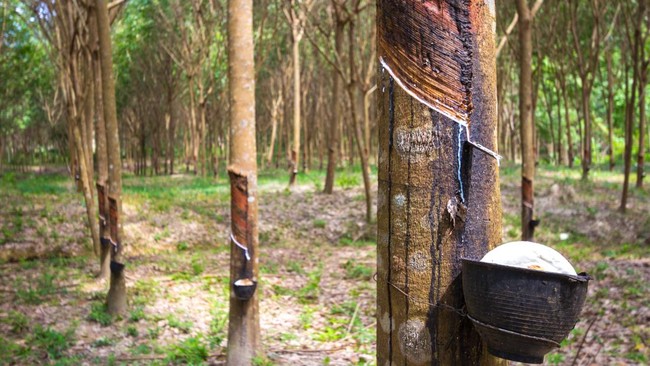
Rubber farmers have issued a stern warning regarding the future of the national rubber commodity. If rubber plantations continue to be neglected without replanting programmes and government support, there are fears that this commodity will become nothing more than a memory within the next 10 years.
This warning was delivered by Supartijo, Chairman of the South Sumatra Regional Leadership Council of the Indonesian Rubber Farmers Association (Apkarindo), during a Public Hearing with Commission IV of the Indonesian House of Representatives (DPR RI) on Tuesday (6/10/2026).
Supartijo stated that the condition of smallholder rubber plantations is increasingly dire. Many rubber trees are aged and experiencing declining productivity.
“Of the existing area, only about 300,000 to 400,000 hectares still maintain high productivity. The rest are old, weak, and lack vitality; they have never been properly fertilised because prices are so low that farmers cannot afford to support their families,” Supartijo said during the hearing at the Parliament Complex, Jakarta.
He noted that these issues are driving farmers to abandon rubber in favour of planting oil palm, which is perceived to be more economically promising.
“Prices have risen now, but the trees are old, they have been overtapped, and yields are very low. Consequently, a massive shift is occurring; many of our farmers are moving from rubber to oil palm,” he said.
He assessed that this situation reflects an imbalance in government attention between the rubber and oil palm commodities.
“Rubber wood is sold quickly for cash, and then oil palm is planted because oil palm is treated as the ‘golden child’, while rubber is treated as the ‘stepchild’,” he remarked.
Rubber Production Continues to Plummet
This threat is reflected in data managed by Apkarindo. National rubber production has dropped from 3.68 million tonnes in 2017 to approximately 2.1 million tonnes in 2025.
This decline is occurring amidst several challenges, ranging from the Pestalotiopsis sp. leaf fall disease outbreak since 2017, the conversion of plantation land, untapped land, to low productivity.
Furthermore, Apkarindo noted that the capacity utilisation of the crumb rubber industry remains below 50%.
The rubber processing industry is also under pressure. Out of 157 crumb rubber processing units recorded as of 30 September 2026, 60 units have ceased operations, consisting of 52 permanent closures and 8 temporary suspensions. Meanwhile, only 97 units remain operational.
This industrial pressure is also felt by workers. Supartijo stated that wages for rubber tappers have become increasingly unattractive, leading labourers to abandon the sector.
“Rubber tappers and labourers no longer want to work because they are only earning Rp50,000 to Rp60,000 a day, instead of Rp100,000,” he said.
He also revealed the shrinking number of rubber factories in South Sumatra.
“In South Sumatra, the number of factories has dropped from 30 to 19, and even those are operating at idle capacity because there is no raw material,” he said.
According to Supartijo, if these issues are not addressed immediately, the sustainability of the national rubber commodity will be further threatened.
“If left alone for another 10 years, rubber will only be a name. Everything will close. Every day, rubber trees are felled, the wood is sold, and replaced with oil palm,” he warned.
Consequently, farmers are requesting greater government support to maintain smallholder rubber plantations, including through replanting programmes and assistance with production facilities.
“We hope that the honourable members of the DPR and the government will provide fair and wise support. If food crops receive harvesting tools and paddy field machinery, we only ask for partial assistance during the planting season; that would be enough,” said Supartijo.
Furthermore, Apkarindo is pushing for the establishment of a Rubber Plantation Fund Management Agency (BPDP Karet) to support the funding of the rubber sector, including production increases and industrial sustainability.
Apkarindo maintains that such support is urgent to prevent the continued decline in production, land conversion, and the closure of rubber processing factories.
Source: jawawa.id (https://jawawa.id/newsitem/farmers-distress-sounds-alarm-indonesian-rubber-could-face-extinction-in-10-years-1791284089)
Originally published by CNBC Indonesia (https://www.cnbcindonesia.com/news/20261006163434-4-773844/tangis-petani-nyalakan-alarm-bahaya-10-tahun-lagi-karet-ri-punah), translated from Indonesian