
Far-Right AfD Wins Landslide in Germany, Threatening Immigrants and Muslims
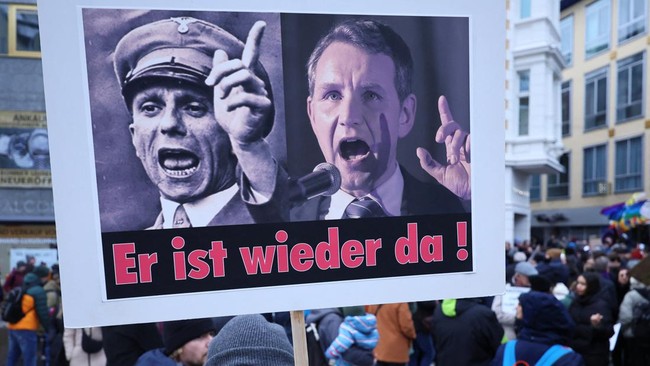
The German far-right party Alternative für Deutschland (AfD) has just scored a major victory in the state election of Saxony-Anhalt, Germany, on Sunday (6/9/2026).
The victory has also raised the profile of Ulrich Siegmund, a 35-year-old politician who served as the AfD’s lead candidate in the election.
The far-right party secured 43.8% of the vote, more than double the 20.8% it obtained in the 2021 election. The AfD won 39 of the total 83 seats in the Saxony-Anhalt state parliament.
Meanwhile, the Christian Democratic Union (CDU), which previously dominated the Saxony-Anhalt government, obtained only 17.2% of the vote and 15 seats. The Social Democratic Party (SPD), the Green Party, and Die Linke each secured eight seats, whilst Bündnis Sahra Wagenknecht (BSW) obtained five.
Despite winning by a clear margin, it is not yet certain that the AfD will lead the government. The party remains three seats short of the absolute majority of 42 seats.
The AfD is also struggling to find partners, as most parties in Germany maintain their refusal to form a coalition or cooperate with it.
Nevertheless, this is not the first time the AfD has become the largest party in a state election. In 2024, the AfD won the Thuringia election with 32.8% of the vote, but failed to form a government because it lacked a majority and coalition partners.
Even so, the result in Saxony-Anhalt marks the AfD’s best performance in its history. The party is now closer than ever to holding power at state level.
So, what exactly is the AfD?
The AfD is a German alternative party founded in 2013 by a number of economists, academics, businesspeople, and former conservative politicians.
In its early days, the far-right party was better known for opposing bailouts of European countries in the midst of a debt crisis. The AfD also opposed the use of the euro as a single currency, which it considered a burden on German taxpayers.
However, over time, the AfD’s orientation began to change. Today, issues of immigration, Islam, national identity, security, and German sovereignty dominate the party’s agenda, particularly since the European refugee crisis of 2015.
The AfD is currently led jointly by Alice Weidel and Tino Chrupalla. Both also serve as co-leaders of the AfD’s parliamentary group in the Bundestag (the German parliament).
Alice Weidel has a background in economics and business. She frequently champions tax cuts, deregulation, opposition to green policies, and reform of the European Union.
Weidel was the AfD’s candidate for chancellor in the 2025 federal election. Her calmer and more professional presentation has often positioned her as the face of the AfD aimed at the business community, the middle class, and conservative voters.
Meanwhile, Tino Chrupalla hails from eastern Germany and has a background as a craftsman entrepreneur. His communication style is simpler and directed at workers, small business owners, and communities in small towns and rural areas.
Chrupalla is also known to be more open to restoring relations with Russia. He views cheap energy from Russia as an important part of Germany’s economic interests.
Weidel and Chrupalla represent two foreign policy tendencies within the AfD. The group around Weidel is more open to relations with the United States under Donald Trump, whilst Chrupalla and a number of figures from eastern Germany tend to advocate closer ties with Moscow.
The AfD’s Grand Programme
The AfD’s ideological foundation is set out in the document Programm für Deutschland, as published on the party’s official website. The basic programme consists of 14 areas, ranging from democracy, the economy, and foreign policy to immigration and energy.
Nationalism
Nationalism forms the core of the AfD’s grand programme. Almost all of the policies championed by the far-right party consistently place the interests of Germany and its citizens first.
The AfD wants Germany to be more independent in determining its own policies and not overly dependent on the European Union or other international institutions.
According to the AfD, the government should focus more on safeguarding the security, welfare, freedom, and national identity of Germany.
This view is also reflected in the AfD’s cultural policy. The party promotes the concept of Deutsche Leitkultur, or a German guiding culture, based on the German language, history, traditions, and the Christian and Western humanist heritage.
The AfD rejects multiculturalism if it requires Germany to change its fundamental values to accommodate newcomers. For the AfD, those who come and settle in Germany must obey the law and adapt to the local language and culture.
The party also wants to enshrine German as the official language in the constitution. The AfD likewise rejects the use of gender-neutral language that has been adopted in a number of institutions and educational settings.
In the political sphere, the AfD proposes a number of changes, including the following.
Euroscepticism
The AfD was born out of opposition to the ‘European bailout’ policy. As such, scepticism towards the European Union and the euro remains an important part of the party’s identity.
The AfD rejects the development of the EU into a federal state centrally controlled from Brussels. The party wants to return many powers to national governments.
In its basic programme, the AfD states that if major reforms cannot be achieved, Germany could leave the European Union. An alternative would be to dissolve the current EU structure and replace it with an economic community of sovereign nations.
The AfD also views the euro as a currency unsuited to countries with differing economic conditions. In its basic programme, the AfD calls for a referendum on the continuation of Germany’s membership of the eurozone.
This stance was reinforced in its 2025 Federal Election manifesto. The AfD declared that Germany should leave the euro system and raised the possibility of reviving the deutsche mark as the national currency.
However, the AfD does not entirely reject cooperation between European nations. The party wants to replace the EU with a Bund europäischer Nationen, or a confederation of European nations.
Cooperation would be maintained for the common market, external border protection, security interests, and the protection of European identity. Meanwhile, other policies would be returned to each individual nation.
Anti-Immigration
Opposition to immigration, particularly illegal immigration and the arrival of asylum seekers, is one of the AfD’s most well-known agenda items.
The AfD contends that Germany is not a country that was built on immigration from the outset. Consequently, it demands that the government be far stricter about determining who may enter and settle in the country.
The party wants to distinguish between refugees genuinely in need of protection, skilled foreign workers, and those using the asylum route without meeting the requirements.
The AfD calls this package of return policies remigration.
In its 2025 Federal Election manifesto, the AfD explains that remigration encompasses the deportation of persons legally required to leave Germany, the repatriation of criminals and foreign extremists, and the termination of protection when the grounds for granting asylum no longer apply.
The term remigration is controversial because, within Europe’s radical right milieu, the concept can be used more broadly to push residents with a migrant background to leave a country.
The AfD denies that it would illegally deport German citizens. The party states that its proposed remigration policy must be carried out in accordance with the constitution and applicable laws.
The AfD still accepts limited legal immigration. However, prospective newcomers would be selected based on education, skills, language ability, and Germany’s economic needs.
A Hardline Stance on Islam
The AfD states that it respects freedom of religion and acknowledges that many Muslims live lawfully, are well integrated, and are valued members of German society.
However, the party distinguishes between Muslim individuals and Islam as a religion, culture, and political system.
In its basic programme, the AfD explicitly states that ‘Islam is not part of Germany’, as quoted from the party’s official website.
The AfD views the spread of Islam and the growth of the Muslim population as a threat to the German state, society, and value system. However, the party emphasises that its rejection is directed primarily at Islamic practices that do not recognise German law, support the imposition of sharia, or place religion above the constitution.
This stance remains evident in the 2025 Federal Election manifesto. One of its sections is titled Einer weiteren Ausbreitung des Islam treten wir entgegen, or ‘we oppose the further spread of Islam’.
The AfD describes this measure as an effort to confront political Islam and prevent the emergence of parallel societies. However, domestic intelligence agencies in several states consider the rhetoric of some AfD branches to have gone beyond criticism of political Islam.
The Saxony State Intelligence Agency explicitly uses the term Islam- und Muslimfeindlichkeit, or anti-Islam and anti-Muslim attitudes, when describing the activities of the AfD in that state.
The agency considers that a number of AfD Saxony officials have portrayed Islam as a religion that is not peaceful and is ‘conquering’ in nature, and have used derogatory expressions to describe Muslim migrants from Arab countries.
Even so, the AfD denies accusations of anti-Muslim sentiment. The party states that criticism of Islam is part of freedom of expression and cannot automatically be labelled Islamophobia or racism.
Source: jawawa.id (https://jawawa.id/newsitem/far-right-afd-wins-landslide-in-germany-threatening-immigrants-and-muslims-1788792701)
Originally published by CNBC Indonesia (https://www.cnbcindonesia.com/research/20260907160549-128-765921/partai-afd-menang-telak-di-jerman-imigran-hingga-umat-muslim-terancam), translated from Indonesian