
Far Behind China, Indonesia's Renewable Energy Still Lags
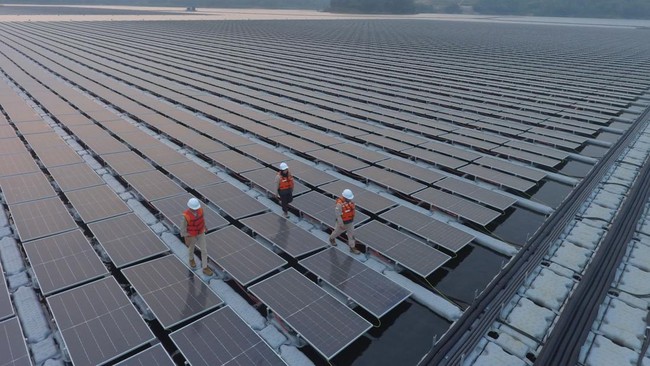
Jakarta, CNBC Indonesia - The Coordinating Ministry for Economic Affairs (Kemenko Perekonomian) notes that Indonesia still lags in the development of new and renewable energy (EBT). Over the past decade, its development has only managed to reach 0.5 Gigawatts (GW), differing markedly from China, which achieves 199 GW per year.
Assistant Deputy for Accelerating Energy Transition, Coordinating Ministry for Economic Affairs, Farah Heliantina initially stated that energy is one of the sources to support achieving the 8% economic growth target.
The national electricity demand will undoubtedly increase, projected to rise from the current 411 Terawatt hours to nearly 600 Terawatt hours by 2030, or equivalent to 2,000 Terawatt hours per capita.
In reality, Indonesia still relies on coal-fired power plants, which account for 60%. Meanwhile, the addition of EBT capacity in the last decade has only been 0.5 GW per year.
“In the last decade, only 0.5 Gigawatts per year, and this shows that we are still far behind, of course, compared to China. We are very far behind, ladies and gentlemen, 199 Gigawatts per year compared to our 0.5; this gap is also very, very large,” explained Farah in her presentation at the Renewable Energy Zones (REZ) as an Enabling Instrument event on Tuesday (28/4/2026).
Not only China, Indonesia is said to still lag behind neighbouring countries like Vietnam, which reaches 3.3 GW. “In 2025, global investment in clean energy has actually seen a significant increase, reaching US$2.15 trillion, almost double the investment in fossil fuels, which is only US$1.15 trillion. So, there has actually been progress, but acceleration is perhaps needed,” explained Farah.
Quoting data from the Ministry of Energy and Mineral Resources, as of 31 December 2025, the EBT mix reached 15.75% of the total national power generation. This figure rose by 1.1% compared to 2024, which was recorded at 14.65%.
This means that Indonesia’s installed EBT capacity reached 15.63 GW. In 2025, it was recorded as the year with the largest addition of EBT capacity over the past five years.
The breakdown includes water at 7.58 GW, followed by biomass energy at 3.14 GW, geothermal at 2.74 GW, and solar at 1.49 GW. The rest comes from coal gasification, wind, waste, and others.