
Fair Finance Asia Urges Banks to Halt Coal Sector Funding in ASEAN
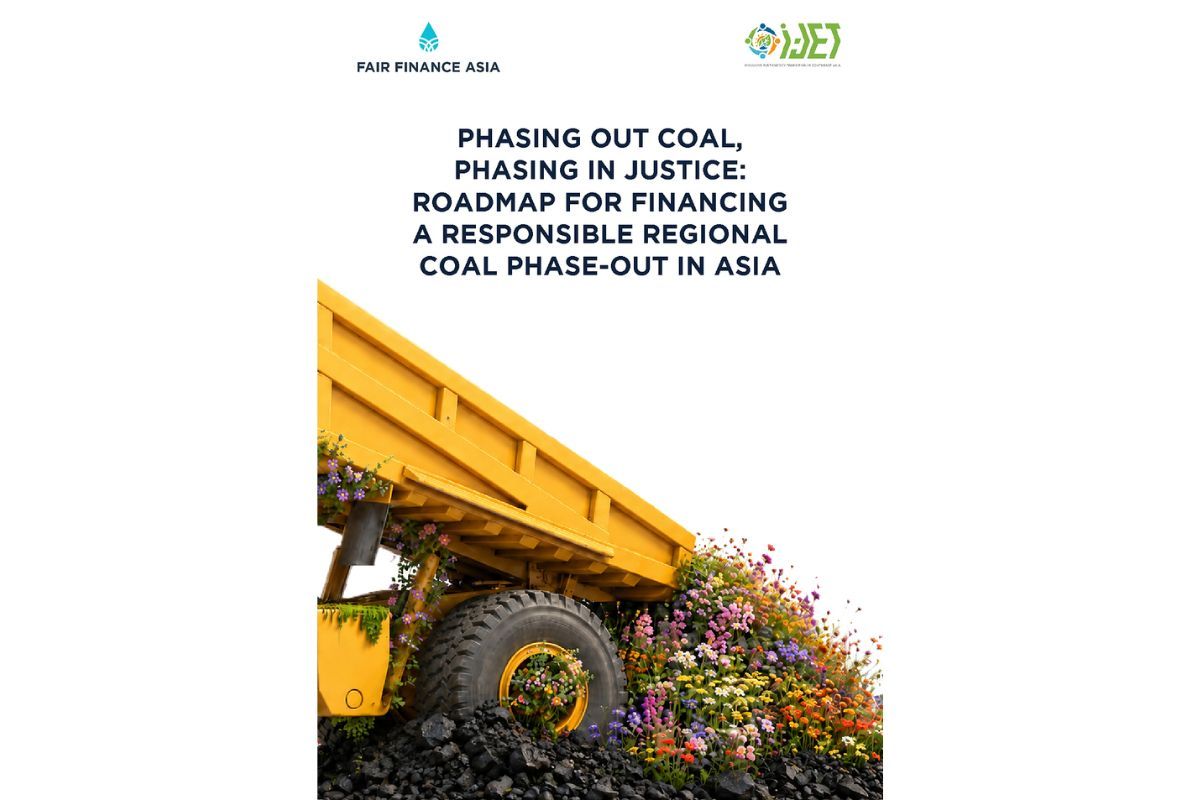
Fair Finance Asia (FFA), together with Influencing Just Energy Transition in ASEAN (I-JET), is urging banks and investors to halt funding for coal business expansion and to strengthen social safety nets. The call was made through a new report titled ‘Phasing out Coal, Phasing in Justice: Roadmap for Financing a Responsible Regional Coal Phase-out in Asia’. The report reviews energy transition developments in Cambodia, Indonesia, Laos, the Philippines, and Thailand, as well as the broader ASEAN context.
According to the report, several ASEAN countries have implemented moratoriums on new coal-fired power plants, updated their Nationally Determined Contributions (NDCs), prepared early retirement programmes for coal plants, developed green taxonomies, and begun implementing carbon pricing policies. However, these steps are deemed insufficient to place the region on a pathway aligned with limiting global temperature rise to 1.5 degrees Celsius, as stipulated in the Paris Agreement.
The report also highlights that while international funding for coal projects is increasingly restricted, financial flows continue through corporate financing and the upstream mining sector. Furthermore, liquefied natural gas (LNG) is still being promoted as a transition fuel despite challenges including high costs, price volatility, the risk of stranded assets, and long-term fossil fuel dependency.
To accelerate a responsible and just coal phase-out, the report recommends several measures: halting all new coal project development, including for artificial intelligence and digital infrastructure needs; establishing a coal phase-out roadmap with clear, binding, and enforceable deadlines; permanently retiring or converting all coal-fired power plant units, accompanied by post-operation site restoration; ending all forms of financing for the coal sector, including for solutions that do not deliver real emissions reductions; and ensuring just transition commitments have a binding legal basis.
The report also stresses the importance of strengthening social safety nets, including income support for affected communities, reskilling, and the provision of decent green jobs for impacted workers. It calls for promoting community engagement, applying the principle of Free, Prior and Informed Consent (FPIC), protecting indigenous peoples’ land rights, implementing gender-responsive policies, and safeguarding environmental and human rights defenders.
Bernadette Victorio, Program Lead at Fair Finance Asia, stated that the success of the energy transition is determined not only by the closure of coal plants but also by the extent to which the process reduces social inequality. She emphasised that this can only be achieved if the rights of workers, communities, women, and indigenous peoples are protected and their voices included in every stage of the transition.
Shubert Ciencia, Energy Justice and ASEAN Influencing Program Manager at Oxfam in Asia, noted that the ASEAN Plan of Action for Energy Cooperation 2026–2030 demonstrates the region’s commitment to accelerating decarbonisation without neglecting energy security. He added that member states must now limit investment in operating coal projects while halting the development of new ones.
Victoria Fanggidae, Executive Director of The PRAKARSA, explained that climate action commitments are meaningless if funding continues to flow into the coal sector. She insisted that Indonesian financial institutions must stop supporting coal expansion and instead direct financing towards renewable energy, ensuring that every funding decision upholds human rights principles and a just energy transition.
Genalyn Arcayera-Aquino, Economic Rights Program Manager at Initiatives for Dialogue and Empowerment through Alternative Legal Services (IDEALS), said that incentives for fossil fuels without a clear phase-out plan only prolong dependence on fossil energy. She noted that reliance on imported fuels keeps electricity costs high and hinders the development of the domestic renewable energy industry.
Yuki Tanabe, Program Director at the Japan Center for a Sustainable Environment and Society (JACSES), explained that governments must play a greater role in accelerating the early retirement of coal-fired power plants through stricter environmental regulations and higher taxation on coal-fired generation.
Source: jawawa.id (https://jawawa.id/newsitem/fair-finance-asia-urges-banks-to-halt-coal-sector-funding-in-asean-1786074801)
Originally published by Antara (Indonesian) (https://www.antaranews.com/berita/5683629/fair-finance-asia-desak-perbankan-hentikan-pendanaan-untuk-sektor-batu-bara-di-asean), translated from Indonesian