
Fadli Zon Visits Soekarno and Hatta Villas in Puncak, What's Happening?
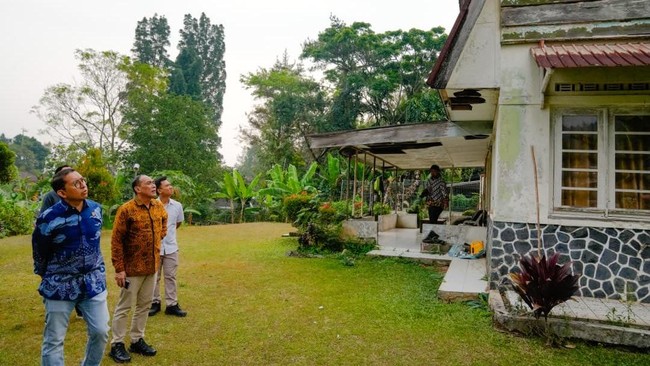
Two historic villas connected to Indonesia’s first president Soekarno and first vice president Mohammad Hatta are set to be revived. Culture Minister Fadli Zon revealed that both buildings, located in the Puncak area of Bogor, are being pushed for development as cultural heritage sites as well as historical destinations that can deliver economic impact for surrounding communities.
“In the Puncak area there are many historical sites related to our nation’s figures. In the Megamendung area, for example, there is Villa Bung Hatta which has already become a Regency Cultural Heritage site, and we hope this year it will also become a National Cultural Heritage site,” said Fadli Zon after visiting the two villas, quoted on Thursday (20/8/2026).
The visit was a strategic step by the Ministry of Culture to directly inspect the physical condition of cultural heritage buildings while formulating governance for the revitalisation of historical destinations in the Cisarua area, Bogor. Villa Bung Hatta is a historic place because it was here that Hatta married Rahmi Rachim on 18 November 1945, only about three months after Indonesia proclaimed its independence.
The wedding also fulfilled a promise Hatta had made since his youth not to marry before Indonesia became independent. When Indonesia gained independence, Hatta was 43 years old and still single.
Interestingly, Hatta’s journey towards marriage was also assisted by Soekarno. The first president acted as matchmaker for his own friend. When asked which woman he wanted to marry, Hatta only provided a description of the person he meant.
“The girl we met at the Pasteur Institute at that time. The one sitting in that room, like this, like that, but I don’t know her name yet,” Hatta told Soekarno, as quoted from R. Soeharto in Saksi Sejarah (1982).
Soekarno then discovered that the woman was Rahmi Rachim, the daughter of Hatta’s friend, Rachim. He visited Rachim’s house to convey Hatta’s intentions. Rahmi eventually agreed to the marriage. Hatta and Rahmi then married simply at the villa in the Megamendung area.
Fadli is pushing for the acceleration of Villa Bung Hatta’s status from Regency-level cultural heritage to National-level, because the Villa Bung Hatta historical site is highly significant and was a place where Mohammad Hatta worked and produced major ideas that provided the foundational colour for the nation’s journey.
“In the Puncak area there are many historical sites related to our nation’s figures. In the Megamendung area, for example, there is Villa Bung Hatta which has already become a Regency Cultural Heritage site, and we hope this year it will also become a National Cultural Heritage site,” he said.
Not only Villa Bung Hatta, government attention is also directed at Villa Riung Gunung in Cisarua. In a post on his X account, Fadli Zon revealed that the building is also known as Villa Guntur Soekarnoputra, a historic stopover place belonging to Soekarno.
History records that in 1960, Soekarno’s villa was an elite villa named Riung Gunung Coffee House. The building was designed by architect I’e Soedarsono, one of the architects behind the construction of the Monas monument.
During Soekarno’s era, the president often brought state guests or officials to enjoy the fresh air of the area. The location also offers views of the Puncak area from a different angle.
Fadli then pushed for Villa Riung Gunung to be designated as a cultural heritage site. According to him, the Puncak area has great potential to be developed as a historical, cultural, culinary and other tourism destination.
“Puncak has extraordinary potential to become a cultural destination, culinary destination, historical destination and various other tourism. Including Villa Riung Gunung, where we can see the Puncak landscape from a different angle,” Fadli explained.
Fadli also encouraged the use of Villa Riung Gunung to advance culture-based economy. According to him, historical sites like Villa Riung Gunung are not merely static buildings that store stories of the past, but their presence must benefit the economy of surrounding communities. Fadli is optimistic that the historic buildings will increasingly attract public interest to visit, particularly among the younger generation.
“This architectural work was built so that we do not forget the journey of this nation, so we must care for it. For that reason, the Ministry of Culture is carrying out restoration, revitalisation and renovation of cultural heritage buildings as well as buildings suspected of being cultural heritage. Villa Riung Gunung must also be returned to its original purpose, as a spirit that demonstrates love for our nation’s culture,” he said.