
Factory Closure Blamed on Extortion by Mass Organisations Leaves Thousands Jobless
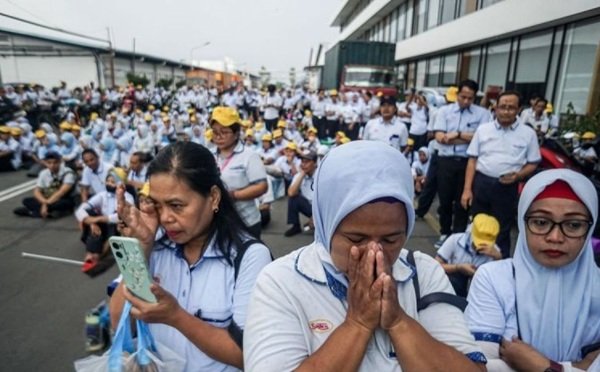
JAKARTA, AFU.ID — Thousands of workers in Lebak have lost their livelihoods after the South Korean-owned shoe factory PT Parkland World Indonesia (PWI) 6 ceased operations in Rangkasbitung district. The closure has led to around 1,100 workers being made redundant. PWI 6 had previously laid off 900 workers in stages from late 2025 to October 2026.
Management decided to move the production line to another area considered safer and more efficient. The factory fully closed on Friday, 23 October 2026, as its building lease expired and was not renewed.
Although the formal reason given for ending manufacturing operations was the expiry of the lease, the Lebak Regency Government has pointed to indications that non-technical factors, including security disturbances allegedly involving members of mass organisations, damaged the local investment climate. Lebak Regent Hasbi Asyidiki Jayabaya said the departure of an export-scale footwear manufacturer should not be reduced to a matter of a property lease deadline.
“As regional head, I ask that this is not viewed from just one perspective. If the media say the contract was not renewed, it cannot be considered from that aspect alone,” Hasbi said after attending an event in Rangkasbitung on Monday, 26 October 2026.
Hasbi stressed the importance of security and legal certainty for businesses. Alleged extortion, illicit levies and operational disruption by members of mass organisations are thought to have significantly increased the cost of doing business and weakened companies’ ability to remain viable. “It may be that they faced disruption from certain individuals while doing business, affecting the investment climate and making it less conducive. So it is not only about the lease with the factory owner expiring; there are many perspectives,” he said.
“We must work together with law enforcement. In PWI’s case, the rights of employees who have been laid off must be met, and I will ensure the regional government oversees the fulfilment of workers’ rights,” he added.
Allegations of extortion by mass organisations targeting factories are not isolated. Data from the Indonesian Industrial Estates Association (HKI) indicate that systematic extortion by individuals affiliated with such organisations has contributed to a high-cost economy, causing losses of hundreds of trillions of rupiah across the national industrial sector. One of the most serious consequences of higher investment costs caused by security disruptions is the withdrawal of global investors. Several prospective investors in West Java have reportedly reconsidered their plans, while the expansion of automotive giant BYD’s project in Subang has faced uncertainty.
In PWI’s case, the additional costs may have come from several sources. First are security costs: companies may have to hire extra security or pay “facilitation” money to prevent disruptions to operations. Second are production delays: when organisations seal facilities or intimidate businesses, production lines may stop, resulting in lost output and revenue.
Third are legal costs, as companies pay for legal representation and dispute resolution. Fourth are reputational costs: areas known for extortion may struggle to attract new investors. Fifth are relocation costs, including moving assets, recruiting a new workforce and adapting infrastructure after a company decides to move.
When a factory relocates to an area considered “safer and more efficient”, thousands of workers can lose their jobs, local supply chains are disrupted and regional income falls. PWI’s transfer of production elsewhere amounts to investors “voting with their feet”: when security is not guaranteed, capital moves to a more favourable location.
The phenomenon also affects prospective investors. Some investors in West Java have reportedly delayed or cancelled investment plans because of security uncertainty. The expansion of BYD’s major automotive project in Subang has also faced uncertainty amid alleged disturbances involving members of mass organisations. Extortion by such groups is therefore not merely a local disruption, but a structural threat to the competitiveness of national industry.
Extortion in other regions follows a similar pattern
The impact of mass organisations’ alleged efforts to extract money from companies under the pretext of providing security has also been reported elsewhere. In Langkat Regency, North Sumatra, an ice factory in Stabat district was forced to suspend production temporarily after alleged intimidation and coercion by members of a local organisation, following the company’s refusal to meet their financial demands.
The reported method is familiar: individuals visit a factory, demand “contributions” or a share of projects, and resort to intimidation when refused, sometimes bringing production to a halt. Although the ice factory was not a large company, the suspension affected dozens of workers and the local supply chain.
A similar case occurred in South Barito Regency, Central Kalimantan. The operations of PT Bumi Asri Pasaman were unilaterally sealed by members of a mass organisation seeking payment of a Rp1.4 billion business dispute without going through the courts. The case was subsequently handled intensively by the Central Kalimantan Police. The sealing, which took place without a court ruling, illustrated how an organisation could act as if it were a law-enforcement authority.
On this issue, the Ministry of Manpower and the Indonesian National Police have said that extortion, coercion and sealing premises without a legal basis by members of mass organisations constitute criminal offences. Such acts may be prosecuted under Article 335 of the Criminal Code on coercive conduct, as well as provisions concerning extortion and threats. Law-enforcement authorities have urged businesses and the public not to fear reporting intimidation through official complaint channels, in order to protect the investment climate and the livelihoods of Indonesian workers.
Ultimately, the conduct of such organisations can put thousands of people’s livelihoods at risk. In PWI 6’s case, around 2,000 people have lost their jobs and income. Regent Hasbi said the regional government would ensure workers’ rights were fulfilled. “We must work together with law enforcement. In PWI’s case, the rights of employees who have been laid off must be met, and I will ensure the regional government oversees the fulfilment of workers’ rights,” he added.
As long as extortion by mass organisations is allowed to continue, companies’ costs will keep rising, investors will keep leaving and thousands of workers will continue to lose their jobs. Firm law enforcement, rather than appeals alone, is essential to prevent industry from continuing to fall victim to thuggery carried out under the guise of mass organisations.
Source: jawawa.id (https://jawawa.id/newsitem/factory-closure-blamed-on-extortion-by-mass-organisations-leaves-thousands-jobless-1793145042)
Originally published by afu.id (https://afu.id/nasional/perusahaan-tutup-garagara-dipalak-ormas-ribuan-orang-kehilangan-pekerjaan-pemerintah-dan-penengak-hukum-kerap-tak-tegas), translated from Indonesian