
Fact Check: Stranded Fish on Beach Unrelated to Anak Krakatau
Fact Check: Stranded Fish on Beach Unrelated to Anak Krakatau
Reporter
October 2, 2026 | 09:24 pm
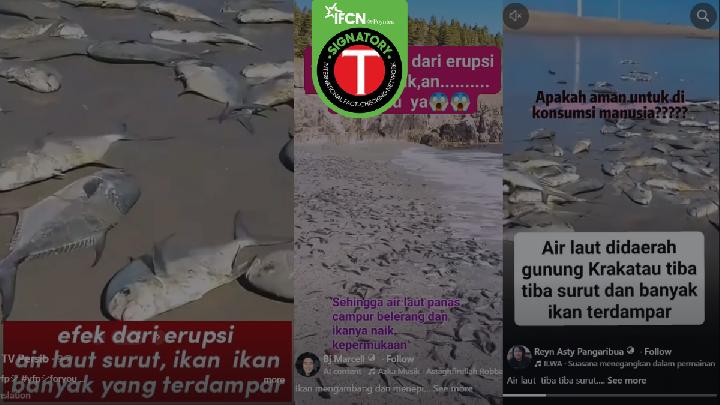
TEMPO.CO, Jakarta - Various video clips are circulating on Facebook (accounts one [archive], two, and three) and TikTok claiming to show fish scattered along Sunda Strait beaches due to receding seawater in the second week of September 2026. Some posts claim the phenomenon occurred in Lampung Province. The footage shows stingrays and sardines stranded on damp sand following the eruption of Mount Anak Krakatau in early September 2026.
The accompanying post caption reads:
“Fish floating and washing ashore. The aftermath of the eruption of Anak Krakatau. The seabed is filled with hot water mixed with sulfur, causing the fish to float and ashore.”
Does the video really capture events along the Sunda Strait or the Lampung coast?
FACT CHECK
Tempo verified this content using reverse image searches on Google and Baidu, as well as location searches on Google Earth. Findings revealed that the clips are old footage originating from different locations overseas.
Video Verification
One clip showing thousands of fish washed ashore on a beach with a cliff backdrop, was recorded at Middle Cove Beach in Newfoundland and Labrador, Canada. The rock formations in the video match the 360-degree view of the location on Google Earth.
As reported by Canadian media outlet CBC, capelin, which look similar to sardines, gather near the shore every summer to spawn before being carried onto the beach by waves. Locals routinely take advantage of this annual event to harvest the fish. This clip was not filmed in the Sunda Strait.
The second clip shows Praia Formosa beach in the city of Cabedelo, Brazil. A Google Earth search confirmed the presence of clusters of dark coastal rocks alongside three wind turbines belonging to a local power plant (PLTB).
Environmental media outlet Mongabay noted that the facility has been operating since 2009. The video also shows residents pulling in fishing nets, proving the catch was gathered by fishermen rather than washed ashore by a volcanic eruption.
Irregularities in how people hauled in the nets further indicate that these fish were harvested from open waters, contradicting claims that the fish were stranded by a volcanic eruption.
Another clip, displaying a sunlit shoreline littered with floundering fish, likewise did not originate in Lampung or the Sunda Strait. This footage has been circulating on Chinese social media platforms Douyin and Sohu.com as far back as 2022. The eruption of Mount Anak Krakatau did occur on September 4, 2026. While Mount Anak Krakatau did erupt on September 4, 2026, the event generated no such coastal anomaly. Indonesia’s Meteorology, Climatology, and Geophysics Agency (BMKG) confirmed that the viral claims of receding seawater are unrelated to the volcanic activity.
CONCLUSION
Tempo’s investigation concluded that the narrative claiming the Mount Anak Krakatau eruption caused fish to wash up along the Sunda Strait and Lampung coasts are misleading.
**Do you have information or claims that you want to have fact-checked? Contact our ChatBot. You can also send criticism, objections, or feedback for this Fact-Checking article via email to [email protected].