
Fact Check: Is It True That Trump Suffered a Stroke Due to Losing a Strategy in the Iran War?
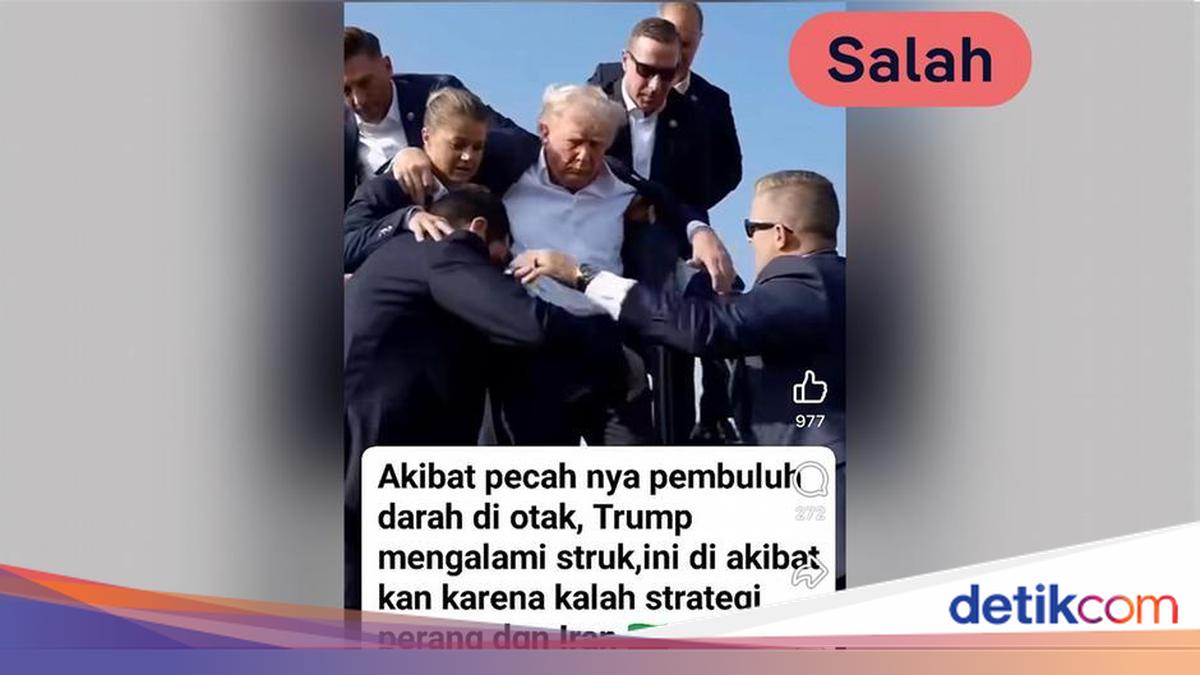
DW Indonesia’s fact-check verifies this claim.
Claim: “Due to the bursting of a blood vessel in the brain, Trump suffered a stroke, caused by losing a war strategy with Iran.”
DW Fact Check: False.
Upon examination using Hive Moderation, the video is not AI-generated. Then, based on a Google Reverse Image search, the video does not originate from a recent event but is old footage from the shooting incident during Donald Trump’s campaign in Pennsylvania, United States, in 2024. In that situation, Trump was indeed supported by the US Secret Service, but the context was a security procedure following the incident, not a medical condition like a stroke.
Furthermore, a search using the keyword “Shooting at Trump Rally Pennsylvania” displays other recordings from different angles that reinforce this chronology.
To date, there are no official reports from the White House, the US presidential medical team, or credible media mentioning that Trump suffered a stroke, let alone linking it to conflict or war strategy with Iran.
What is the pattern of “recycling” hoax videos?
This phenomenon illustrates a common pattern in the spread of disinformation, namely the reuse of old videos with new hoaxes. Fact-check Analyst from Mafindo, Aribowo Sasmito, explains that hoaxes usually “ride on” issues that are currently being widely discussed by the public to more easily attract attention and spread widely.
“Why create a hoax if people are not paying attention? That means the debate won’t be as intense if (there’s) something that society is focusing on,” said Aribowo in an interview with DW Indonesia.
He also added that in such situations, emotions often dominate over verification, so social media users tend to share information, including viral videos, immediately without checking their truthfulness.
“Even if people might know the source is unclear, how do we know if Trump really had a stroke or not? So ultimately, it comes back to the basic aspect that humans are often ‘trapped’ by their emotions,” continued Aribowo.
Is technology a challenge in the era of rampant disinformation content?
In a broader context, Drone Emprit Analyst, Rizal Nova Mujahid, assesses that technological developments actually add challenges in distinguishing authentic content from AI manipulation.
“Actually, that is indeed a challenge for technology, even up to now. Because images or videos produced by AI are getting better and more secure; at a glance, they become increasingly difficult to recognise,” said Nova to DW Indonesia.
Nova added that this condition makes the public increasingly reliant on transparency from content creators and digital platforms. According to him, labelling content is very important so that society can immediately recognise whether a piece of content has the potential to mislead or not. He also emphasised the need for an active role from the government and platforms in verifying circulating content.
“We rely on the willingness of content creators to label this as AI-generated or not AI-generated, so we can immediately recognise hoaxes or not. Then the next strategy is to ask the government to encourage verification of such things by the platforms,” said Nova.
This viral Trump video serves as an example of how context can be removed to build a false narrative. Not only that, videos related to the Iran conflict and videos of President Prabowo’s meeting with President Putin have repeatedly been used to spread hoaxes due to the high public attention on global issues.
Amid the torrent of information, the public is reminded not to react quickly but to critically check sources and context before believing and sharing them.