
Fact Check: 'Hanta' Does Not Mean 'Nonsense' in Hebrew
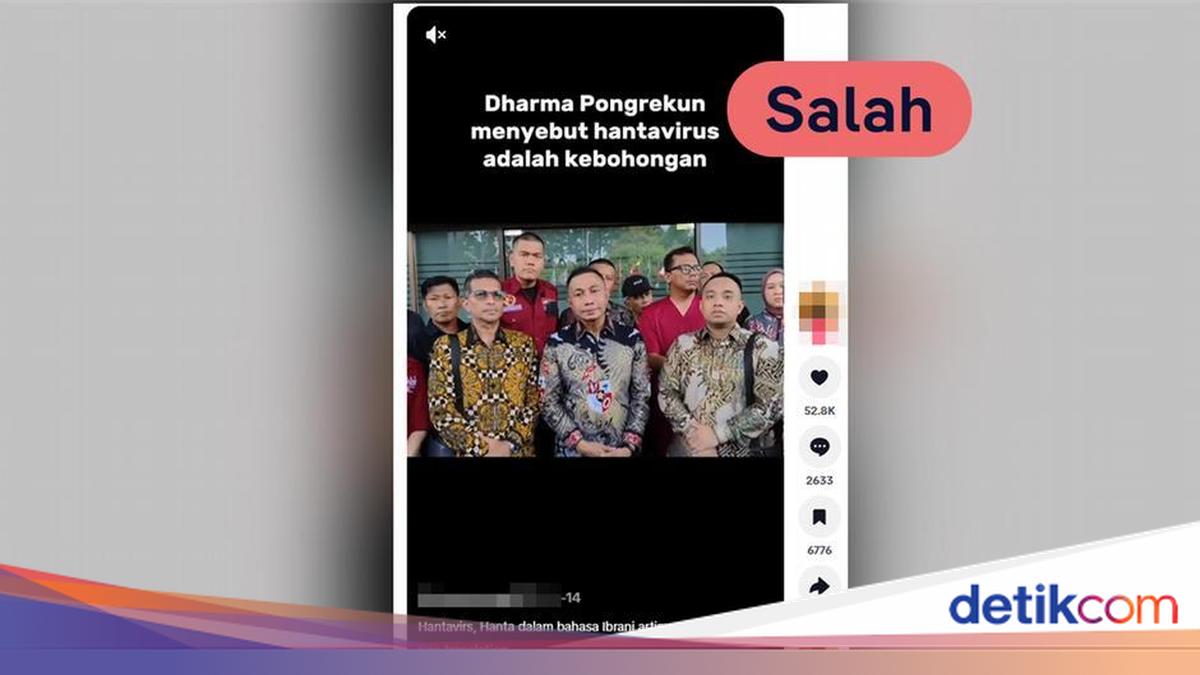
A video claiming that the word ‘hanta’ in hantavirus means ‘nonsense, liar, and deceiver’ in Hebrew has been viewed over a million times and sparked thousands of comments, many believing the claim. DW Fact Check has verified this matter.
Claim: ‘Hanta’ from Hebrew means nonsense, liar, and deceiver.
DW Fact Check: False.
Originating from an AI chatbot error
DW’s investigation found this claim began with a conversation on X on 10 May 2026. At that time, a user asked the meaning of the word ‘hanta’ in Hebrew to X’s AI chatbot, Grok.
Grok then answered that ‘hanta’ meant deception, nonsense, falsehood, or something fake. That answer then circulated and was used by some users as evidence that the word ‘hanta’ had a hidden meaning.
However, Grok’s answer was wrong.
Several X users then replied and showed that Grok had mixed up ‘hanta’ with another Hebrew slang word, namely ‘kharta’ or ‘chartah’.
After being corrected, Grok revised its answer and admitted that the previous definition was incorrect. The word whose meaning is closer to nonsense is ‘kharta’ or ‘chartah’, not ‘hanta’.
Confused: ‘hanta’ and ‘kharta’
The word widely referred to as ‘hanta’ is ’’. In the Morfix Hebrew dictionary, this word does not mean deception, falsehood, or nonsense. Its meaning relates to fruit ripening. Related words can also mean to embalm, or in the context of trees, to bear fruit or ripen.
Meanwhile, the slang word that Grok admitted to confusing is actually ’‘, commonly written as ’kharta’, ‘harta’, or ‘chartah’.
Morfix marks the word ’’ as slang meaning rubbish or nonsense. Urban Dictionary also contains an entry for ‘Kharta Barta’ since 2005 and explains it as Hebrew slang for ’bullsh*t’. In that entry, ‘kharta’ is also mentioned as being usable on its own with the same meaning.
The name hantavirus comes from a river in Korea
The name hantavirus itself does not originate from Hebrew.
The scientific article ‘A Brief History of Bunyaviral Family Hantaviridae’ explains that the virus originally called ‘KHF strain 76-118’ was later named ‘Hantaan virus, strain 76-118’ because it originated from the Hantan River area.
The Korea Times also notes that hantavirus was first identified in the Hantan River area. The disease later associated with this virus once infected more than 3,200 UN troops during the Korean War. South Korean virologist Lee Ho-wang later identified the virus from rodents caught near the Hantan River.
This means ‘hanta’ in hantavirus refers to a geographical name, not a word meaning in Hebrew.
Not like COVID-19
On its official website, the Indonesian Ministry of Health explains that Hanta virus disease is a zoonotic disease caused by Orthohantavirus and transmitted through rats and shrews. Transmission can occur via urine, faeces, saliva, or contaminated dust.
The Ministry of Health also mentions that hantavirus has been detected in Indonesia and needs to be watched. This issue was highlighted again after the emergence of a Hanta Pulmonary Syndrome cluster on the cruise ship MV Hondius, which according to WHO is related to Andes hantavirus.
However, its transmission pattern is not like COVID-19.
University of Indonesia epidemiologist, Pandu Riono, stressed that hantavirus is not a new virus. According to him, most hantavirus transmission occurs from rodents to humans, and it does not spread easily between humans.
‘As long as there is no transmission that we can confirm from human to human, we do not need to worry too much about a pandemic like COVID occurring,’ Pandu told DW Indonesia.
However, Pandu reminded that misinformation about diseases can still be detrimental. If a disease truly becomes a threat, narratives that the disease is engineered or a lie could cause the public to respond too late.
AI is not a dictionary
Mafindo Fact-Check Specialist, Aribowo Sasmito, assessed that this case demonstrates the risk when AI answers are directly used as evidence without being checked against stronger sources.
According to Aribowo, AI chatbots can give incorrect answers if they take references from wrong or unverified sources. Therefore, AI answers cannot replace checking with dictionaries, language experts, scientific sources, or fact-checking institutions.
‘AI also has a learning period and is taught by humans too. Perhaps early on, because the issue had not yet been clarified, they would take from sources that actually were not clarifying, but instead made things worse,’ said Ari.