
Fact Check: Claim That US F-22 Entered Indonesian Territory Without Permission
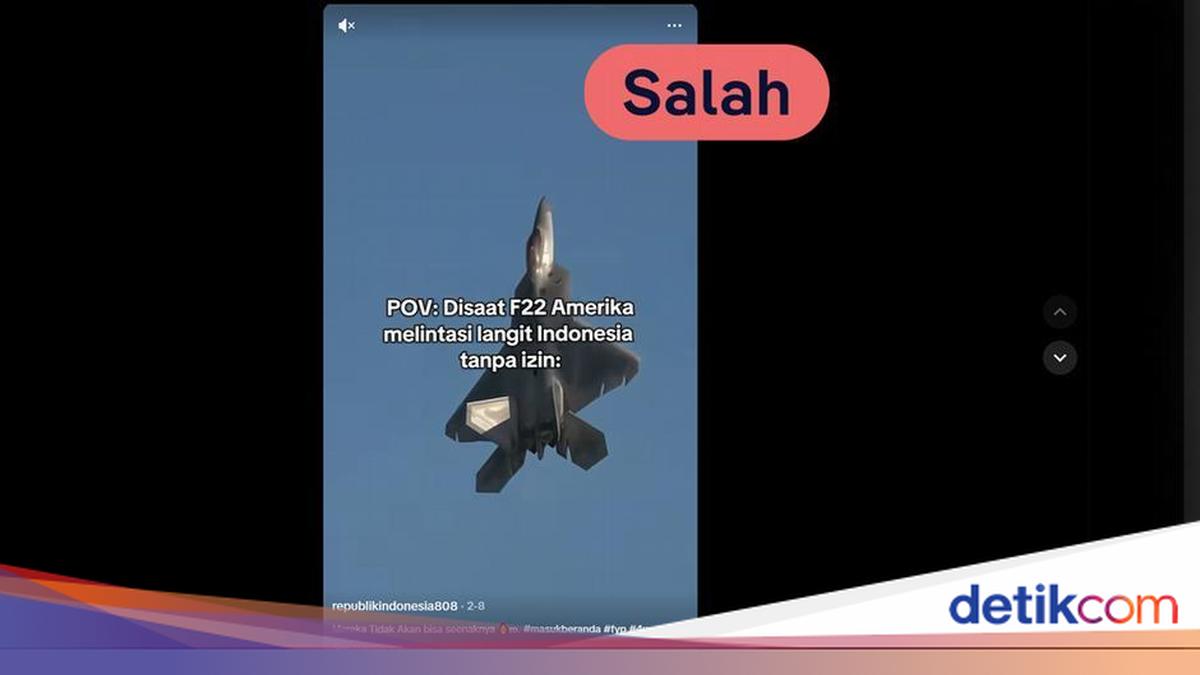
A 20-second video circulating on TikTok, viewed more than 3.5 million times, shows a fighter jet claimed to be a US F-22 crossing Indonesian airspace without permission. The video’s narration states that the aircraft was subsequently intercepted by TNI AU F-16 fighter jets. Although uploaded in February, the video remains widely discussed by netizens, particularly in the comments section, following issues regarding requests for airspace access or blanket overflight between Indonesia and the United States. Netizen responses in the comments vary. Some question the video’s authenticity, even suspecting it was created using artificial intelligence or AI. The claim in the video: “When the American F-22 crosses Indonesian skies without permission: That’s when TNI with its F-16 acts to prevent it.” DW Fact Check: False. To verify the claim, the DW Fact Check team analysed the video using the AI detection tool Hive Moderation. The results showed a 2.6 per cent probability that the video was created with AI. This means the video is most likely not an AI fabrication. However, if not AI-made, where did these videos come from? Using Google Reverse Image, DW continued the search by taking several image snippets from the viral video. The results found several similar visuals from other sources with different contexts. One video snippet matches footage of an F-22 fighter jet taking off at the AirVenture Oshkosh 2023 event. That video was uploaded to the YouTube account VH Aviation. The location is in the United States, not Indonesia. Meanwhile, the F-16 visuals claimed to be an interception action were also found to originate from other documentation. Among them is footage of a formation of TNI AU fighter jets in preparation for the 80th TNI Anniversary celebrations. In the comparison video, there is no narration of interception or emergency situations as claimed in the viral video. These findings indicate that the circulating video is a combination of visual snippets from different events, assembled with a false narrative claim. What are the rules for crossing Indonesian airspace? Intercepting foreign aircraft violating Indonesian airspace sovereignty is not as simple as depicted in the 20-second viral video. The use of airspace is strictly regulated under international law that forms the legal basis for every country, namely the 1944 Chicago Convention. Every country has full sovereignty over the sky above its territory. This means there is no concept of “free sky” that can be crossed without permission. Every aircraft, especially military aircraft, must obtain approval before entering another country’s territory. Retired TNI Marshal Chappy Hakim, Chairman of the Indonesian Air Power Study Centre and former Chief of Staff of the TNI Air Force (2002-2005), emphasised that these rules apply universally. “Crossing another country’s airspace requires permission. There is no free airspace. If without permission, it’s a violation,” he told DW. According to Chappy, Indonesia has strict rules regarding permits for foreign aircraft to cross. Starting from diplomatic clearance through the Ministry of Foreign Affairs, then security clearance from the Ministry of Defence, to flight approval from the Ministry of Transportation. Without going through these procedures, a flight is not considered legal in Indonesian airspace and could be categorised as a sovereignty violation. Procedures for handling violations of Indonesian airspace. In the 2003 Bawean incident, the movement of foreign aircraft in Indonesian airspace once triggered tension. At that time, several US Navy fighter jets were detected crossing over Bawean Island in the Java Sea. The identified aircraft were F/A-18 Hornets operating from a US aircraft carrier in the area. In response to the situation, the TNI Air Force deployed two F-16 Fighting Falcon units to conduct interception and confirm the aircraft’s identity. During the process, both parties were in a tense aerial position. The fighter jets manoeuvred against each other, including radar locking and the use of electronic warfare systems, though it did not result in weapon contact. Retired TNI Marshal Chappy Hakim, who was then Chief of Staff of the TNI Air Force, described the incident as just one of many similar events. “The Bawean case was just one of many incidents. It happened to be when I was Air Force Chief of Staff, so I reported it to the media. Those not reported to the media were far more numerous,” he told DW. He added that from that incident, the public began to realise the vulnerability of Indonesian airspace. “From there, people then knew and realised that our airspace is vulnerable and can be crossed at will,” said Chappy. However, Chappy emphasised that responses to foreign aircraft are not carried out recklessly. The procedures are layered and measured, starting from detection via radar to monitor every object entering the airspace. If the aircraft’s identity is not immediately recognised, the TNI AU will deploy fighter jets to conduct interception, namely approaching and identifying visually. “Detected, identified, intercepted,” Chappy explained the initial stages. At this stage, the fighter jet pilots do not immediately take aggressive action. They first conduct communication and issue warnings, while ensuring the situation on the ground. If the aircraft responds and can be clarified, the handling usually stops there without further escalation. However, under certain conditions, if the aircraft does not respond or lacks valid permission, further steps can be taken gradually. “If indeed without permission and non-compliant, it can be forced down,” said Chappy. Indonesia’s skies in the swirl of global interests. Indonesia’s geographical position