
Facing Godzilla El Niño, Minister of Public Works to Fully Fill Dams
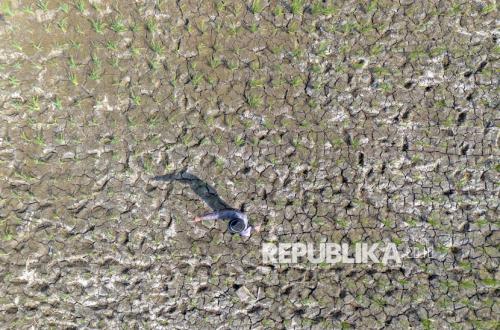
Minister of Public Works Dody Hanggodo stated that the government is filling dams to full capacity as a strategic measure to address the impacts of the extreme El Niño phenomenon, known as Godzilla El Niño, in order to safeguard national food resilience.
Dody explained that mitigation efforts against the El Niño impacts have been underway for some time through integrated water resource management in various regions with major dams.
“If it’s about mitigating El Niño, we’ve actually already started. The Ministry of Public Works has begun,” said Dody in a statement in Jakarta on Saturday (11/4/2026).
According to him, all dams are being endeavoured to be maintained at maximum volume capacity to supply irrigation needs even if rainfall decreases drastically during the prolonged dry season in various areas. For example, the Gajah Mungkur Dam in Wonogiri Regency, Central Java, can irrigate agricultural land without rain until September or October 2026 if its water capacity is full according to the determined maximum limit.
“A while ago, I visited the Gajah Mungkur Dam. I wanted to see its condition, and there I received information that currently all dams are being endeavoured to be in full condition,” he said.
However, Dody cautioned that dam capacities have time limits, so additional steps are needed if the dry season lasts longer than the period supported by those water reserves.
To address this, the government is preparing weather modification operations targeting upstream areas of dams so that artificial rain can optimally add water supply to the reservoirs.
He emphasised that weather modification operations are not conducted directly at the dams to avoid risks that could cause greater impacts on water management.
“Weather modification operations are carried out upstream of the dams, so the water still flows to the reservoir,” Dody explained.
“We do not conduct weather modification operations at the dams because we are concerned it might miss the target. If it misses, the impact could be greater. From our experience, it’s better to do it upstream of the dams,” he added.
In addition, the Ministry of Public Works is preparing small-sized water pumps in collaboration with the Ministry of Agriculture to ensure water supply remains available for agricultural lands experiencing drought.
The use of these pumps will be optimised in areas experiencing significant declines in water flow, so water distribution to rice fields continues even if water sources are limited.
Dody also identified issues with inadequate irrigation networks in some regions, meaning the utilisation of pumps cannot yet operate at full potential.
For this reason, his side is encouraging the construction of tertiary irrigation as a solution to make water distribution more effective and efficient, capable of reaching agricultural areas optimally.
Regarding the budget, Dody stated that he cannot yet detail the exact funding needs but assured that the programme is a priority in line with President Prabowo Subianto’s directives in maintaining national food resilience.
He added that the government will adjust budgets from less priority programmes to ensure El Niño mitigation runs optimally to prevent failure in achieving food self-sufficiency targets.
“If that fails, then food self-sufficiency in 2026–2027 could also fail,” said Dody emphatically.