
Facing EUDR, TFCA-Sumatra and SCOPI Push for Coffee Farmer Traceability Readiness
Traceability has become an unavoidable new prerequisite if Indonesian coffee is to remain competitive in the global market. With the European Union Deforestation Regulation (EUDR) set to be enforced on 30 December 2026 for operators and large and medium traders, and 30 June 2027 for micro and small enterprises, every exported coffee product must be traceable to its origin and proven not to come from deforested areas.
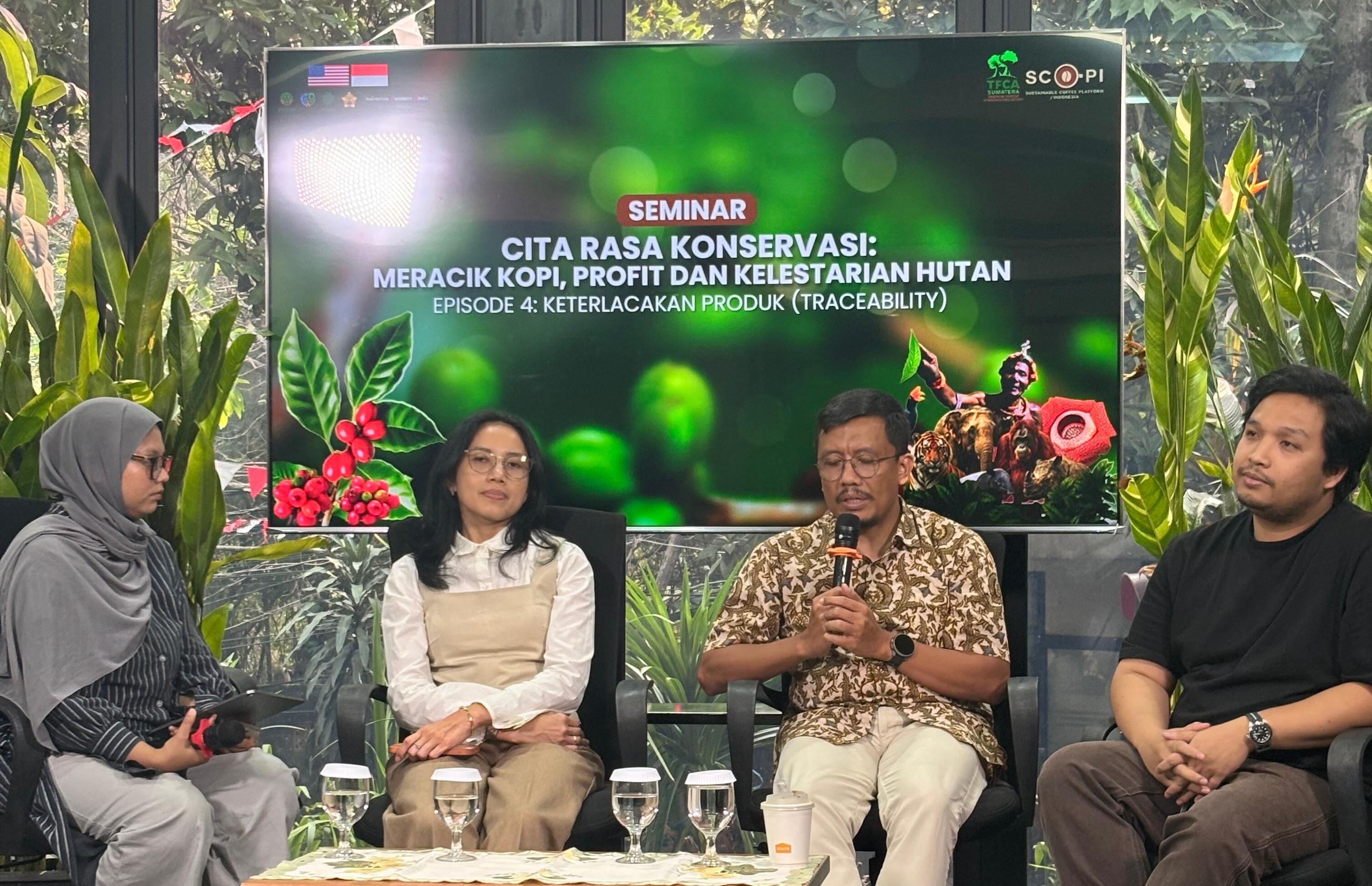
Addressing this challenge, the Tropical Forest Conservation Action for Sumatra (TFCA-Sumatra), Yayasan KEHATI, and the Sustainable Coffee Platform of Indonesia (SCOPI) held the fourth episode of the ‘Cita Rasa Konservasi: Meracik Kopi, Profit, dan Kelestarian Hutan’ webinar titled ‘Product Traceability’ on Wednesday (5/8), in a hybrid format from Rumah KEHATI, Jakarta. The webinar served as a knowledge-sharing space, bringing together government, business actors, technology providers, civil society organisations, academics, and practitioners to discuss strategies for building a traceability system that enhances the competitiveness of Indonesian coffee while preserving forests. Over 100 participants from various regions joined the discussion online and offline.
Various challenges in implementing traceability on the ground emerged, ranging from regulation and data digitalisation to geolocation verification and the readiness of farmers and businesses to meet international market demands. The discussion was guided by Sophia Mega, a coffee influencer actively promoting a sustainable coffee ecosystem. Samedi, Director of Programmes at TFCA-Sumatra, emphasised in his opening remarks that implementing traceability is no longer a choice but a necessity for the future of the national coffee industry. ‘Traceability is crucial, especially for coffee commodities, because besides ensuring land legality, it also relates to coffee quality and farmer welfare,’ Samedi stated.
Noverian Aditya, Founder of Java Kirana, explained his experience assisting off-takers and farmers in facing global supply chain demands, including the implementation of EUDR. He noted that the regulation is not intended to burden farmers but to serve as an instrument to ensure coffee commodities are produced without driving deforestation. ‘In terms of on-the-ground implementation, the challenge is that farmers cannot yet see the EUDR from the buyer’s perspective, because meeting their daily needs is still a struggle for them,’ Noverian said. He explained that Java Kirana acts as an ecosystem builder, assisting farmers through field condition mapping, needs identification, and the formulation of steps to meet sustainability standards and access wider markets.
Ainu Rofiq, Co-Founder and Board Member of Koltiva, presented how digitalisation and geolocation verification can strengthen the Indonesian coffee traceability system while opening export market access. According to Ainu, the benefits of traceability are not only felt in terms of regulatory compliance but also in improving quality control and market trust. ‘Market access is increasingly appreciating single origin and specialty coffee. To support this, a platform that can guarantee product traceability is needed, making traceability very important,’ he said.
Meanwhile, Bryant Hartanto from the Pundi Sumatra–Telapak Consortium outlined the traceability system concept to be implemented by TFCA-Sumatra partners in the X Grant Cycle. The system is expected to strengthen sustainable coffee supply chain governance, support forest protection, and increase market access and added value for farmers. According to Bryant, traceability has a much broader meaning than just technology. ‘Traceability is not just about lines of numbers on a computer screen or a QR code on the back of a coffee package. It is a tool to tell an honest story to the world about the sweat of farmers who care for their coffee plants on the mountain slopes,’ he revealed.
Doris Monica Sari Turnip, Madya Supervisor of Agricultural Product Quality at the Directorate of Plantation Product Downstreaming, Directorate General of Plantations, Ministry of Agriculture, explained the government’s various steps in strengthening the implementation of traceability for plantation commodities. She outlined the national target for developing traceability systems, capacity building for farmers and business actors, and strengthening the implementation of the Cultivation Registration Certificate (STDB) as an instrument for land legality and sustainability. According to Doris, the government is now opening wider collaboration opportunities in the data collection and mapping process for coffee plantations. ‘The acceleration being undertaken by the government is allowing the STDB data collection and mapping stages to be carried out by parties outside the government. Development partners, processing industries, and buyers can now contribute to this process. This step is expected to accelerate the increase in STDB data for coffee commodities,’ she explained.
Through this webinar, TFCA-Sumatra and SCOPI hope that more stakeholders will understand that traceability is not merely a requirement to meet international market regulations, but also a long-term investment for the future of the Indonesian coffee industry. A robust traceability system is believed to enhance the competitiveness of Indonesian coffee in the global market, while ensuring environmentally responsible production practices, preserving forests, and improving farmer welfare. This webinar is part of the ‘Cita Rasa Konservasi: Meracik Kopi, Profit, dan Kelestarian Hutan’ series, a learning and collaboration forum continuously presented by TFCA-Sumatra and SCOPI to encourage the realisation of a productive, competitive, and sustainable Indonesian coffee sector.