
Facing Drought, Farmers Claim: Government Mandated Simultaneous Planting but Failed to Provide Water
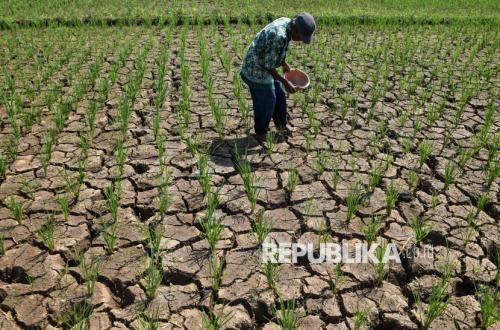
The drought affecting thousands of hectares of paddy crops across six districts in Indramayu Regency, West Java, remains unresolved. Farmers are currently racing against time to save their crops, which are now at high risk of total failure (puso).
The six drought-stricken districts include Sukra, Patrol, Anjatan, Bongas, Gabuswetan, and Kandanghaur. In these areas, at least 10,673 hectares of paddy crops, aged between 7 and 25 days, are threatened by the lack of water.
The Vice Chairman of the Indramayu Regency Farmers and Fishermen Alliance (KTNA), Wastam Priyatna, stated that the government previously requested farmers to undertake simultaneous planting to achieve national food self-sufficiency. Consequently, farmers have been following the Global Planting Schedule (RTTG) rolled out by the government.
However, Wastam expressed regret over the lack of synchronisation between this planting programme and water availability. As a result, farmers who have already completed planting are now struggling to obtain sufficient water supplies for their crops.
“The government ordered simultaneous planting, but the water was not prepared. The government issued the RTTG, but the water supply does not support it. Is the government capable or not? Ultimately, the farmers are the ones becoming victims,” Wastam, who also serves as the Chairman of KTNA Bongas District, told Republika on Thursday.
Wastam noted that the irrigation water for these six districts originates from the Jatiluhur Reservoir, with the distribution point located at the Salamdarma Weir. He, along with KTNA chairmen from five other districts and six sub-district heads from the affected areas, has visited the Salamdarma Weir to request additional water supplies.
He explained that to meet the water requirements for the six districts, the flow rate at the Salamdarma Weir should be 22 cubic metres per second. In reality, it is only 14 cubic metres per second, which is insufficient to irrigate the affected areas.
“The reason given is that water is ‘lost’ along the way. I have requested an investigation into the cause of this loss, but so far, the cause remains unknown,” Wastam lamented.